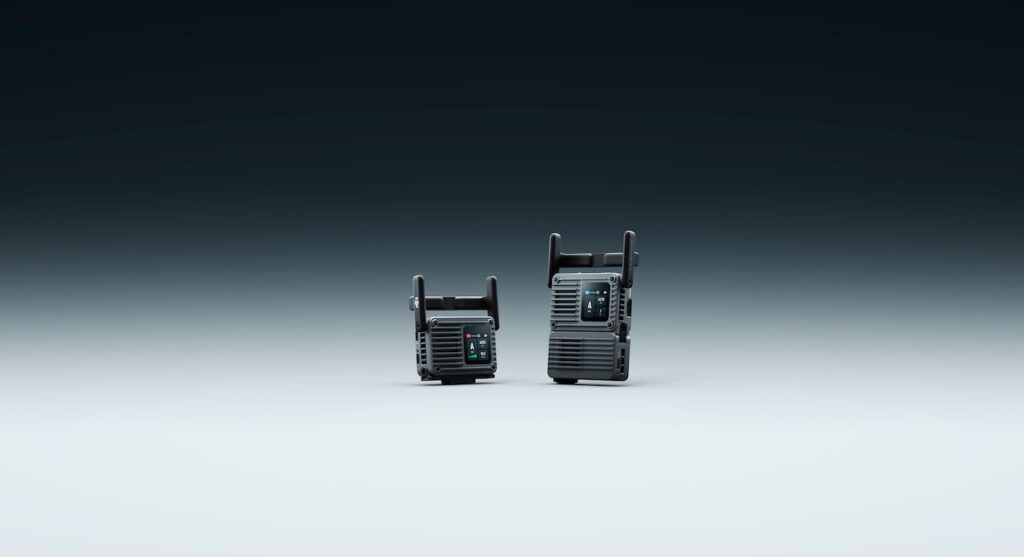
DJI announced the SDR Transmission 2 on 17 September, and the headline here isn’t the product — it’s the price it arrives at: €349 per unit, €629 for a pair. That’s roughly a tenth of what a high-end wireless video system costs, and what it delivers is not toy-grade.
What it actually does
The big change is that transmitter and receiver are now the same object: there’s a physical switch, you decide which does what. Anyone who bought the first generation back in 2024 carried two different units, and if one died, that function was down. Here you pack three and you’ve got three mutual spares.
- DCI 4K60 10-bit HDR (HLG and HDR10), H.265 up to 50 Mbps — double the previous generation’s bitrate
- 35 ms stated latency, excluding camera and display
- 4 km range in open conditions
- 136 g in transmit mode with antennas, 105 g in receive
- One TX feeds up to 8 RX; the system handles 5 TX and 40 RX together
- Tri-band with automatic frequency hopping (2.4 GHz, 5.8 GHz and DFS) plus automatic channel allocation
- NP-F or USB-C PD power, or straight off the gimbal
- Metadata from ARRI and RED cameras over SDI
Two things to know before getting excited. There’s no SDI on the body: you need the optional expansion plate (€169), and even then it’s capped at 1080p60. And Wi-Fi phone monitoring, which was genuinely handy on the first generation, is gone — the phone now plugs into the receiver over USB-C. Those choices push this unit towards people working in HDMI with mirrorless and compact cinema cameras, not towards the feature-film cart.
The detail that helps us in Italy
The SDR Transmission 2 is on sale right now across Europe and the UK, and it is not available for purchase in the United States. That’s a reversal of what we’re used to: for once the blocked market is theirs. For American crews shooting here it means the wireless gets rented in Europe rather than flown in — worth knowing when you build an equipment list.
Our take: when it makes sense and when it doesn’t
On a small set — commercial, short film, music video, two-camera documentary — a €629 pair changes the maths. Until yesterday wireless was the first line item to get cut and you ended up with a 10-metre HDMI cable on the floor. At these numbers you can afford a video village even on a one-day job.
Where we still reach for the Teradek Bolt 6 750 is the set where the link simply cannot flinch: interiors crowded with networks, jobs where the client is watching from 50 metres away, industrial environments. The Bolt runs at 60 GHz, it’s genuinely zero-delay and it doesn’t share a band with everyone’s phone. The DJI, tri-band and frequency-hopping as it is, still lives where everybody’s Wi-Fi lives. That’s not a flaw, it’s physics — you just need to know which set gets which.
Third, a practical one: if you’re working with a DJI RS 3 Pro or an RS 3 Mini, the SDR 2 draws power from the gimbal and is controlled from the Ronin app. It’s the one case where DJI’s closed ecosystem is a clear advantage rather than a cage: fewer batteries, fewer cables, one app.
One recommendation from people who hand out wireless kit every day: whichever system you pick, test the link on location the day before, not in the office. Those 4 km hold in open ground, and a reinforced concrete wall in an Abruzzo town centre will eat them in twenty metres. If there’s any doubt, add an Atomos Ninja V on the camera as backup monitoring and sleep easy.
The SDR Transmission 2 is going into our inventory alongside the Bolts. In the meantime you’ll find everything available for rental, delivered to set anywhere in the region.
Sources: official DJI press release and CineD.
A wide range of equipment in our catalogue, on-set delivery included across Abruzzo.