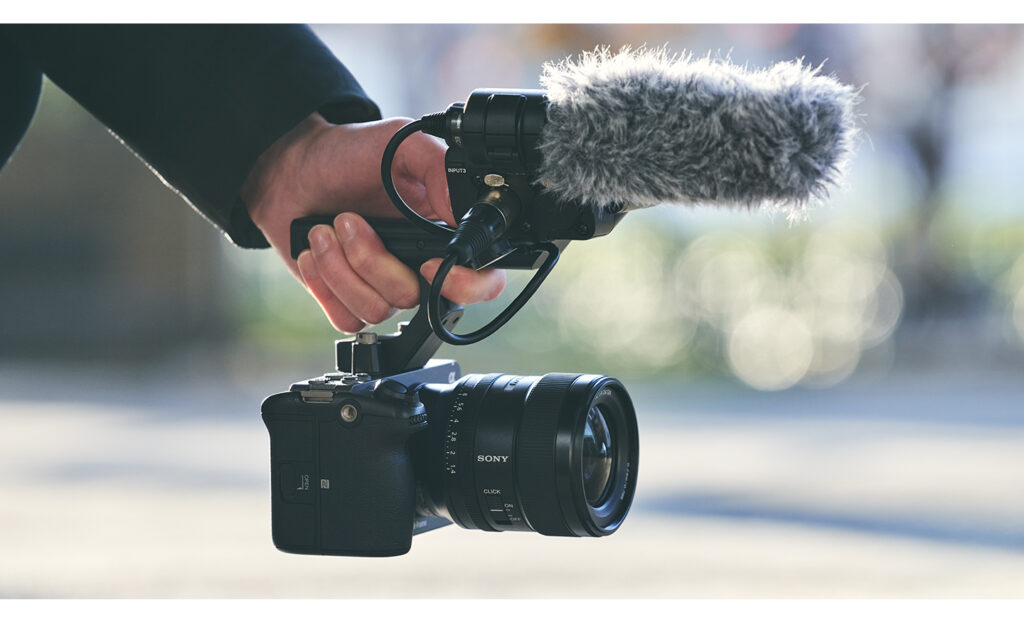
The Sony FX3 is the camera that most often leaves our shop alongside another one. As a B-cam next to an FX6, on a gimbal while the A-cam stays on sticks, rigged on a car for tracking shots, inside a vehicle or a corridor where a bigger body won’t fit. But more and more it goes out on its own, and we think that makes sense: for certain jobs it is the right camera, not the fallback.
What’s inside, from the official spec sheet
- Full frame sensor, about 10.3 effective megapixels for video, ISO 80 to 102,400 (expandable to 409,600)
- More than 15 stops of claimed dynamic range, with S-Log3 and S-Cinetone built in
- 4K up to 120 fps, 10-bit 4:2:2 in All-Intra and Long-GOP
- 16-bit RAW output over HDMI to an external recorder
- 5-axis in-body stabilisation, internal fan, front and rear tally lights
- Top handle with two full-size XLR inputs, dual CFexpress Type A / SD slots
Full details are on Sony’s official FX3 page. What matters on set is something else: it is a real cinema camera, with the colour science of the FX6 and FX9, inside a mirrorless-sized body.
Who it’s for
Documentary and reportage. Light, compact, and the second native sensitivity in S-Log3 at ISO 12,800 saves interior scenes with whatever light is there. In a church or a wine cellar you don’t have to flood everything with light.
Music videos and branded content. On the DJI RS 3 Pro the FX3 with a light prime weighs little, balances quickly and keeps the operator going all day.
Cinematic weddings. Reliable autofocus, S-Cinetone for fast deliveries without heavy grading, XLR audio on the handle.
As a B-cam. Next to a Sony FX6 or an FX9 the FX3 matches without surprises in the grade: same family, same curves.
Where we don’t put it: on productions with a full crew, remote focus and a video village all day long. There, the lack of internal NDs and pro connectors costs you in accessories and in minutes lost at every lighting change.
Why rent it instead of buying
On Sony Italy’s store the FX3 lists at 4,699 euros including VAT, body only. With us it is 75 euros a day plus VAT, 190 for three days, 280 for a week. Net of VAT on both sides, you need around fifty rental days to break even on the body alone, before lenses, cards, batteries and a cage. If you shoot every week, buy it. If you need it for a short film, a commercial or a wedding season, the numbers favour renting, and the body isn’t losing value sitting on your shelf.
Three things we’ve learned in the field
- No internal ND. Outdoors with fast lenses you need a variable ND or a matte box: ask for it in your quote, don’t find out on set.
- Batteries. NP-FZ100s last well, but a full day needs several. Alternatively, power it over USB-C PD from a V-mount.
- The HDMI port. It’s the weak point when you record externally or feed a monitor: without a cable clamp on the cage, sooner or later it works loose mid-take.
What we pair it with
For RAW, an Atomos Ninja V: ProRes RAW from the HDMI output and a bigger screen for focus. For the director’s feed, the Teradek Bolt 6 750. You’ll find the FX3 on its rental page, and if you want a ready-made package take a look at our kits.
It always goes out with cards and charged batteries, and we deliver to set anywhere in Abruzzo, from the coast to the mountains. If you’re torn between FX3 and FX6, call us first: nine times out of ten the answer depends on how many people you’ll have on the crew.
A wide range of equipment in our catalogue, on-set delivery included across Abruzzo.