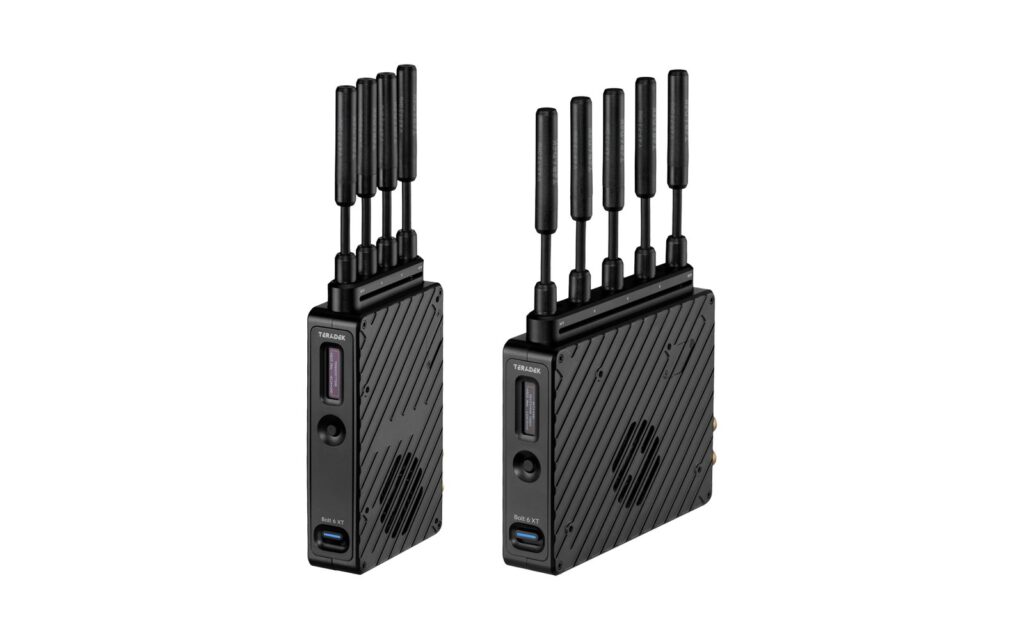
The Teradek Bolt 6 750 is one of the kits that leaves our warehouse most often, and the question on the phone is rarely “what does it do” but “how do we set it up”. A wireless video link works well or badly mostly because of how it is rigged. Here is how we set it up on set, from the transmitter on the camera to the director’s chair.
First things first: who needs to see what
Our kit is 1 transmitter and 2 receivers. Teradek states up to 6 receivers per transmitter in its official specs, but before adding more it is worth asking who really needs to watch. The split that usually works is this:
- Receiver 1, video village: director, agency, client. A big monitor, ideally in the shade.
- Receiver 2, camera department: DoP, focus puller or DIT, depending on who owns the image that day.
If make-up or art department also want to check continuity, a monitor looped out from the village is often enough, without a third receiver.
The transmitter on the camera
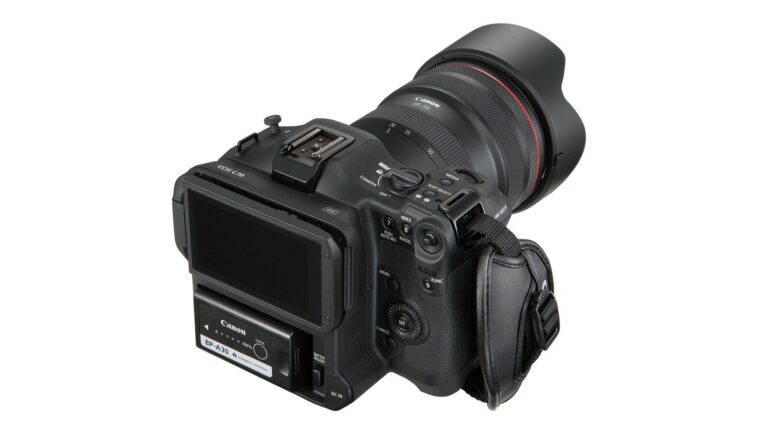
The TX takes SDI or HDMI, so it works on a cinema body like the ARRI Alexa Mini as well as a Sony FX6. Two rules we always follow:
- Antennas clear and vertical: not blocked by the handle, the matte box or the operator’s hand. The 750 kit has vertical antennas, and they hold the signal better when they stay upright.
- Power from the camera battery, via D-Tap or a plate: one battery to swap instead of two, and nobody forgets the TX switched off after lunch.
On the camera, use SDI whenever you can. The locking BNC won’t pull out when the camera goes from sticks to shoulder; HDMI will.
Receivers: higher than you think
The stated 750 feet, about 230 metres, are line of sight. In the field, what cuts range the most is not distance but what’s in between: a van, a stone wall, a group of extras. We mount the village receiver on a stand, a couple of metres off the ground, facing the area where the camera moves. Sitting on a table behind the monitors it performs much worse.
The second receiver, for the camera department, usually moves with the focus puller: distances are short there and the problem doesn’t come up.
Channels: 6 GHz is on our side
The Bolt 6 works on the 5 and 6 GHz bands. As soon as we reach the location we run a scan and pick the cleanest channel, favouring 6 GHz: it is far less crowded than 5 GHz, where bar wi-fi, wireless follow focus and phones all end up. In a historic town centre in Abruzzo in high summer it makes a difference; in a forest in the Marsica almost any channel will do.
The director’s monitor
A good match on the receiving end is an Atomos Ninja V connected to the receiver: it acts as the director’s monitor and, if the production wants it, records a reference copy to review between takes without touching the camera cards.
Rent or buy
At Teradek’s list price, the XT 750 transmitter plus receiver set costs 4,990 US dollars, and the second receiver is extra. With us the full kit is 100 euros a day plus VAT, 235 for three days, 335 for a week, already tested and with antennas and power supplies. For anyone shooting a few commercials or short films a year in the region, in our view there’s no contest. If you want a complete camera package, have a look at our kits, or call us and we’ll tell you how we’d rig it on your set.
A wide range of equipment in our catalogue, on-set delivery included across Abruzzo.