On 29 September Apple released Final Cut Camera 2.4, a free update to its iPhone capture app, alongside Final Cut Pro 12.4. The headline on general tech sites is variable aperture on the iPhone 18 Pro main camera. We care more about a different line in the announcement: with iOS 27 the app outputs a clean SDI signal and handles genlock offset. In plain terms, the phone stops being a separate gadget and tries to join a real video chain.
What’s in 2.4
- Variable aperture on iPhone 18 Pro: manual control, plus aperture priority and shutter priority modes.
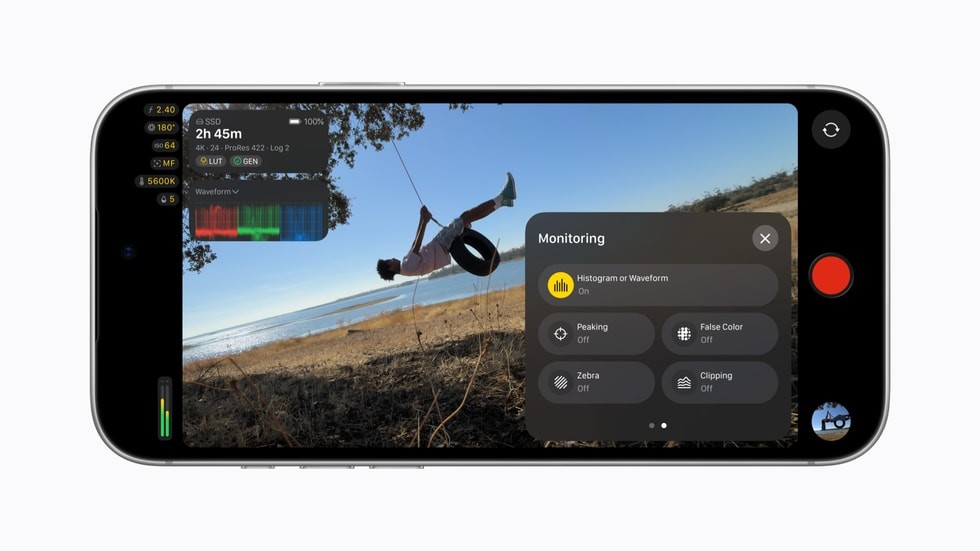
- Redesigned interface: shutter angle, ISO and white balance within reach, a tally light while recording, two-finger tap to clear the viewfinder.
- Exposure tools: false color, clipping indicators, focus peaking with adjustable sensitivity.
- With iOS 27: RGB Parade and histogram, clean SDI out through an HDMI-to-SDI converter, genlock offset to compensate for display and camera latency.
- Final Cut Pro 12.4: Cinematic mode effects now work on regular video, ProRes and Apple Log included. Focus point and depth of field can be changed in the edit. Requires macOS 27.
Clean SDI is the real news
On set we already see the iPhone used as a behind-the-scenes camera, a locked-off angle in live shows and a C-cam on tight-budget music videos. The limit has always been the same: getting it to talk to the rest of the set. A graphics-free output, taken to SDI with a converter, means you can feed a switcher, a director’s monitor or a transmitter without the app’s menus ending up on air.
Genlock offset points the same way. In live multicam the problem isn’t only sync, it’s the different delay between sources: compensating for it in the app saves chasing alignment downstream. We don’t yet know how it behaves in a real gallery next to proper broadcast cameras, and Apple gives no latency figures: we’ll say more once we’ve tested it.
Scopes on a phone: useful, not magic
RGB Parade and false color on a six-and-a-half-inch screen help, but they don’t replace a calibrated monitor. In our view the value is elsewhere: anyone shooting Apple Log can finally expose with some method instead of by eye. And variable aperture removes a constraint every iPhone shooter knows from exteriors, where exposure could only be managed with shutter and ND.
Cinematic mode refocus in post on ProRes and Apple Log is interesting for social content, less so for drama: a focus decision made in the edit is still a choice someone should have made on set.
What it means for a production in Abruzzo
For live events, town festivals, conferences and weddings with multicam direction, an iPhone on SDI becomes an extra angle at almost no cost. The A-camera is still a real camera, though: a Sony FX6 or a Sony BURANO has SDI, timecode and a sensor that copes with the mixed light of a hall or a town square at night.
The sensible way to use it, in our view, is as an addition: the main rental camera with its own media and monitoring, the phone on a fixed or utility angle. If the signal needs to reach a video village or a gallery without cables, the Teradek Bolt 6 750 takes an SDI source like any other. Before a live multicam job, run a latency test anyway: converter, cables and phone power are where things usually go wrong.
If you’re building a gallery and want to work out where an iPhone makes sense and where you need a real camera, call us: ready-made combinations are in our kits.
Official source: Apple Newsroom. Verified by: RedShark News.
A wide range of equipment in our catalogue, on-set delivery included across Abruzzo.