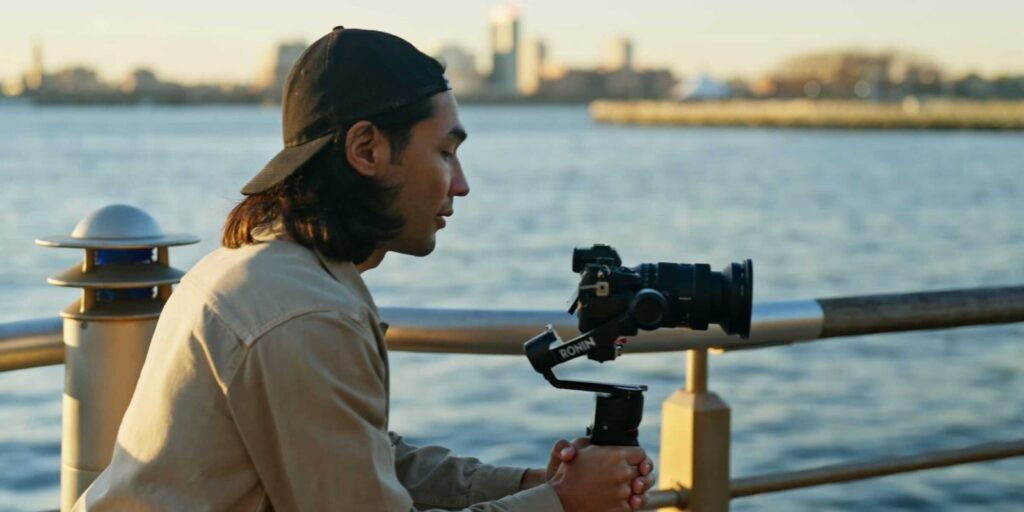
The DJI RS 3 Mini is the gimbal that leaves our warehouse most often without anyone talking about it. It is not a cinema camera and it does not make headlines, yet on plenty of quotes it is the piece that makes the day work: a mirrorless body with a light lens, a single operator, and the need to move without hauling a three-kilo rig.
The numbers that matter
Straight from the official DJI page, with no rounding in its favour:
- Tested payload: 0.4 to 2 kg.
- Weight: 795 g in vertical mode, 850 g in horizontal mode, quick-release plate included.
- Battery life: up to 10 hours, measured balanced and static. It drops once you move, so on set we plan for a short day, not two.
- Charging: about 2.5 hours over USB-C at 10 W.
- Control: Bluetooth 5.1 shutter control, USB-C camera control port, 1.4″ colour touchscreen.
- Native vertical shooting and the third-generation RS stabilization algorithm.
Who we hand it to
The typical renter shoots alone or as a pair: cinematic weddings, social content for a brand, behind the scenes, light documentary, music videos on a tight budget. A Sony FX3 with a standard zoom or a fast prime sits comfortably under 2 kg, and that is the pairing we recommend most. DJI itself quotes an A7 with the 24-70mm F2.8 GM as an example.
Vertical is why many people ask for it. On the Mini the camera rotates without extra accessories, so switching from 16:9 to 9:16 takes a minute, not ten. If you have to deliver the long edit and the reels from the same day, that is a real advantage.
When it is the wrong tool
If the build needs a monitor, follow focus, transmitter or a V-mount battery, the Mini is the wrong call: you blow past the payload and the motors work at their limit. That is when we send the DJI RS 3 Pro, which is built for heavier setups. Same for bodies like the Canon C70 with serious glass: they go on the Pro.
Why rent instead of buy
A small gimbal is cheap next to a camera, true. But people who fly a stabilizer once or twice a month often end up with one in a drawer, outdated firmware and a battery that drains on its own. Rented, it arrives updated, charged and with the plate ready. And if the next job needs the Pro, you swap rather than buy a second one. In Abruzzo, where many productions last one or two days, the maths usually favours renting.
Three things to watch on set
- Balance with everything mounted: lens cap off, card in, hood as you will use it. Removing the hood later throws off the tilt.
- Test Bluetooth before you leave: pair it with the camera once at base, not in front of the client.
- Camera batteries: the gimbal lasts the day, the mirrorless often does not. Carry spares and swap them without removing the plate.
The launch specs are also covered in CineD’s launch piece. If you are putting together a lean crew, have a look at our ready-made kits: the Mini often goes out alongside the FX3. Tell us what the job is and we will tell you whether it is enough or you need the Pro.
A wide range of equipment in our catalogue, on-set delivery included across Abruzzo.