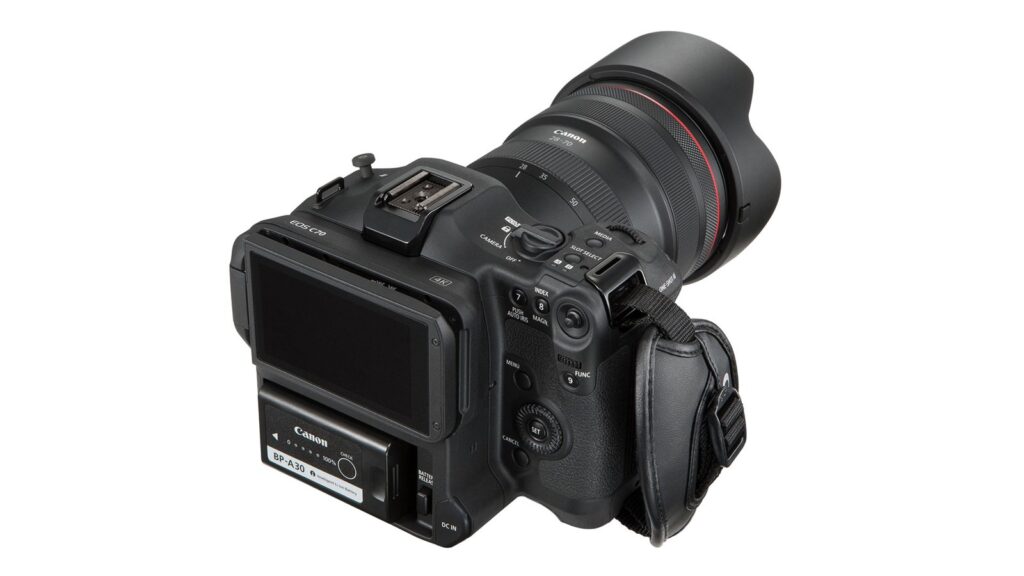
When a production calls us about a documentary, our first question isn’t about the camera. We ask how many people are on the crew and how much weight they can carry by hand. If the answer is “two people and a car”, the camera we suggest most often is the Canon EOS C70. It isn’t the newest body we have, nor the most expensive, but for documentary work it’s still one of the most sensible choices.
What’s inside, in short
The C70 is a Canon cinema camera in an oversized mirrorless body: about 1.17 kg body only, RF mount, Super 35 4K sensor with DGO (Dual Gain Output) technology, which Canon rates at over 16 stops of dynamic range in Canon Log 2 and Log 3. The numbers that matter on set:
- Built-in motorised ND of 2, 4 and 6 stops, expandable to 8 and 10.
- 4K up to 120p, 2K crop up to 180p.
- Internal XF-AVC and Cinema RAW Light on dual UHS-II SD cards.
- Two mini XLR inputs and four-channel audio.
- Timecode on BNC, full-size HDMI output.
- Dual Pixel CMOS AF with face and head detection.
Full specs are on the official Canon page.
Why we think it’s a documentary camera
The real reason is the internal ND. On a documentary you go from a cellar to a sunlit courtyard in ten seconds, and there’s no time to unscrew filters. With the C70 you turn the ND dial and stay wide open. On mirrorless bodies that job falls to a variable ND in front of the lens, with all its colour casts and cross patterns.
The second reason is audio. Two XLRs on the body mean your sound recordist can send you a clean feed, or, if there’s no recordist, you can plug a wireless lav and a boom straight into the camera. For a two-person crew that’s the difference between a system that works and a box full of adapters.
The third is autofocus. In the field, with Dual Pixel and a stabilised RF lens, a solo operator following someone on the move comes home with sharp shots and no focus puller. It won’t replace a 1st AC on a drama set, but on a doc it does the job.
When we recommend it, and when we don’t
We recommend it for documentaries, interviews, corporate reportage, cinematic wedding films and low-budget music videos. We’d steer you away when the production needs SDI outputs with long cable runs to video village, a native full-frame sensor, or a body that builds up into a big shoulder rig. In those cases we look at larger cameras.
In Abruzzo the maths is simple: a documentary is shot in short blocks spread over months. Buying a C70 for three four-day blocks means it sits on a shelf the rest of the year. Renting, you pay for shooting days only, and the camera arrives checked, with charged batteries and formatted cards.
Three practical tips
- No SDI: video comes out over HDMI only. If you’re feeding a director’s monitor, lock the cable to the body: a loose connector is the first problem of the day.
- Cards matter: RAW and high-bitrate intra need reliable V90 cards. Our cameras go out with cards already tested.
- EF glass: with Canon’s EF-EOS R 0.71x adapter you can mount EF lenses, gaining a stop and a wider field of view. It’s the cheapest way to use an EF lens kit you already own.
What we pair it with
For movement we put it on the DJI RS 3 Pro: with a mid-weight RF lens it stays well within payload. For exposure, especially when the operator works outdoors, we add a 5-inch Atomos Ninja V with false colour and waveform. Everything else is on our kits page.
If you’re planning a documentary and aren’t sure the C70 is enough, call us before you decide. We’ll tell you honestly whether it’s the right camera or you need something else. For a deeper look at dynamic range, see the CineD lab test.
A wide range of equipment in our catalogue, on-set delivery included across Abruzzo.