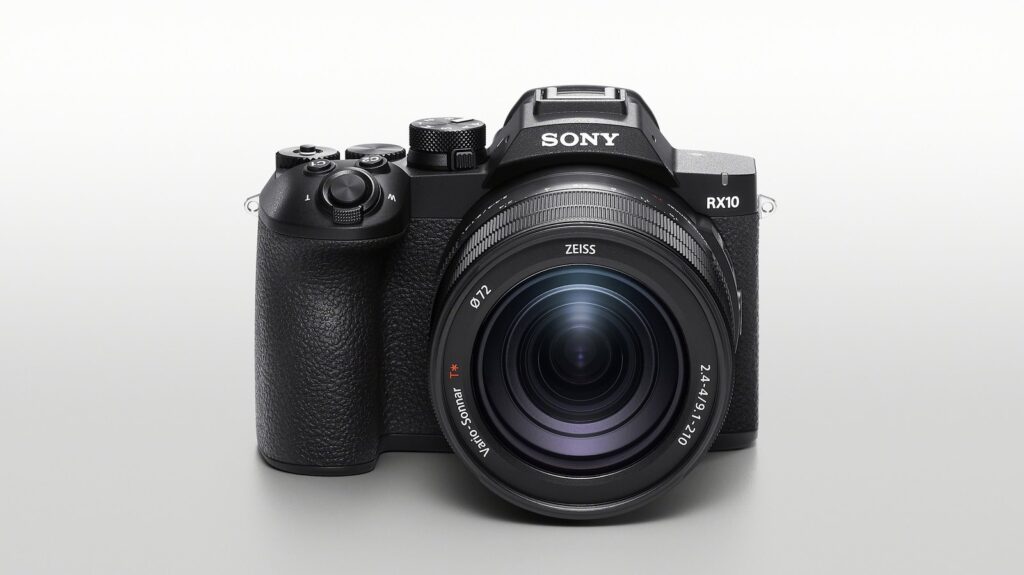
On 9 July Sony pulled the wraps off the RX10 V (DSC-RX10M5), the fifth generation of its 1-inch superzoom bridge camera. The date alone tells the story: the RX10 IV came out in 2017, almost a decade ago, and plenty of us — ourselves included — had written the line off. The official Sony announcement revives the all-in-one formula with a spec sheet that, this time around, speaks to video people too.
What’s inside
At the core sits a 20.1 MP stacked Exmor RS CMOS 1.0-type sensor paired with the BIONZ XR processor and a dedicated AI unit — the same architecture as Sony’s recent Alpha bodies. Up front is the series trademark: the ZEISS Vario-Sonnar T* 24-600mm equivalent F2.4-4.0, a 25x optical zoom that focuses down to 3 cm at the wide end and 72 cm at 600mm.
- Real-time Recognition AF with AI subject detection for people, animals, birds, insects, cars, trains and planes; 575 phase-detection points covering roughly 71% of the frame.
- Blackout-free 30 fps bursts with the electronic shutter and 60 AF/AE calculations per second.
- A mechanical leaf shutter for flash sync — a detail stills shooters will appreciate on set.
- A roughly 3.68M-dot Quad-VGA OLED viewfinder with 0.78x magnification, a 3.0″ 1.62M-dot LCD, and a dust- and moisture-resistant body.
Video: it finally speaks Cinema Line
This is the part that matters to us: 4K up to 120p with slow motion up to 5x, 10-bit 4:2:2 recording, S-Log3 and S-Cinetone profiles, up to 16 user LUTs, plus Active Mode stabilisation for handheld work. In practice, RX10 V footage will sit next to material from a Sony FX3 or a Sony FX9 in the grade without a fight. The bridge camera stops being the behind-the-scenes body and becomes a credible B-cam for documentaries and second units.
One workflow detail we’d argue is worth half the spec sheet: the battery is the NP-FZ100, the same cell used by the Alpha series and the FX3. One battery pool for the entire lightweight kit, rated at around 630 shots with the LCD and 570 with the viewfinder. Wi-Fi on 2.4/5 GHz and USB Type-C round things out.
In the field, here in Abruzzo
Anyone shooting wildlife around here knows the drill: chamois, deer and bears don’t wait for a lens swap, and up on the Gran Sasso the wind carries dust into everything. A sealed 24-600mm with autofocus that recognises animals and birds on its own, plus 30 fps with no blackout, is exactly the tool for location scouting, wildlife recces and pickup shots where hauling a cinema camera and a 3 kg telephoto makes no sense. On bigger productions we can see it working as a recon camera alongside a Sony Burano: same colour family, featherweight, no downtime.
Price, availability and the usual question: buy or rent?
The official list price is $2,299.99, with availability set for August 2026; for Europe, CineD reports a suggested price of around €2,500, with Italian VAT-inclusive pricing still to be confirmed. That is not compact-camera money — it’s mirrorless-plus-lens territory. Our take from the field is simple: if you need a superzoom every week, buying pays for itself; if you need it for one wildlife project a season or the occasional second unit, renting remains the saner route. We’re keeping an eye on it for our fleet — in the meantime you’ll find bodies and lenses ready to go in our equipment catalogue.
A wide range of equipment in our catalogue, on-set delivery included across Abruzzo.