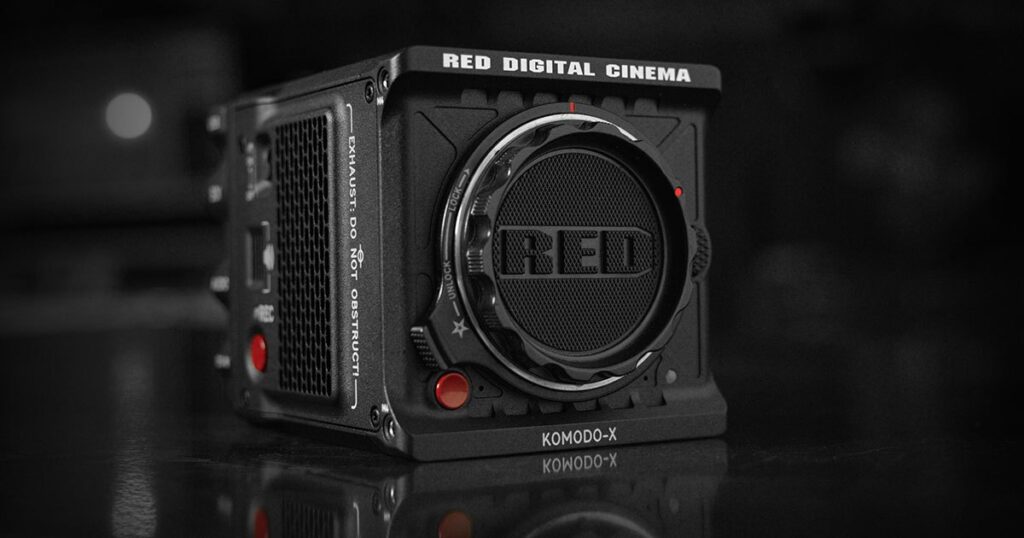
RED has released firmware 2.2.4 for the whole V-RAPTOR family — V-RAPTOR, V-RAPTOR [X], V-RAPTOR XE and V-RAPTOR XL [X] — plus the KOMODO-X. On the official RED download page the KOMODO-X build is dated May 18, 2026, with trade press coverage following in early June. This is not a routine maintenance release: it brings a much faster boot, lower power draw and a set of features clearly aimed at multicam and broadcast work. And, as always with RED, the download is free.
What’s in 2.2.4
- Boot time cut by roughly 40%: the KOMODO-X now starts up in about 19 seconds.
- Power draw reduced by up to 5W on V-RAPTOR bodies.
- External Tally trigger: the camera records full-resolution to CFexpress only while it is on air.
- Timecode-triggered recording.
- Standard test patterns over SDI for aligning and calibrating on-set monitors.
- Improved focus peaking.
- Touch control of the electronic ND: the DSMC3 monitor now adjusts the filter strength of the RED PL Electronic ND adapter, with ND iris tracking.
- Discrete Phantom Track control with independent shutter angles and Broadcast R3D support in RED Connect.
- Support for Angelbird and Nextorage media, SmallHD RED Touch OS 6.1.2 integration, better network stability (GIG-E, REDConnect, XL) and more reliable ProRes at high ISO.
Nineteen seconds to boot: the line we care about most
Anyone who works in the field knows how much a slow-booting camera costs you. Nineteen seconds is not mirrorless territory, but a 40% cut over the previous firmware changes the rhythm of every job where the camera powers on and off all day: documentary, events, exteriors where batteries are counted one by one. In our view this is the most tangible item in the changelog, together with power draw: up to 5W less on a V-RAPTOR means extra runtime at the end of the day, and on a set high up on the Majella or in a village with no mains power, every V-mount you save matters.
External tally and timecode: RED is looking at live work
The External Tally trigger is the most interesting feature for multicam crews: the camera writes full-resolution files to CFexpress only while it is actually on air, so there are no hours of useless footage to offload, sync and archive. Add timecode-triggered recording, Broadcast R3D support in RED Connect and Discrete Phantom Track with independent shutter angles, and the message is clear: RED wants these bodies inside broadcast and live workflows, not just on film sets.
On the more traditional cinema side there is the reworked focus peaking and the touch control, straight from the DSMC3, of the electronic ND strength on the RED PL Electronic ND adapter with iris tracking: fewer hands on the mattebox, smoother exposure transitions. And SDI test patterns make monitor alignment far less painful — something anyone will appreciate who has ever lost half an hour working out whether the problem was the monitor, the cable or a wireless link like the Teradek Bolt 6 750.
What this means if you shoot in Abruzzo
An update like this is also a solid argument for renting: the body you pick up arrives already updated, tested and paired with compatible media — now including Angelbird and Nextorage — without you having to deal with firmware and surprises on the morning of day one. If you own a V-RAPTOR or a KOMODO-X, update before the next job: it costs nothing, and the faster boot alone is worth the time it takes.
Worth noting: 2.2.4 covers the KOMODO-X and the V-RAPTOR family — the original KOMODO is not on the list. In our catalogue you will find the RED KOMODO 6K and the RED Gemini 5K S35, both workhorses for film and commercial work; if your project needs the R3D workflow on a controlled budget, renting remains, in our experience, the smarter route compared with buying a body that gets updated — and devalued — at this pace. You will find everything on our equipment page.
The full changelog is in the official release notes; for an independent overview, see the write-up on CineD.
A wide range of equipment in our catalogue, on-set delivery included across Abruzzo.