The Sony FX3 leaves our shelves almost every week, and not because it’s fashionable: it’s the camera that solves jobs where you need a cinema image and a two-person crew. After taking it onto very different sets — documentaries at altitude, corporate spots in the Val di Sangro, music videos shot at night — we have a fairly clear idea of when it’s the right call and when you should step up a class.
What the FX3 actually is
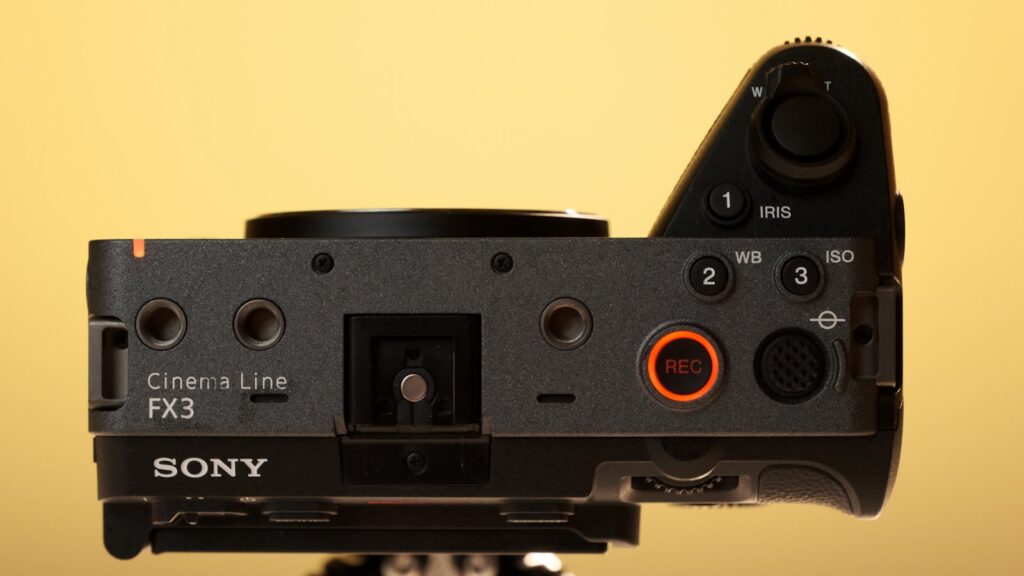
On paper it’s a mirrorless: 12.1 MP full frame back-illuminated Exmor R sensor, E-mount, a body that sits just above 700 grams with battery and card. In practice it works like a small cinema camera. It records 4K up to 120p in 10-bit 4:2:2, offers S-Cinetone and S-Log3 with a claimed 15+ stops of dynamic range, dual base ISO (800 and 12,800) and 16-bit RAW output over full-size HDMI to an external recorder. It has a real active cooling fan, dual CFexpress Type A / SD slots, 5-axis stabilisation and five threaded mounting points on the body so you can rig it without a cage.
The difference you feel on set is the included XLR handle: two professional audio channels with physical controls, no external mixer and no adapters. On a location interview, that alone saves you half an hour every time.
Who it suits
In our view the FX3 is at its best in three scenarios. First, documentary and branded content with a small crew: it’s light, quiet, it doesn’t intimidate the person in front of it and it goes where a camera with a matte box can’t. Second, low-light work — church interiors, venues, night exteriors — where the high base ISO lets you work with two panels instead of six. Third, as a B-cam alongside a Sony FX6 or FX9: same colour science, and S-Cinetone cuts together in post without chasing skin tones.
Where we wouldn’t send it: productions that demand motorised internal NDs and full days handheld with heavy glass. That’s a different job, and the FX6’s higher price pays for itself in time saved on set.
Why rent it instead of buying
A new FX3 body with the handle, a couple of serious CFexpress Type A cards and batteries only makes sense in Abruzzo if you shoot steadily all year. Anyone doing ten or fifteen shooting days a season amortises nothing: you pay for the body, watch it age on a shelf, and keep the risk of failure and the cost of media on top. As a rental the same camera costs a fraction per shoot, arrives with cards and charged batteries, and if the next project asks for something else you simply change body without reselling anything.
Three practical notes
- Manage the fan. It’s adjustable: in very quiet rooms set it to minimum or auto and keep the microphone away from the air vents. With sound recorded a metre from the camera, you will hear it.
- Don’t judge S-Log3 by eye alone. On the built-in screen the latitude fools you: use Cine EI with a monitoring LUT, or attach an external monitor. An Atomos Ninja V also gives you RAW recording and a screen you can actually read outdoors.
- Respect the 12.1 MP. That sensor was built for light, not for cropping: if you already know you’ll reframe heavily in post, factor it in when you compose.
What we pair it with
The package we recommend most often is the FX3 plus a set of fast primes, an Atomos Ninja V for monitoring and RAW, and an Aputure LS 300x as a bicolour key: a configuration that fits in one car and covers interview, b-roll and a few staged scenes. When the job grows, add the FX6 as A-cam and the FX3 drops to second camera. You’ll find ready-made combinations on our complete kits page, or go straight to the Sony FX3 rental listing for daily and weekly rates.
We deliver and collect on set across the whole region, from the Adriatic coast to the inland valleys: prepped the night before, it’s ready for the first take. Full specifications are on the official Sony ILME-FX3 page, while for an independent technical verdict CineD’s FX3 review still holds up.
A wide range of equipment in our catalogue, on-set delivery included across Abruzzo.