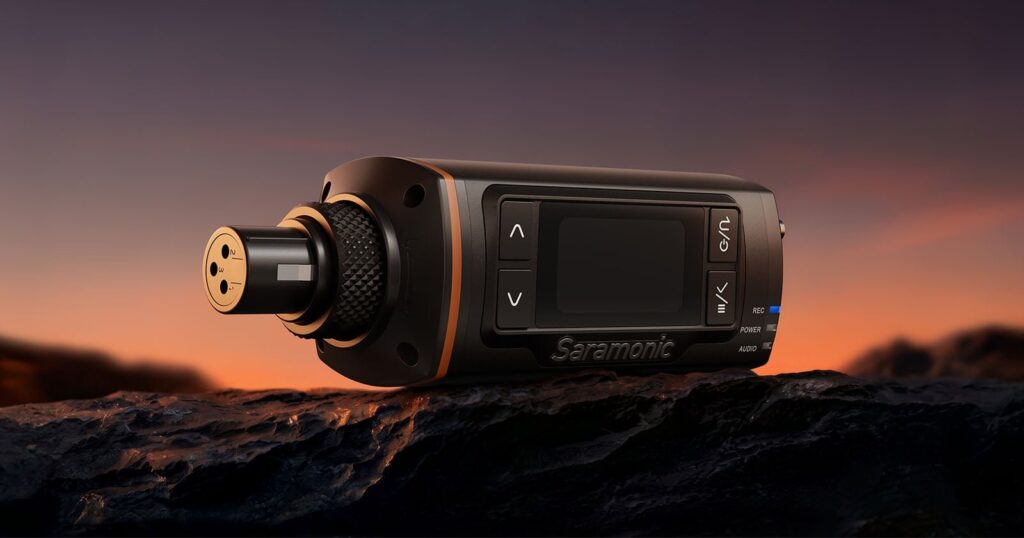
Saramonic started selling the K9 XTX on 4 August, a plug-on transmitter that screws onto a microphone’s XLR output and turns it into a wireless mic. Plug-ons have been around for twenty years and are not news in themselves. What is news here: a body starting at $299 packs three things that until now lived on gear costing three times as much, namely 32-bit float internal recording, LTC timecode generated and read on board, and selectable phantom power up to 48V.
The specs that matter
- UHF platform covering 550-960 MHz, with RF output selectable at 10, 25, 50 or 100 mW; Saramonic quotes 150 metres at 50 mW under favourable conditions.
- 3-pin female XLR with phantom power selectable at 3, 5, 12, 24 and 48V or line level; 0-30 dB of gain and a low-cut filter at 75, 100 or 150 Hz.
- Internal WAV recording at 48 kHz in 24-bit or 32-bit float, on microSD up to 256 GB (64 GB included).
- LTC timecode generation and reading at 23.98, 24, 25, 29.97, 29.97 drop frame and 30 fps, with a quoted drift of 0.15 ppm, which is less than one frame over 48 hours.
- Two AA batteries for over 7 hours, 130 dB of input dynamic range, operation from -30 to +60 °C and app control of up to 48 units.
32-bit float is not the point
Everyone puts 32-bit float in their gear now, as we wrote a few days ago about the DJI Mic Mini 2S. In our view the interesting part of the K9 XTX is different: a recorder and a timecode source inside the same body that is already up on the boom pole. That means the sound recordist gets a safety track physically attached to the microphone, already synced to camera, without adding either a bag recorder or a separate timecode box to the rental list.
On set the difference shows up in two situations above all. The first is documentary work, where the receiver drops for twenty seconds exactly while your interviewee says the line you need: with onboard recording that line still exists, and it lines up with the picture in post without manual work. The second is fast multicam, where clean timecode has always meant renting dedicated little boxes.
What it changes for shooting in Abruzzo
Much of the work we see here is reportage and documentary in places where cables are a problem: gorges, hill towns, building sites, trails. A plug-on removes the cable between boom and cart without forcing you into a full wireless system, and on a camera with decent XLR inputs like the Sony FX9 or the Canon EOS C70 the receiver feeds the camera inputs directly. If there is an Atomos Ninja V at the monitor, shared timecode does the rest.
Two caveats, though. The first is frequencies: “550-960 MHz” is what the hardware covers, not what you are allowed to use in Italy. The 694-790 MHz slice went to mobile networks, so set the regional preset and check the band the day before, not on set. The second is RF coexistence: if the same crew is also running wireless video such as the Teradek Bolt 6 750, scan and assign channels calmly, because the worst moment to discover interference is the first take.
Price and availability
The K9 XTX costs $299 on its own, and $749 for the kit with the full K9 transmitter, receiver and accessories. It is shipping now. Those numbers make buying sensible for a sound recordist working every week, much less so for a production covering three shoot days: there, renting stays the honest choice, along with the rest of the audio and video kit. We are evaluating it for our rental fleet and will update the listing once it lands.
Official announcement on the Saramonic product page, full specs also verified by CineD.
A wide range of equipment in our catalogue, on-set delivery included across Abruzzo.