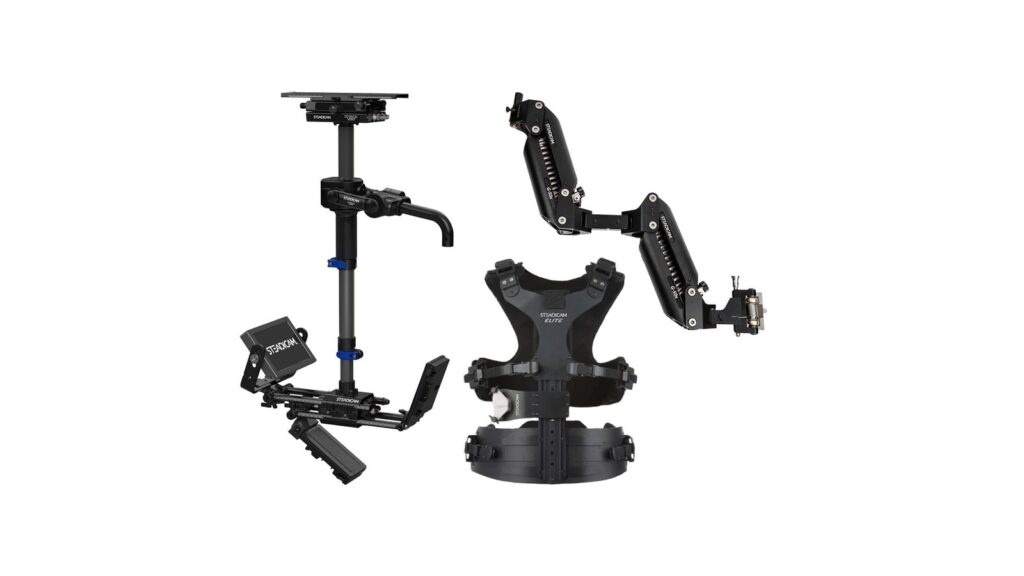
On 6 August Tiffen opened pre-orders for the Steadicam Elite, a mid-sized sled aimed squarely at the gap every operator knows: too heavy for compact rigs, not enough to justify pulling out a full-size sled with everything that means in transport and crew days. This isn’t trade-show talk — the official product page is live with prices and configurations.
What the Elite carries
- 30 lb / 14 kg maximum payload on the top stage
- Rigid unibody top stage with side-mounted fine adjustments
- Two-stage carbon fibre post, half-inch gimbal handle
- Integrated three-axis Volt, with control on pan as well
- 12V/24V power distribution at 8A with battery hot-swap
- Dual sliding and pivoting battery mounts, Gold Mount or V-Mount
- Universal yoke monitor bracket that also handles 9:16
The prices, and how to read them from here
The sled alone — post, integrated Volt, monitor bracket, no monitor — starts at $9,995. The turn-key kit, with the Elite vest, G-50x arm and a 7-inch high-brightness SDI monitor, sits at $19,995. Those are US list prices: in Europe you add VAT, duty and distributor margin, so don’t do a straight currency conversion and don’t blame us when you see the real figure.
Honestly: at that level the Elite isn’t a purchase you justify with two jobs a year. It’s gear for a working Steadicam operator who amortises it in shooting days, or for a rental house that lists it alongside someone who can actually fly it.
Volt on pan is the real story
Volt isn’t new, but here it’s integrated and it works on horizontal rotation too. On set the difference shows up in two specific situations: long walking shots, where the horizon starts drifting after the first minute, and long lenses, where next to nothing is enough to make the frame wobble. Any operator knows the problem with a pan isn’t making it, it’s making it without the inertia going off on its own. In our view that’s why this sled is interesting even to people who already own something bigger.
Steadicam or gimbal? Wrong question
We get asked this on every quote. A gimbal like the DJI RS 3 Pro solves smooth movement at a budget and footprint nothing else matches, and on half the jobs that come through here it’s the right call. But a gimbal has a low payload ceiling and a character of its own that you can see. A Steadicam with 14 kg of payload lets you fly a properly built ARRI ALEXA Mini or Sony BURANO — mattebox, cine glass, follow focus, wireless — and gives you movement with the operator’s own inertia in it. Two different crafts, not two competing products.
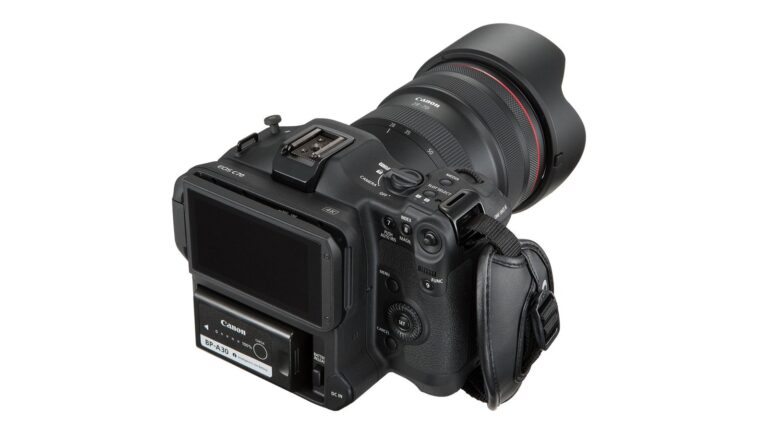
If the rig needs to stay light, a RED KOMODO 6K or a Canon EOS C70 sit comfortably under 14 kg even loaded, and you spend the headroom on bigger batteries instead of holding your breath.
In Abruzzo you rent it, and you rent the operator with it
Practical advice from people who put gear on sets around here: the Steadicam is the one item we advise against taking bare. Rent it with whoever flies it. A rig like this in the hands of a department without flight hours turns into a lost day, and on a production with a single shooting day in the Valle Peligna or on the coast you don’t get that day back. Everything else — bodies, lenses, lights, wireless — you’ll build yourself without trouble; for the sled, ask for the full package.
Pre-orders are open now on the Tiffen site. If you’re planning a job that needs one, get in touch — meanwhile you’ll find bodies, gimbals and supports in our equipment catalogue.
Official source: Steadicam Elite product page on Tiffen. Verification: Newsshooter.
A wide range of equipment in our catalogue, on-set delivery included across Abruzzo.