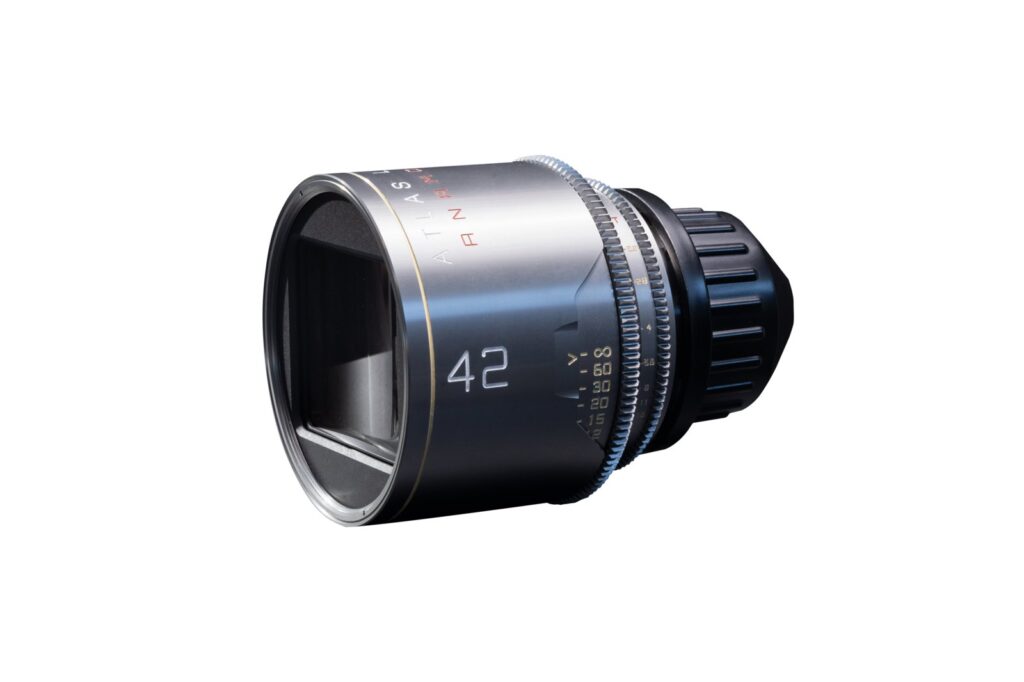
Atlas Lens Co. has rewritten the price list for its Mercury 1.5x anamorphics, and this is not a two-week promo: it is the new standard price. Six of the nine focal lengths drop from $7,995 to $4,499, while the three wides go from $9,995 to $5,999. On a full-frame anamorphic set that adds up to tens of thousands of dollars, and for rental houses like ours it changes the maths.
The new pricing, focal length by focal length
- 36, 42, 54, 72, 95 and 138mm: from $7,995 to $4,499 — $3,496 off each.
- 24, 27 and 32mm: from $9,995 to $5,999 — $3,996 off each.
Do the sum and a full nine-lens set falls from roughly $78,000 to about $45,000, before duties and VAT. This is not a refurbished clear-out either: Atlas is talking about updated list pricing on new product, the announcement is only days old and the trade press has already covered it.
What the Mercury lenses are, briefly
These are 1.5x squeeze anamorphics designed for full frame from the ground up: stated coverage is 36.7 x 25.54mm, so they are not stretched S35 glass. T2.2 across most of the range, PL mount, a 14-blade iris, a consistent 95mm front diameter on every focal length, close focus around 0.56m and weights between 1.1 and 1.75kg. The character is classic Atlas: obvious oval bokeh, warm horizontal flares, and enough distortion that you will notice it on a face in a wide shot.
That single front diameter saves more time on set than you would expect: matte box, filters and rings stay put, and a lens swap takes as long as unscrewing one.
The detail people forget: they are PL only
There is no E-mount or RF version. Either you start from a native PL body — the ARRI ALEXA Mini and the Blackmagic URSA Cine 12K are the two we keep in house — or you put a PL adapter on the camera, with all that implies for back focus checks and lens support on the rails. With a lens weighing a kilo and a half, support is not optional: hanging one off a mirrorless mount is the fastest way to start an argument with your focus puller.
What actually changes for production in Italy
In our view the cut moves the line for two groups. First, shooters who only ever shot anamorphic on rental because buying was out of the question, and who can now budget for two owned focal lengths alongside a rented set. Second, small rental houses: $45,000 now buys a complete set instead of three mismatched primes.
For the average spot, music video or short, though, the calculation is the same as ever. An anamorphic set earns its keep on selected projects: use it five days a year and buying means tying up capital you still have not recovered in year five — while the used anamorphic market has just repriced downwards because of this very announcement. Anyone who paid $7,995 for a Mercury six months ago is holding second-hand glass worth a lot less today. That is a risk you simply do not take when you rent.
Our practical advice, from the field: before you sign a purchase order, rent the set for the project you care about most and actually shoot that scene. Mercury lenses are not neutral — you either want the flares and the distortion or they get in your way, and you find that out in half a day of shooting, not by reading spec sheets. If the look is yours, the new pricing makes the decision far less painful than it was six months ago.
On a shoot with PL bodies and heavy glass, the surrounding kit matters too: a fluid head that can take the weight, a decent follow focus, a matte box. It is all in our equipment catalogue, and if you would rather start from a ready configuration, look at our kits.
Sources: the official Atlas Lens Co. Mercury Series page and verification from CineD.
A wide range of equipment in our catalogue, on-set delivery included across Abruzzo.