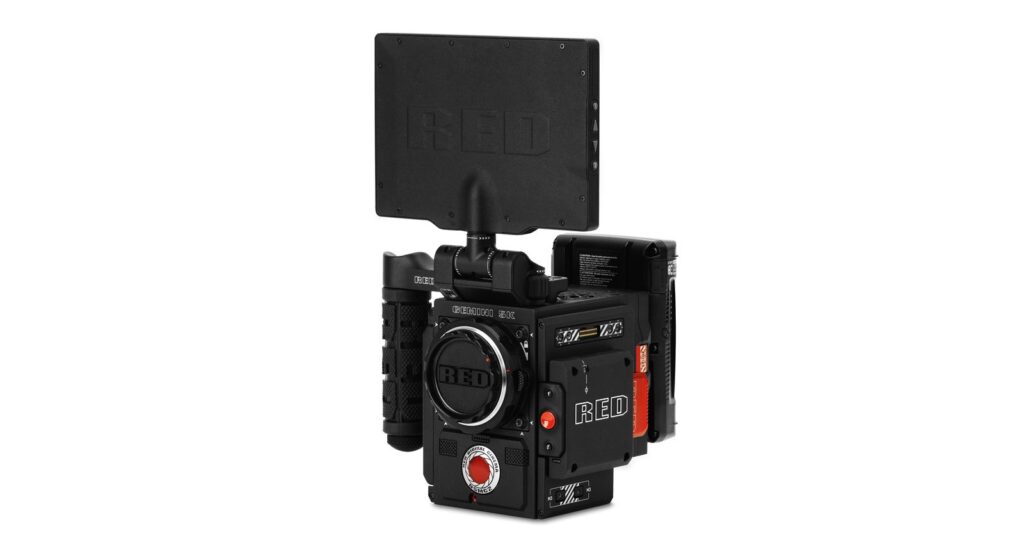
The RED GEMINI 5K S35 is one of those cameras nobody asks for by name — until they end up shooting in low light on a budget that won’t stretch to filling the set with 1200 W heads. That’s when the call comes in, and that’s why we keep one on the shelf.
A sensor built for the dark
It’s worth remembering where it came from: the GEMINI sensor started life as a special commission for shooting in orbit and in extreme light conditions, and only later did RED make it available to everyone. It’s a Super 35 chip measuring 30.72 × 18 mm, 15.4 megapixels, with a 6-micron pixel pitch — the largest RED has ever put in a body. Fewer pixels, but bigger ones. It’s the exact opposite of the resolution race, and it’s why it behaves the way it does when the light drops.
The part that actually matters on set is dual sensitivity: Standard mode with a native ISO of 800, Low Light mode with a native ISO of 3200. This isn’t digital gain forced in post, it’s a different read of the sensor, and you can see it in the shadows. At full 5K (5120 × 2700) it runs up to 96 fps, and up to 120 fps in 4K. It records REDCODE RAW with ProRes alongside it, so the editor has proxies ready while the colourist works on the raw. The official details are in RED’s GEMINI sensor FAQ, and anyone wanting the technical comparison with Helium will find a solid summary in AbelCine’s first look.
Who it’s for, in our opinion
The GEMINI is our first pick whenever we don’t control the light: night documentary, live shows and concerts, music videos shot in the street, practical interiors where the only source is the one already there. It’s also ideal for the auteur short that wants RED texture without the production weight of an ALEXA Mini or a Sony BURANO.
We wouldn’t recommend it, though, if you need raw resolution for print or heavy reframing in post: if the project lives on crops and repositioning, look at 8K or 12K bodies instead. And if the whole job is in controlled light, on a stage with a generator, the GEMINI’s advantage thins out considerably.
Three practical notes
- Low Light isn’t free. Switching to a native ISO of 3200 doesn’t give you licence to underexpose by another two stops: crush the shadows too far and chroma noise shows up anyway. We use it to protect a correct exposure in the dark, not to shoot with no light at all.
- DSMC2 is a brain, not a finished camera. It needs rigging: power, monitor, RED MINI-MAG media, handles. Budget the setup time, especially on day one.
- Think about the data flow. REDCODE RAW fills drives fast. If you’re shooting two full days, bring twice the storage you think you need and get a triple backup going in the van.
What we pair it with
The combination that leaves our warehouse most often is the GEMINI plus a Teradek Bolt 6 750 to get SDI to the director without cables, and a DJI RS 3 Pro for handheld moves (in a minimal build, always checking payload against the lens you’ve picked). When we need a discreet support source, we add an Aputure LS 300X: bi-colour, quiet, battery-friendly on location. The rest is on our kit page.
Buy or rent
The maths here is simple. A used GEMINI body, with media, batteries and a decent rig, is still a five-figure investment that only pays for itself if you shoot constantly. If your year is six or seven productions where the camera is needed for three days each, renting wins hands down: with us the RED GEMINI 5K S35 starts at €230 a day, with better rates over three days and a full week, delivery and collection included anywhere in Abruzzo.
There’s a second reason, less about accounting: a RED body bought today is a RED body you’ll have to resell tomorrow. Renting lets you pick the right sensor for the project — GEMINI when it’s dark, something else when the job asks for something else — without staying married to a decision made two years ago. Tell us what kind of production you have on your hands: we’ll tell you honestly whether the GEMINI is the right camera, or whether another body in our catalogue makes more sense.
A wide range of equipment in our catalogue, on-set delivery included across Abruzzo.