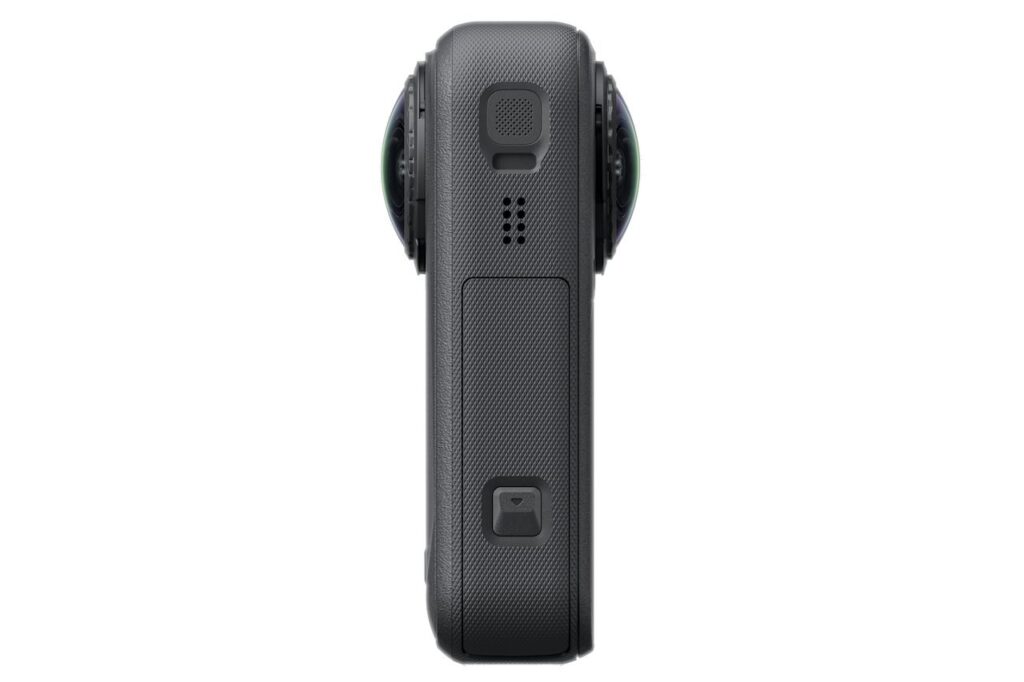
On August 12 Insta360 announced the X6, the new flagship of its 360 line. It is not a cinema camera and nobody is selling it as one, but the numbers are finally serious enough to be worth a few lines from a rental house that handles cine bodies every day.
What changed since the X5
The real jump is in the sensors: two square 1/1.1-inch Sony chips, with 33% more sensor area than the previous generation and, according to Insta360, roughly four times the light gathered per frame. The lenses are f/2 with a 7.78mm equivalent. Behind them sits a triple processing setup built around a 4nm, 3.3GHz chip.
- 360 mode: 8K at 50fps, H.265 encoding up to 240Mbps.
- Single lens: up to 5K60, a 170-degree wide view at 5K30, and 4K120 for slow motion.
- Native Dolby Vision with dynamic metadata, plus an I-Log profile for post.
- 2600mAh battery: 140 minutes at 8K30, empty to 80% in 24 minutes, rated down to -20 degrees.
- IP68 to 20m, 60m with the dedicated case. A 2.32-inch OLED screen at 1200 nits, 47GB of usable internal storage.
- Replaceable front lenses, claimed to be five times more scratch resistant.
The Standard bundle sits just under 700 dollars, the Essentials at 799.99. It went on sale the same day it was announced, with European pricing due to follow a few weeks later, as usual. The spec sheet is confirmed by Newsshooter as well.
Where it actually earns its place
In our view a 360 camera at this level replaces nothing: it gets added. On the jobs we see around Abruzzo it has three concrete uses. First, the reference plate: park it in the middle of the set, roll thirty seconds and the whole environment is in the can for the VFX team or the colorist, no chasing the light at the end of the day. Second, the shot nobody can hold: inside a car, on a helmet, clamped to a bike on the Gran Sasso climbs, in a cellar too tight for an operator with a camera on the shoulder. Third, the least glamorous but the one that pays the bills: tourism. Villages, hiking routes, hotels, where a navigable tour is worth more to the client than another thirty-second spot.
The single-lens mode with subject tracking is the part that convinces us most for behind the scenes. One body left in a corner delivers a flat 4K reframe on its own, and the making-of comes home without a second person on the call sheet.
The other side of the coin
These are still small sensors behind f/2 optics: when the light drops it shows, and no log profile fixes that. Editing takes twice as long, because the reframe has to be decided by hand shot by shot, and 240Mbps files fill drives fast. Then there is the stitch line between the two lenses: if a subject walks through it half a metre away, you see it. The practical rule is to keep people in front of one lens, never in between.
How we would slot it into a shooting day
In our inventory a camera like this stays a supporting tool, never the A cam. The pairing we suggest is simple: a light main body such as the Sony FX3 for the real footage, a DJI RS 3 Mini for movement, and the 360 left rolling where nobody can stand. If the set is up in the mountains and the files have to go out the same evening, the Starlink kit solves the most basic and most common problem of all. Ready-made combinations are on our kit page.
Buy or rent? At these prices, if you use one more than three or four times a year, you buy it and stop thinking about it. Renting makes sense for the rest of the package: that is where the real money goes.
A wide range of equipment in our catalogue, on-set delivery included across Abruzzo.