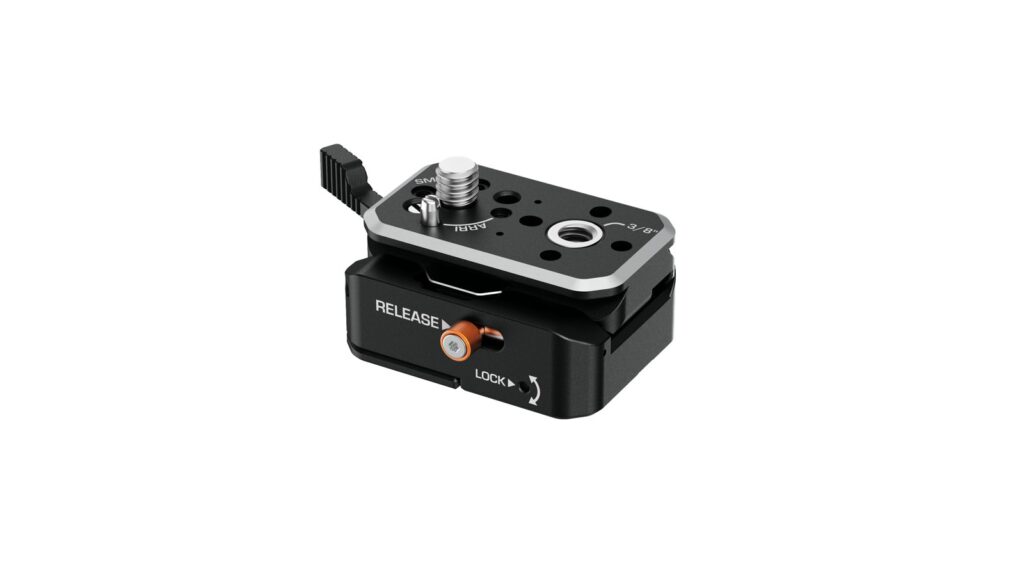
On 14 August Bright Tangerine announced the Unity Drop-In Lock, a NATO-compatible quick-release system that mounts pretty much anywhere on a rig. It is not the loudest announcement of the week, but it belongs to the category that quietly changes the rhythm of a shooting day: it is the part that lets you pull a monitor, a transmitter or a handle off the camera without hunting for an Allen key.
What it actually is
The kit comes in two parts: a clamp and a rail with built-in magnets that guide alignment. You drop the accessory in, the magnets pull it into position, the clamp closes on its own. To release it there is a push button with a safety stop, so your monitor does not end up on the ground at the first knock. Loading happens from the top or from the side — trivial on paper, decisive when the rig is already loaded and there is no room to slide a plate in.
Build quality is what you expect from Bright Tangerine: single-cut billet aluminium, hard anodised, 24-month warranty. Mounting accepts 1/4″ and 3/8″ screws and threads, with a dedicated anti-twist kit for accessories that tend to rotate under load. The 2mm hex key is only needed for the initial setup.
Pricing and availability
- Unity Drop-In Lock (part number B4003.0020), clamp + rail kit: 69 US dollars, in stock now
- Unity Drop-In Clamp on its own: 41.67 GBP
- Unity Drop-In Rail on its own: 16.67 GBP
- Unity Anti-Twist Screw Kit: 8.33 GBP
Selling the parts separately is the smart bit: you buy one lock, then fit a rail to every accessory you want to make interchangeable. Cost per accessory drops below twenty euros.
Why it matters to a rental house
Anyone shooting in Abruzzo knows the pattern: the rig gets stripped and rebuilt several times in the same day. Shoulder rig to tripod, tripod to gimbal, and every switch means unscrewing the monitor, moving the wireless receiver, finding the right screw. On a small crew — two or three people, which is the norm for shorts, documentaries and regional commercials — those minutes are the only thing standing between you and an hour of lost daylight.
In our view the real value is not speed itself but repeatability: the monitor goes back to the same place, at the same angle. If you are shooting for continuity and the DoP has found their viewing position, getting it back identically after every reconfiguration matters more than it sounds.
Two practical notes
First: NATO compatible does not mean every NATO accessory from every brand will slide in with the same smoothness. If your kit is a mix of brands, test the fit at base and not on set. Second: the magnets help with alignment but hold nothing — the clamp carries the load. With heavier bodies, say a 7-inch monitor with battery and cage, the anti-twist kit is not an optional extra, it is the difference between a solid mount and one that works loose by lunchtime.
What we would pair it with
In our inventory the natural candidates are the pieces that move constantly: the Atomos Ninja V, which travels between cameras during the same day, and the Teradek Bolt 6 750, where the transmitter comes off every time the configuration changes. On a Sony FX6 in documentary configuration, where setup time is everything, a system like this pays for itself in two shooting days.
If you are prepping a production and want to settle the rig before you get to location, have a look at our rental gear: these things are best decided at a desk, not at seven in the morning with the van doors open.
Official source: Bright Tangerine. Verification: Newsshooter.
A wide range of equipment in our catalogue, on-set delivery included across Abruzzo.