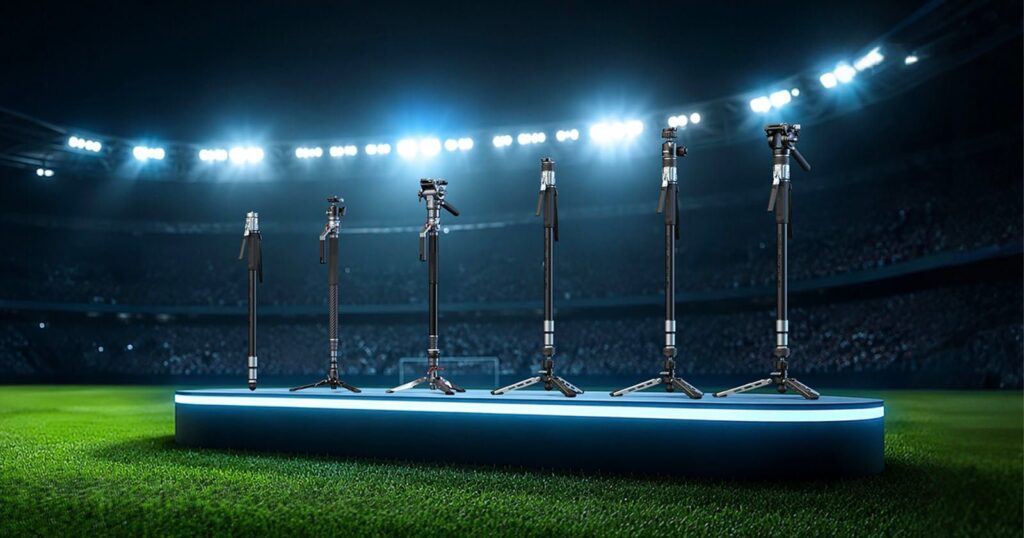
SmallRig started selling the TRIBEX PRO Monopod on 20 August, the second chapter of its collaboration with Potato Jet after the TRIBEX tripod. The prototype was already doing the rounds at IBC 2025, so the announcement surprises nobody. What does surprise is the price: the version with an integrated fluid head lands under 430 dollars.
X-Clutch: one lever instead of three twist locks
The core of the product is the new-generation X-Clutch hydraulic system. You squeeze the lever on the handle and all three carbon sections extend and lock themselves in under a second, with nothing to unscrew and screw back. On the way down, hydraulic braking avoids the thud that usually costs you the frame. SmallRig claims 20,000 test cycles on the mechanism.
Honestly: on paper it reads like the usual promo-video gimmick, but anyone working ENG or weddings knows how much time goes into adjusting three twist locks while the scene is already happening. If the mechanism holds up over time, the benefit is real.
The stated numbers
- Working height: 90–170 cm, 89 cm folded (fits a carry-on backpack)
- Weight: 2.6 kg for the video version with fluid head
- Payload: 25 kg on the monopod body, 6 kg on the fluid head
- Counterbalance: fixed, set for a 4 kg camera
- Base: three-leg foot with a pedal that switches between 360° panning and locked; metal spikes hidden inside the rubber feet
- Quick release plate: compatible with DJI RS and Manfrotto 501PL
- Operating temperature: -20 °C to 60 °C
- Warranty: 4 years
The four versions
- Basic (ID 6284): pole only, no base or head – 200 dollars
- Standard (ID 6283): pole plus tripod base, bring your own head – 360 dollars
- Photography (ID 6285): with ball head – 430 dollars
- Video (ID 6286): with fluid head – 429.99 dollars
Why we cover it if it isn’t a rental item
Fair question. A 430-dollar monopod makes no sense as a rental: anyone who works with one buys it and pays it off in three jobs. What interests us is a detail in the spec sheet, namely the quick release plate compatible with the DJI RS series. It means the same plate you mount on the DJI RS 3 Pro moves onto the monopod without swapping anything, and the camera goes from gimbal to pole in ten seconds.
On set that is the kind of thing that saves a day. On a mountain documentary, or on a wedding where you cannot plant a tripod in the middle of the aisle, having gimbal and monopod speak the same language removes the dead moment where you rescrew everything. It works with the DJI RS 3 Mini too if you are travelling light.
The 6 kg head payload is enough for a body like the Sony FX6 with a zoom and a monitor, but the counterbalance fixed at 4 kg is the real limit: if your build weighs much less or much more than that figure, you cannot balance the head and tilts get jerky. With a bare FX3, for instance, you will always be over-counterbalanced. Before ordering, weigh your complete setup including lens, battery and monitor: that is the only number that matters.
Second piece of advice, obvious but worth repeating because we have learned it the hard way: a monopod with a three-leg base is not a tripod. It holds the camera upright while you swap a card, it does not leave it standing alone in the wind. In Abruzzo, on mountain passes or on the coast in March, that distinction gets expensive.
In our equipment range we keep renting gimbals, fluid heads and load-rated tripods; for a personal pole, if the mechanism lives up to the promise, this TRIBEX PRO looks like sensible money. We will come back to it once we have had one in hand for a few weeks. The news is also verified by PetaPixel.
A wide range of equipment in our catalogue, on-set delivery included across Abruzzo.