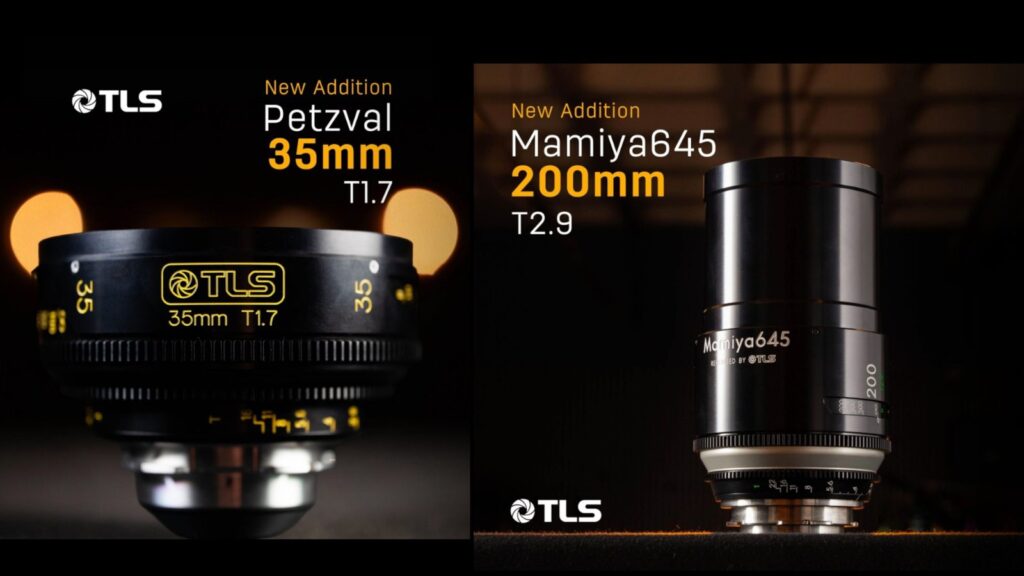
On 22 August True Lens Services, the British shop that has been rehousing vintage glass for cinema for years, added two pieces to its catalogue: a Petzval 35mm T1.7 and a Mamiya 645 200mm T2.9. Optically these are not new designs. They are historic ones dropped into a modern cine barrel, with proper focus scales, standard gears and repeatable back focus. That is exactly the point.
Petzval 35mm T1.7: the flaw is the look
The Petzval is a nineteenth-century optical design and it shows: soft centre, heavy fall-off towards the edges, bokeh that swirls. Every one of those traits is something a modern lens tries to engineer away. Here they are the selling point, and rightly so, because nobody rents this glass for clinical resolution.
- PL mount, T1.7
- Close focus around 25 cm (10 inches)
- 110 mm front diameter, 66 mm total length
- Weight 0.83 kg
- TLS list price: 8,100 pounds
A 35mm that is only 66 mm long stands out: it is remarkably short, almost a pancake in a cine housing. On a gimbal or a light rig that is a real advantage, but keep the 110 mm front in mind, because it drives your mattebox and step-ring choices.
Mamiya 645 200mm T2.9: a real two hundred
The 200mm is the one we find more interesting. TLS rehouses it keeping the native focal length, with no speedbooster involved: what you get is a true 200mm, with the perspective compression you expect from a medium format tele. It is a lens for compressed landscapes and distant detail, not for a tight set.
- PL or LPL mount, T2.9
- 61 mm image circle at infinity: it covers full frame with room to spare and gets close to large format
- Minimum object distance 5’10”, roughly 1.78 metres
- 95 mm front diameter, 184 mm long
- TLS list price: 6,950 pounds
What this actually costs
Two lenses, about 15,000 pounds at list. Add the exchange rate and Italian VAT and you get a figure no working videomaker buys for a single job. This is the calculation we run every time: character glass only pays for itself if you use it constantly and always for the same look. If you need the Petzval swirl for a three-day music video, buying it is bad accounting. Renting it is not.
One thing that often gets underestimated: rehoused vintage glass is not plug and play. It needs testing beforehand, on a calibrated monitor, and it needs to be decided in pre-production, because the character of these lenses cannot be added or removed in the grade. Turning up on set with a Petzval you have never tested costs you half a day.
Our take
We do not stock these two TLS lenses, and we are not going to pretend otherwise. Flagging them is still worth it, because they confirm a trend we have been seeing on the ground for a couple of years: mid-range Italian productions increasingly ask for a look, not for a spec sheet. The client does not say “I want 4K”, they say “I want it to feel like it was shot in the seventies”.
If that is your starting point, the body matters less than the glass. A 61 mm image circle like the Mamiya’s sits comfortably on any sensor we rent, and on a native PL ARRI ALEXA Mini a vintage tele works particularly well, precisely because Super 35 leaves margin to reframe without going hunting for the edges. On bodies like the Sony BURANO or the RED KOMODO 6K you need the right PL adapter, and that has to be sorted in advance, not on the morning of the shoot.
Our advice is simple: pick the look, then the body, then the rest of the kit. If you have a vintage rendering in mind for a project in Abruzzo, talk to us before you lock the dates. There is usually a way to get there, inside or outside our own catalogue.
The official pages are on the True Lens Services website, and the announcement was also covered by Newsshooter.
A wide range of equipment in our catalogue, on-set delivery included across Abruzzo.