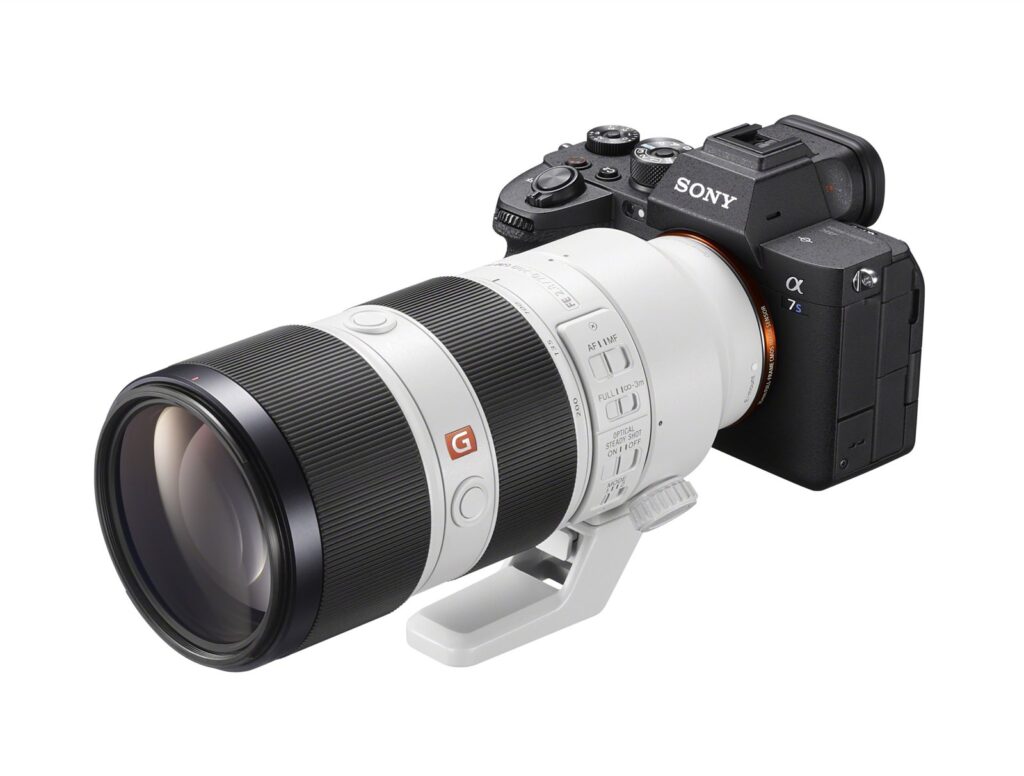
The Sony A7S III came out in July 2020, and in 2026 it is still one of the bodies that leaves our warehouse most often. Not because it is new — it isn’t — but because it does one thing better than almost anything else: it sees in the dark. In a region where half the locations are hill towns with four streetlights, churches, cellars and unlit mountain roads, that matters far more than twenty extra megapixels.
What it genuinely does well
The 12.1MP full frame BSI sensor is built for video, not for print. Each photosite is large, and the result is noise that stays clean and filmic at high ISO instead of breaking up into colour blotches. In S-Log3 it runs two base ISOs, 640 and 12,800: you get the same dynamic range in daylight and at night, without paying for it in grain. Sensitivity expands to 409,600 ISO, but that is not the point — the point is that at 12,800 the file is still perfectly deliverable.
- 4K up to 120p in 10-bit 4:2:2, All-Intra included (120p comes with a slight crop)
- around 15 stops of claimed dynamic range in S-Log3
- 16-bit RAW output over HDMI to an external recorder
- no 30-minute limit: the body dissipates heat and long takes hold up
- 5-axis in-body stabilisation, 9.44-million-dot viewfinder, dual CFexpress Type A / SD slots
Who it is for
In our opinion the A7S III has three jobs where nothing beats it. First, documentary and reportage: just under 700 grams, you carry it all day, and when the sun goes down you don’t have to light anything. Second, concerts and evening events, where the lighting belongs to someone else and changes every eight seconds. Third, B-camera duty: shoot with a Sony FX6 as your A-cam and the A7S III gives you the same S-Log3, the same S-Cinetone and the same E-mount glass, so grading is painless. On cinematic weddings we often pair it with a Sony FX3: two bodies with an identical look, one on the gimbal and one handheld.
Why rent it instead of buying
With us the Sony A7S III is 70 euro a day, 180 euro for three days and 250 euro a week, VAT excluded, with batteries and cards ready to go and delivery to set included anywhere in Abruzzo. Do the maths: if you shoot two or three low-light projects a year, renting costs a fraction of buying and leaves you without a body that will be worth half as much in two years. Buying makes sense only if you use it every week — and people who use it every week already know it.
Three things to know before it goes in the car
- Twelve megapixels are twelve megapixels. There is no room to reframe in post: get the framing right, or shoot 4K knowing you will deliver in 1080 and take your crop there.
- Cards matter. 4K 120p and All-Intra need CFexpress Type A; SD cards, even V90, will stop you short. We supply them with the rental, but check the rating if you bring your own.
- It is a mirrorless, not a cine camera. No internal NDs, no native XLR: if you are recording an interview plus ambience you need an audio adapter or a separate recorder. Budget for it from the start.
What we pair it with
The package we hand over most often is the A7S III plus the Sony G Master f/1.4 set: fast glass on a body that loves the dark. For movement we put it on a DJI RS 3 Pro, which handles that weight comfortably and leaves headroom for a light matte box. When a client wants maximum latitude in colour we add an Atomos Ninja V and record ProRes RAW from the 16-bit output. The rest of the combinations live in our complete kits.
Official specs are in the Sony Alpha Universe announcement, while Newsshooter published what is still the most honest technical breakdown of the camera. If you have a shoot date and you are not sure this is the right body, write to us: quite often we will tell you to take something else.
A wide range of equipment in our catalogue, on-set delivery included across Abruzzo.