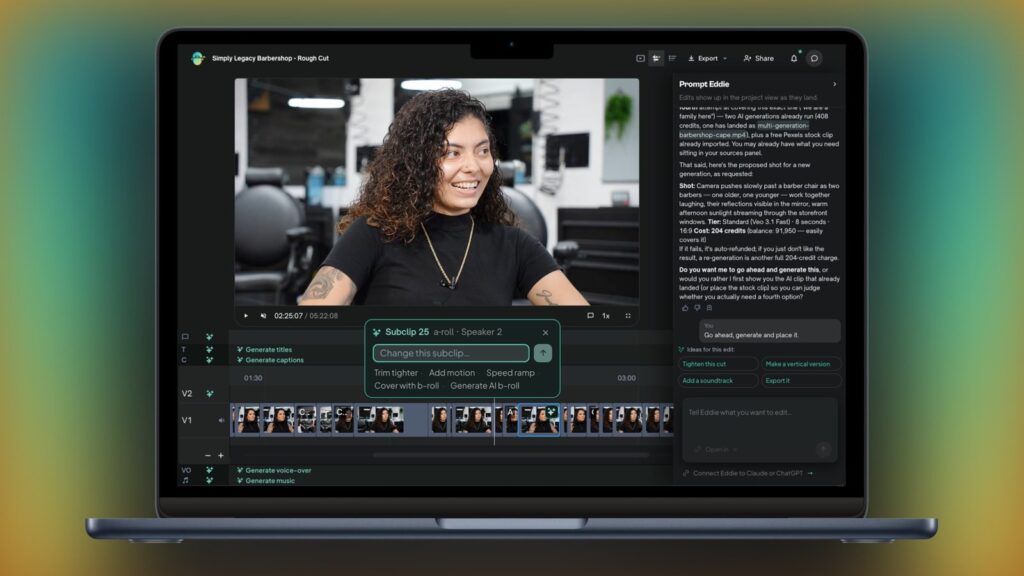
Eddie AI has scrapped subscriptions. As of 27 August the assistant editor is paid for in one-off credits, and on top of that it can now be driven from inside Claude or ChatGPT. It’s the biggest change since version 3 arrived, and for once it isn’t about a spec sheet: it’s about the invoice that lands at the end of a job.
How the pricing works now
No more monthly fee: you buy credit packs and they never expire. Official pricing starts at $10 for 1,000 credits, then $45 for 5,000, $120 for 15,000 and $350 for 50,000. Every new account gets 1,000 free, and auto top-up is switched off by default, which is a rare courtesy.
The real burn is on import: roughly 500 credits per hour of source material, billed in fifteen-minute blocks. Everything else (assembly, b-roll, captions) costs according to what you ask for. Eddie reckons a 5,000-credit pack covers about two three-hour projects.
Here’s the sum that matters to working crews. A documentary with twenty hours of rushes eats 10,000 credits on ingest alone: somewhere between $90 and $120 before a single scene has been cut. That’s not expensive next to a human assistant, but it belongs in the budget rather than in a nasty surprise.
The interesting part: Eddie inside Claude and ChatGPT
Eddie now runs as an MCP server, meaning it exposes around a hundred tools to an external language model: transcripts, soundbite selection, first assembly, b-roll, captions, music, voice-over, multicam angle switching, NLE export. The model directs, Eddie holds the media, the timecode and the timeline. Exports come back as editable projects in Premiere Pro, DaVinci Resolve or Final Cut Pro, not as a flattened MP4 you’d have to rebuild.
There’s also a free iPhone app for prompting and reviewing cuts on the move, with imports from the camera roll, Drive or Frame.io. Cloud workspaces have gained Slack, Teams and enterprise SSO.
What it changes for productions here
In our view the point isn’t “AI edits for you”. It doesn’t, and anyone claiming otherwise is selling smoke. The point is transcription and the first pass of selects: the two days on a documentary or a corporate event that nobody wants to pay for and someone always ends up donating. At around $90 a project that maths works, especially for the small crews that are the norm in Abruzzo.
The savings start on set, though, not in post. If cost is calculated on hours of footage, shooting tidy is worth double: shared timecode across cameras, consistent card naming, obvious rejects stripped out before upload. On a multicam job with two Sony FX6 bodies and an FX3 as a support camera, syncing properly in-camera saves both credits and nerves.
The other catch is bandwidth. All of this lives in the cloud, so those hours have to be uploaded, and out at a farmhouse in the province of L’Aquila there is often no fibre at all. That’s exactly why our Starlink kit goes out on jobs: start the upload the same evening instead of waiting to get back to the edit suite.
One last caution, which never appears in a press release: a client’s NDA material ends up on a third-party service. Before uploading an embargoed campaign, get it agreed in writing with the production. Otherwise this is an honest update with legible pricing, and these days that counts for something.
The rest of our kit, cameras, lenses and lighting, is on the equipment page.
A wide range of equipment in our catalogue, on-set delivery included across Abruzzo.