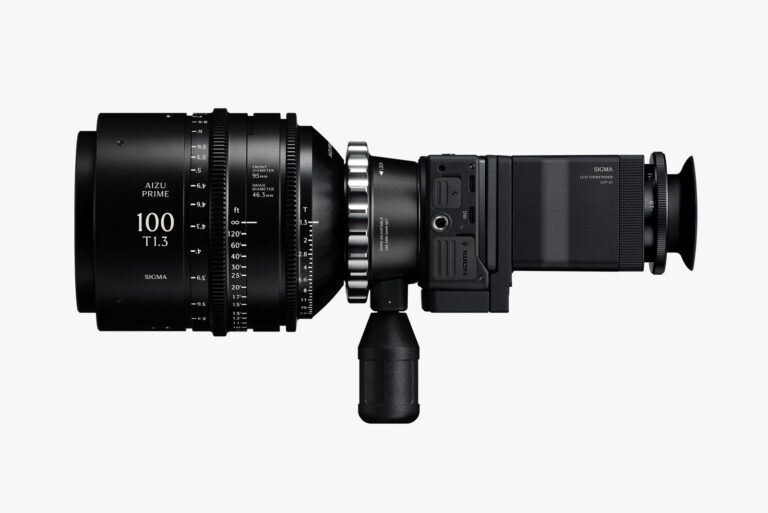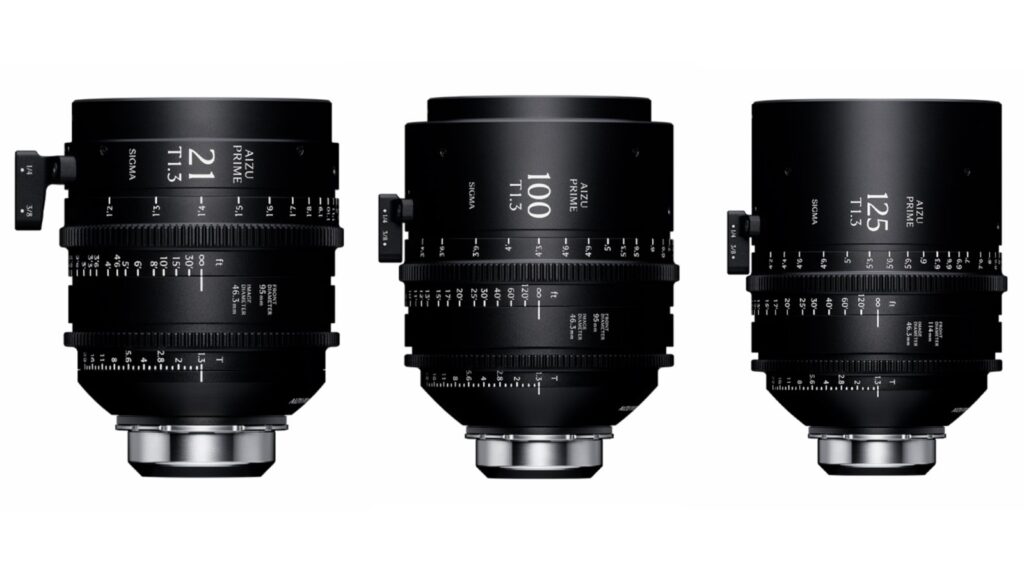
SIGMA has made it official: three new focal lengths join the Aizu Prime line — 21mm, 100mm and 125mm T1.3 LF. The announcement is dated September 1st, each lens costs $9,799 and deliveries start in November 2026. Until yesterday the series ran from 25 to 75mm; now it stretches to wide angle and short telephoto without leaving the family.
The specs, no fluff
- 21mm T1.3 LF — close focus 0.35 m, length 120.1 mm, weight 1.6 kg, front diameter 95 mm.
- 100mm T1.3 LF — close focus 1 m, length 144 mm, weight 2.2 kg, front 95 mm.
- 125mm T1.3 LF — close focus 1.25 m, length 152.8 mm, weight 2.2 kg, front 114 mm.
- 46.3 mm image circle, PL or Sony E mount, 270° focus rotation, 0.8 MOD gears, ZEISS eXtended Data metadata.
That 46.3 mm image circle is the number that matters: it covers full frame and Super 35 with room to spare, and it holds up on large-format bodies such as the ALEXA LF in Open Gate. Watch the 125mm, the only one of the three that breaks the uniform front: 114 mm instead of 95. If you work with a mattebox and reduction rings, budget for it during prep, not on the morning of the first shot.
A constant T1.3 is not a brochure gimmick
On a cine set the real value isn’t the widest possible stop, it’s having the same stop on every focal length. You swap lenses, you don’t redo the exposure, you don’t move a light, and nobody in post sees the jump. On the floor that’s twenty minutes saved on every setup change, which over a shooting day adds up to one more scene in the can. With 100 and 125mm added, the same logic now covers long close-ups: to go past 75mm you previously had to mix the set with something else and accept a visible shift in rendering.
$9,799 each: buy or rent
European pricing hasn’t been announced yet. Rough maths, exchange rate and VAT included, puts three lenses comfortably above €30,000, and a full Aizu set is an investment for a structured production company, not a freelancer. In our view the calculation is simple: if you shoot fewer than twenty days a year where you genuinely need T1.3 on large format, buying means capital sitting in a cabinet — plus glass that has to be insured, checked and stored properly.
That’s exactly why this tier of glass makes sense as a rental: you take it for the commercial, the music video, the three days of drama, then it goes back to the shelf. On a lens set at this level, renting is the rational call nine times out of ten, even for people working steadily.
The bodies we’d pair them with
The dual mount is the smartest part of the announcement. In E-mount they go straight onto the Sony BURANO, which is full frame and has in-body stabilisation — with a 2.2 kg 125mm on the front, you’ll appreciate it. In PL the reference is the Blackmagic URSA Cine 12K, where all 46.3 mm of that image circle gets used, and the ARRI ALEXA Mini for anyone working Super 35 who still wants a consistent set. Everything else we keep ready is on our equipment page.
What’s still open
The original twelve-lens plan still lacks the 18mm T1.3, for which SIGMA hasn’t given availability. And above all, the field test is missing: 1.6 kg for a 21mm and 2.2 kg for the two teles are honest weights for the class, but on a gimbal they change the balance of the whole rig. November is close — we’ll come back to this with the glass in our hands.
Source: official SIGMA press release. Specs cross-checked on Newsshooter.
A wide range of equipment in our catalogue, on-set delivery included across Abruzzo.