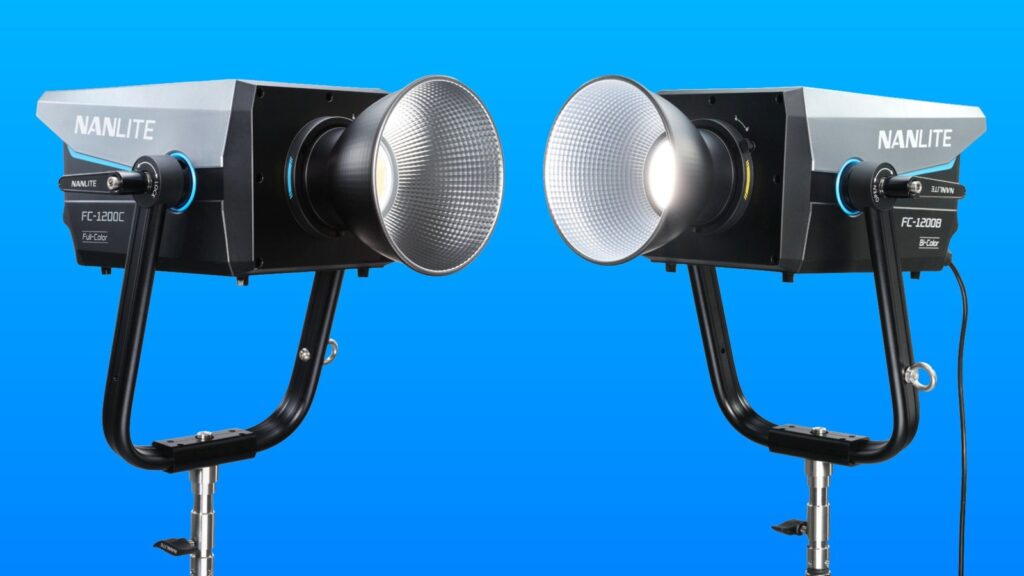
On 3 September NANLITE announced two 1200W output fixtures, the FC-1200B (bi-color) and the FC-1200C (full color). On paper this is the power class that cost three times as much two years ago, and the headline reads quickly: 1200W, Bowens mount, everything built into the head, a single mains cable. Then there are the two or three lines that matter far more to us, since we are the ones loading this gear into a van and taking it to set.
The actual numbers
Both heads are rated at 1350W of draw for 1200W of output. The bi-color FC-1200B covers 2700-6500K and claims 15,620 lux at 3 metres with a 45-degree reflector, with CRI 96 and TLCI 98. The full-color FC-1200C uses the Nebula C4 engine, runs from 2400K to 12,000K with +/-150 green/magenta correction and drops to 14,220 lux at 3 metres, with CRI 95 and TLCI 94. Both weigh 10 kg, measure roughly 43x38x20 cm, dim from 0 to 100 per cent in 0.1 per cent steps and are controlled from the head, the NANLINK 2.0 app, DMX/RDM or NFC. In quiet mode NANLITE claims around 26 dB(A).
The European price is not the American one
Worth slowing down here. The trade press quotes 1,290 and 1,490 dollars, shipping now. The European press release instead lists 1,619 euros for the FC-1200B and 1,869 euros for the FC-1200C, shipping from late October 2026. Those are two different worlds: read the dollar price, assume you will have one in hand for a September shoot, and in Italy you end up nearly 400 euros higher and two months later. If you have autumn work booked, factor that in now.
1350W on an Italian socket: do the maths
This is the part the spec sheets leave out. A 1350W draw means that on a 3 kW domestic supply, still the norm in half the villages in Abruzzo and in plenty of the B&Bs and rural houses we shoot in, you run one of these and not much else. Two heads is 2.7 kW and you are already over the limit with the fridge running. On set the consequence is concrete: either you bring a properly sized generator, or you split across separate circuits, or you accept that this light is the key and everything else comes from 300-600W heads. In our view that is exactly why an Aputure LS 300X still earns its place next to a big fixture: it is the light you can afford to leave switched on without tripping anything.
Bowens, 10 kg up top, and what it pairs with
The Bowens mount is a smart choice for rental: modifiers are cheap and available everywhere. Two cautions, though. First, at 1200W the heat is no joke, and not every budget Bowens softbox is built to sit in front of it, so always check how the fabric holds up. Second, 10 kg all-in-one means fast rigging, no ballast on the floor, no head cable to manage, but also 10 kg at the top of the stand. Outdoors, with the wind coming across the plateau or near the coast, a light stand will not do: you need a serious stand, sandbags and safety cables. That is not fussiness, it is the difference between a rental that ends well and a 1,600-euro fixture on the ground.
In our inventory the powerful key role is currently covered by the Aputure LS 600x Pro and the Nanlite Forza 720, both Bowens mount and therefore sharing the same modifier ecosystem. If these FC heads interest you for a specific job, get in touch: we assess case by case whether it makes sense to add them, and in the meantime we will find the right combination from what is already in the catalogue.
Buy or rent
1,619 euros for 1200W is an aggressive price, and if you fire up a fixture like this every week, buying pays for itself. For everyone else the calculation is the same as always: how many times a year do you genuinely need a 1.2 kW head? If the answer is three or four, renting costs less than depreciation, and you also skip the heavy stands, the sandbags, the spare parts and the obsolescence. The LED lighting market moves every six months: today’s new thing is next year’s previous model.
Sources: the official NANLITE press release and CineD’s write-up.
A wide range of equipment in our catalogue, on-set delivery included across Abruzzo.