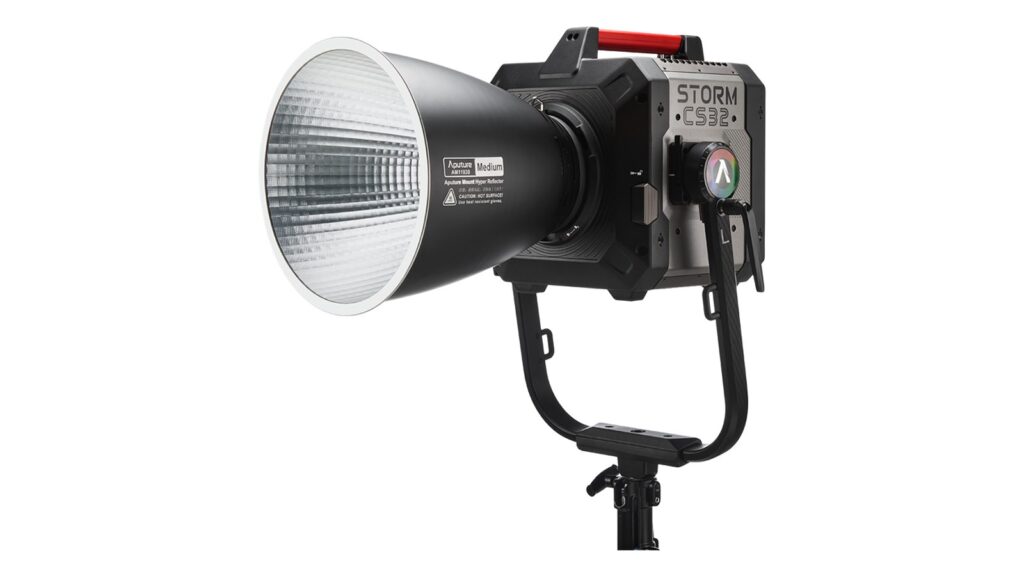
Aputure officially announced the STORM CS32 on 8 September, the most powerful point source it has ever put on a price list. We got a glimpse of it at NAB back in April, but that was a promise; now there are prices, published photometrics and open pre-orders. The sales pitch fits in one line: 3,200W draw, white output claimed to match a 4K HMI or a 10K tungsten fresnel, and in 220V countries it runs from an ordinary 15A household circuit.
The numbers that matter
- Output: 106,000 lux at 3 metres with the included 30° reflector at 5,600K, 35,500 lux at 5 metres. Bare bulb drops to 15,000 lux at 3 metres, with a 78° native beam.
- Colour: BLAIR-CG chipset with Extended Red, 1,800K to 20,000K CCT with ±100% green correction, covering over 90% of Rec. 2020.
- Fidelity: CRI 97, TLCI 98, SSI Tungsten 93, SSI D56 91, TM-30 Rf 96 and Rg 100.
- Electrical: 100-240V, 3,200W maximum draw, 16A at 240V (32A at 100V).
- Weight: 16.8 kg for the lamp head, 10.8 kg for the control box. Head cable extendable up to 45 metres when daisy-chained.
- Build: IP65, operating range from -20 to +45 °C.
- Fan noise at 1 metre: 24.3 dBA in silent, 31.3 in low, 40.2 in medium, up to 52.6 dBA flat out.
List price is 6,990 dollars (around 5,600 euro excluding VAT) for the body, 7,590 dollars (around 5,980 euro) for the flight case kit. If you are in Amsterdam, it is on the stand at IBC from 11 to 14 September.
The household socket: it is the meter, not the plug
One clarification you will not find in the press release, and it is the first thing we ask when a client calls us about a fixture this size. 3,200W at 230V is roughly 14 amps: the Schuko socket handles it, the cable handles it, the breaker handles it. The problem sits further upstream. A standard Italian domestic supply is rated at 3 kW, with the cut-off just above that: fire up a CS32 at full power in a farmhouse or a normal flat and the meter will trip. You need at least a 6 kW contract, or a generator.
That said, the advantage over a real 4K HMI is still huge, because an HMI almost always means a lighting desk and a genny. With a CS32 on a location that has 6 kW available — a warehouse, a municipal hall, a hotel — you get a light level that until yesterday meant a truck and a genny operator.
When it makes sense, in our view
This is not an everyday light, and that is exactly why it makes sense as a rental. You reach for a CS32 when there is a specific problem to solve: punching through a window in broad daylight, lighting a large interior from outside through glass, holding a wide night ambience with a single source. Those situations come up on two or three days a year, not on every job. Buying a body at nearly 6,000 euro plus modifiers to use it that way means amortising it over three or four years, assuming Aputure does not replace it in the meantime — and knowing their update cadence, we would not bet against that.
Three practical notes for the set. First: the 78° native beam without a reflector is not much use at distance, so plan around the reflector, because the whole jump from 15,000 to 106,000 lux lives there. Second: above medium mode the fans go past 40 dBA at one metre, so for a sync-sound interview either stay in silent or move the head further away. Third: 27.6 kg between head and control box calls for a serious stand and two people when you are working high, whatever the single-operator claim says.
Where it would sit in our inventory
In our catalogue the top end is currently covered by the Aputure LS 600x Pro and the Nanlite Forza 720, with the Aputure LS 300X as a fill and support light. The CS32 does not replace any of the three: it sits a step above, and it would be the piece to call in when 600W bi-colour is no longer enough. We want to get our hands on one before saying whether it joins the fleet, but its place is obvious. If you need a lighting package for a production in Abruzzo in the meantime, the rest is in our equipment list.
Official source: the Aputure STORM CS32 product page. Independently verified by Newsshooter.
A wide range of equipment in our catalogue, on-set delivery included across Abruzzo.