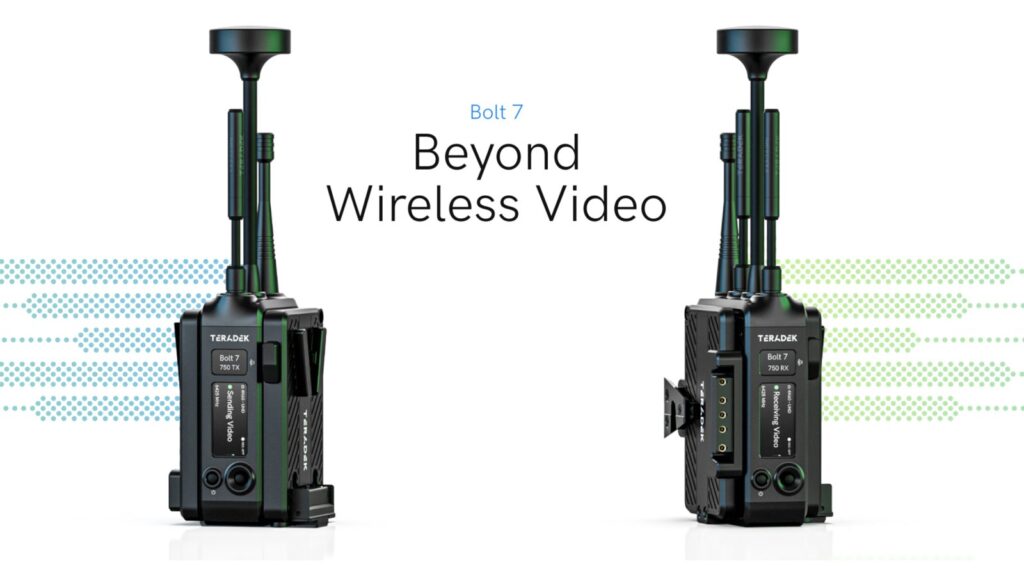
On 9 September Teradek unveiled the Bolt 7 series, and for once “major update” isn’t marketing talk: it’s the biggest change to the Bolt line since 2013. Not because the video got better — that was already fine — but because there’s now a second, 900MHz radio dedicated to data inside the transmitter, running in parallel with the zero-delay video signal.
What actually changes
Video is what we already know: up to 4K60 10-bit 4:2:2 HDR over 12G-SDI, zero-delay, 5GHz and 6GHz bands with automated RF management picking the least crowded channel. The new part is the separate data pipe: the 900MHz radio behaves like a wireless replacement for Ethernet and USB. On set that means camera control from SmallHD monitors or the manufacturer’s own apps, LUTs and CDLs pushed live, telemetry and shading — with no Wi-Fi network to set up and no extra hardware bolted to the camera.
Anyone who has spent half a day trying to make a cheap access point talk to a camera six metres up on a jib will get the point immediately. Pairing itself now happens over the radio, so the TX can sit buried under a cage or on top of a crane and still be configured from the ground. The transmitter is also 20% smaller than the Bolt 6 XT, with a larger colour OLED display and a built-in frequency analyser.
Models and pricing
- Bolt 7 750 — set from $5,990
- Bolt 7 1500 — set from $8,990
- Bolt 7 MAX — set from $13,990, with an RX that can record to SD
You get reversible Gold Mount and V-Mount cradles, USB-C with DisplayPort Alt Mode (a single cable for video and data on PYXIS and iPhone) and, priced separately, the $899 Advanced Spectrum licence and the $4,490 RF-X module. Those are US dollars before tax: add import duty and exchange rate and you’ll see why a 750 set is not a casual purchase in Italy.
The detail that matters if you already own a Bolt 6
This is the bit that, to us, outweighs every spec. On video the Bolt 7 stays compatible with Bolt 4K, Bolt 6 and Ace: a Bolt 7 TX will happily feed a Bolt 6 RX you already own. But the 900MHz data radio only works between Bolt 7 units. Buy the transmitter planning to recycle your old receivers and you simply don’t get wireless camera control. The very old BB2 units (500, 1000, 3000) are out entirely.
One honest caveat: the 900MHz band is regulated differently across markets, so before ordering a unit to work in Italy, ask Teradek which regional version they’re shipping and which functions are enabled on it. That’s not something you want to discover on set.
Buy or rent
In the field the question is always the same: how many times a year do you actually need wireless video with integrated camera control? If the answer is “two commercials and a short”, the maths doesn’t work — a Bolt 7 750 set eats an entire project’s equipment budget, and eighteen months from now RF-X will be standard. The Teradek Bolt 6 750 in our inventory covers 90% of the productions shooting here just fine: video village twenty metres away, a client monitor, no cable running across set. We’ll look at the Bolt 7 when European stock actually lands — and we’ll add it if clients ask for it for remote camera control jobs, not because of the spec sheet.
In the meantime, if you’re prepping a day with the camera on a gimbal or a crane, the package that works is always the same: a camera body — ARRI ALEXA Mini or Sony BURANO — a wireless link, and an Atomos Ninja V downstream for whoever is watching. It’s all in our ready-made kits.
Sources: official Teradek Bolt 7 page and Newsshooter.
A wide range of equipment in our catalogue, on-set delivery included across Abruzzo.