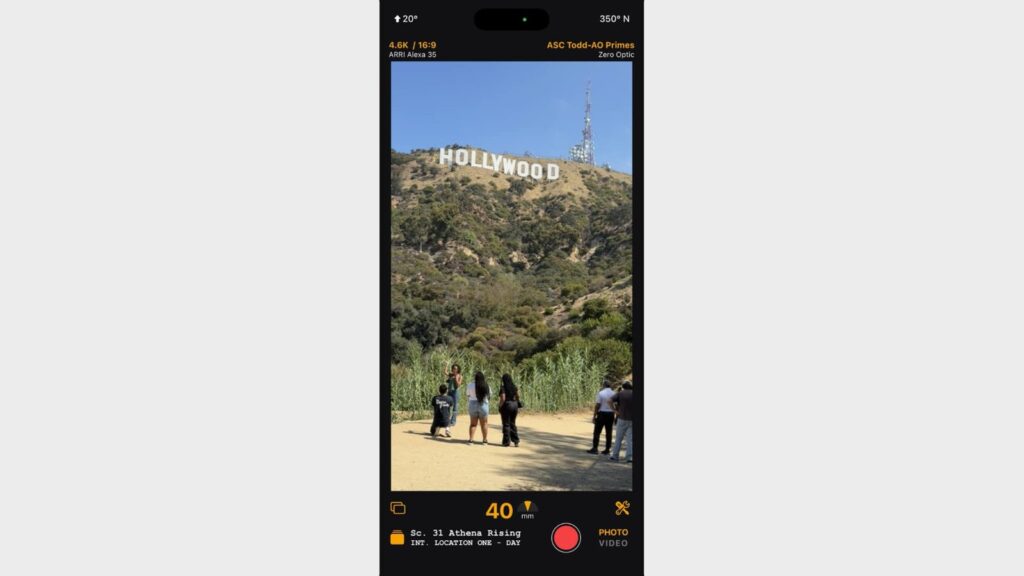
Chemical Wedding has released Artemis 8.9.0, and there is only one headline feature — but it matters: the most widely used director’s viewfinder on set now has a native Vertical Mode, built for 9:16 rather than adapted from horizontal. It is a free update for existing users and is switched on in Settings.
What actually changes
Until now, anyone planning a vertical piece in Artemis did what we all do: frame horizontally and crop in their head. That works right up until you have to pick a lens. The field of view of a 35mm on full frame in 9:16 is not “16:9 turned sideways”: the angle changes, the shooting distance changes, and so does how much room you need on set. Get that wrong on the recce and you turn up on shoot day with the wrong lens set.
With 8.9.0 all of the app’s tools — lens and sensor calculations, framing, shot planning — work directly in vertical. Helios Live-View is included too, so natural light planning for exteriors also covers vertical formats, and everything stays in sync with Artemis Studio, the Mac desktop app used to share shot plans with the rest of the crew.
Chemical Wedding’s own line is that vertical content now accounts for a large share of all production, not a niche corner of it. That matches what we see. Looking at the jobs coming through our door, the share of work that starts life in 9:16 — or has to be delivered in both versions — has grown a lot in the last two years, and not only for small brands.
Why this matters in Abruzzo
Most of what gets produced here is advertising and branded content for local businesses: wineries, food producers, tourism, hotels, craft manufacturers. Almost none of those clients ask for just the horizontal video for the homepage any more. They ask for the package: the 30-second spot, the vertical social cutdowns, often the same footage reused for a paid campaign. And that vertical version is no longer a hopeful crop out of the 16:9 master — increasingly it has to be shot vertically, with its own composition.
Here is the practical maths: if you plan the vertical on the recce, you walk into the rental house knowing what you actually need. In our view this is exactly the point where a cheap app saves you hundreds of euros of gear you rented and never put on the camera.
How we would use it in prep
- Recce with the phone: lock the final vertical frames with real focal lengths, not “roughly a 50”.
- Lens list closed before pickup: vertical framing tends to run wider than expected, so you often need one more wide and one less long than the list you drew up by eye.
- Light check with Helios: in vertical exteriors the sky takes up a huge slice of frame, which makes sun timing more critical than it is horizontally.
On the gear side, our advice for vertical-first jobs has not changed in a while: compact body, light gimbal. A Sony FX3 on a DJI RS 3 Mini is the combination that goes out most often for this kind of work, because the Mini handles the vertical roll well without the weight of a full rig. If vertical is just one deliverable inside a bigger production, step up to the DJI RS 3 Pro, shoot wider and crop later. Ready-made combinations are in our rental kits.
One caveat, no hype
Artemis is still a pre-production tool, not a miracle worker: if the client decides the format the day before the shoot, no viewfinder will save you. But this is the first time a director’s viewfinder treats 9:16 as a first-class format rather than a fallback, and for anyone working on mixed horizontal/vertical briefs it is one less thing to eyeball.
The update is available now, free for Artemis users. Details on the official Chemical Wedding site; the news was also covered by RedShark News.
A wide range of equipment in our catalogue, on-set delivery included across Abruzzo.