On 14 September Blackmagic released the Blackmagic Camera 10.3 update, and inside it is the thing a lot of us had been waiting five years for: Generation 6 Color Science. The last time Blackmagic touched its color science was July 2020, with Gen 5. This is not a cosmetic tweak — it changes where the image starts, and it changes how you handle footage that is already in the archive.
What changes in the image
The pipeline has been rebuilt around DaVinci Wide Gamut. Blackmagic’s own wording is dry: the gamut is large enough to preserve everything the sensor captures, and 3D LUTs then take you to the gamut you actually need, including your own. On set that means one intermediate conversion step disappears, and with it a source of color drift you had to watch in Gen 5.
The rest comes from the trade press hands-on: the Gen 5 “Standard” video color spaces are replaced by the Blackmagic Rec 709 BT1886 technical transform, built for Rec 709 displays, and gamut compression — previously an in-camera toggle — now rides inside the LUTs, so it costs far less processing. On skin tones, which is the real test, Blackmagic claims a more natural rendering: bright, well-exposed faces were exactly where Gen 5 struggled.
The part that matters if you have already shot
This is the bit that earns the article, in our view. Generation 6 is not only a way to record: it is also a decoding option for existing Blackmagic RAW files, available in DaVinci Resolve 21.1 and the Blackmagic RAW 6.0 SDK. Gen 5 material shot months ago can be brought into Gen 6 in post, which keeps a project consistent when it has been spread across several shoots and several bodies. Anyone with a documentary that has been open for a year will get why that counts.
What else 10.3 brings
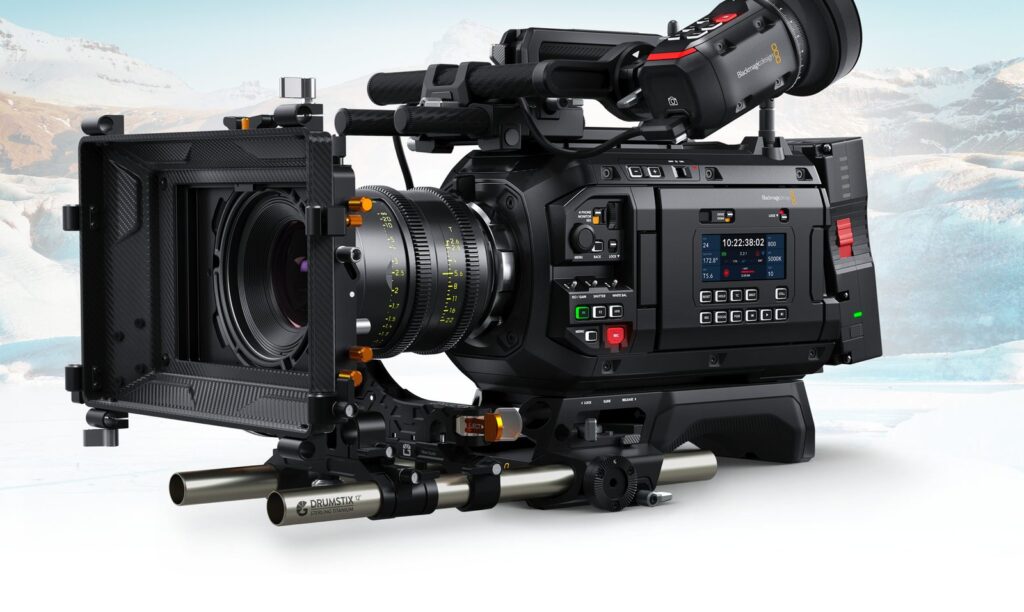
The update is for the Blackmagic URSA Cine 12K and it goes well beyond color. From the official notes:
- Pre-record: the camera holds a buffer, so you do not lose the start of the action.
- SMPTE-2110 from the 10G Ethernet connector, up to 2160p60, with tally and talkback over ATEM.
- The DaVinci Resolve color corrector inside the camera.
- Blackmagic RAW 4.6K crop format.
- Dual LUT: one LUT on the LCD, another on the SDI output — the operator in Rec 709 and video village in HDR, no compromise.
- Four-channel audio recording and SDI Camera Control input on SDI B.
- Support for the URSA Cine Mount B4, the B4 adapter cable and the URSA Cine Studio Viewfinder.
- Improved battery compatibility, REST API support and lens control.
Our take, as the people who rent the camera out
Two practical warnings, because we have already watched them turn into problems. First: decide the color science before the shoot, not after. If your edit and grade run on a Resolve build older than 21.1, nothing will decode Gen 6 for you and you end up chasing updates mid-post. We ask at booking: what Resolve are you running? If the answer is “20”, you stay on Gen 5 and nothing bad happens.
Second: dual LUT is the feature that actually changes your day on set, far more than the color science does. Sending the director and the client a readable image while the operator looks at what they need kills half the arguments around the monitor. If video village sits away from the camera we send the signal wireless with a Teradek Bolt 6 750; if you need a second control point or a safety record, we add an Atomos Ninja V, which takes LUTs without fuss.
Our URSA Cine bodies go out updated: if you are booking now and want 10.3 already installed, say so with the request and the camera leaves like that, media formatted and production LUTs already on board. The rest of the camera and lighting fleet is on the equipment page.
Official source: Blackmagic Design. Verification and hands-on: Newsshooter.
A wide range of equipment in our catalogue, on-set delivery included across Abruzzo.