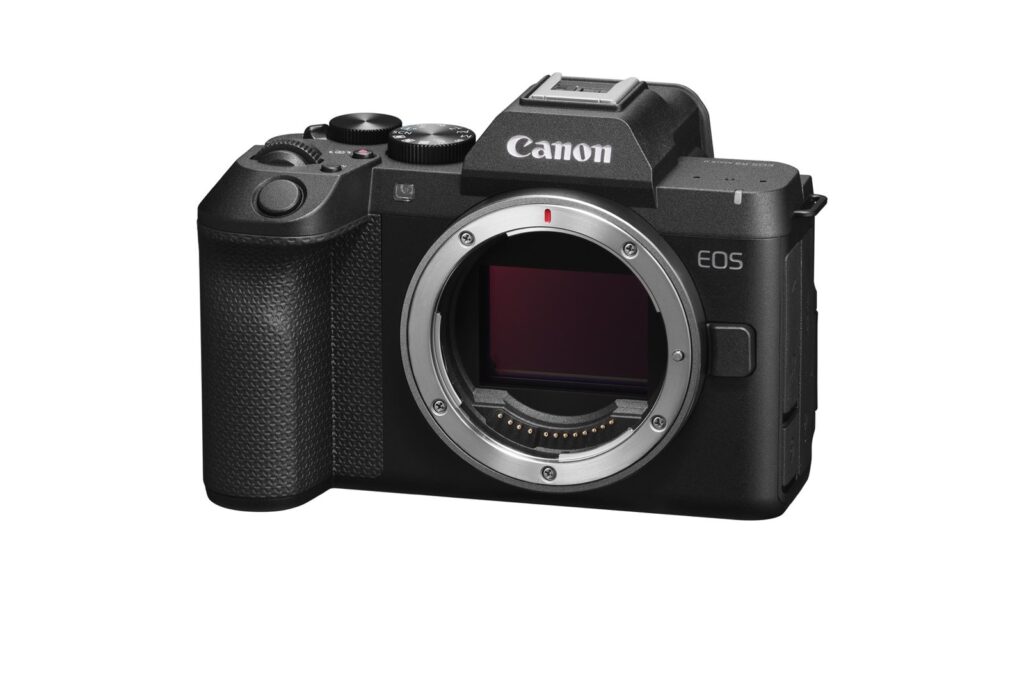
Canon announced the EOS R8 Mark II on 15 September, and for anyone shooting video the headline isn’t the sensor — that’s still the 24.2-megapixel full-frame chip from the first R8 — it’s the 546 grams. This is the lightest EOS body Canon has ever put in-body stabilisation into.
What actually changes
The original R8 was great on a gimbal and much less so handheld. The 5-axis stabiliser closes that gap: Canon claims up to 7.5 stops at the centre of the frame and 7 at the edges when coordinated with compatible RF glass. Lab numbers, as always, but the difference between “no IBIS” and “IBIS” on a half-kilo body shows up on your first handheld walking shot.
The video side is what we expected, and then some: uncropped 4K up to 60p, oversampled from 6K, and uncropped Full HD up to 180p. Ten-bit 4:2:2 in the XF-HEVC S and XF-AVC S codecs, Canon Log 3 with a base ISO of 800, plus HLG and PQ. At 4K60 you’re looking at roughly 225 Mbps in HEVC and 250 Mbps in XF-AVC — the latter needs at least a V60 SD card, so check before you empty the drawer of old media.
Where Canon cut
Worth saying plainly, because it’s why this isn’t an A-camera. No internal RAW, no 4K120, no open gate. A single SD slot. And above all micro HDMI type D, which on set is the connector that pops out at the worst possible moment: if you’re hanging a monitor off it, budget for a proper clamp on the cage.
Record limits, on the other hand, are generous: six hours below 100 fps, two hours above. The real bottleneck is the battery, around 40 minutes of 4K60 at 23°C. You shoot the R8 Mark II with three batteries in your pocket, not one.
Our take: buy this one, don’t rent it
We’re saying this as a rental house, against our own interest: at 1,879 euro body-only (1,899 dollars in the US, 2,099 as a kit with the RF 24-50) you buy an R8 Mark II and pay it off in a year of work. Renting it makes no sense, and we won’t be stocking it. What does change the maths is when this body becomes the second camera next to a proper cine one.
The typical job we see in Abruzzo: a documentary or a commercial on a tight budget, A-camera rented, your own light body as B/C. If the A-cam is a Canon EOS C70, you’re already inside the same Canon Log 3 and matching in post takes half an hour instead of half a day — that’s the concrete payoff of staying in one family. If you’re a Sony shop, the FX3 is still the compact body we rent most; it shares the R8 Mark II’s philosophy but not its files, and mixing the two on a two-camera doc means budgeting an extra colour pass.
The other natural home is the gimbal. Just under half a kilo with a 24-50 on it sits beautifully on a DJI RS 3 Mini, and with IBIS on, the micro-jitter of your footsteps disappears without cranking the in-camera electronic stabilisation, which crops. If you need to build it into a bigger package, the rest of our inventory is here.
When it ships
Deliveries from late October 2026 — the stated date in Japan is the 29th. Alongside the body Canon is launching the EG-E2 extension grip at 99.99 dollars and the Speedlite EL-5 Ver.2 at 379. If you’re shooting video with heavier RF glass, that grip isn’t an accessory: it’s the part that makes the body holdable for more than two takes in a row.
Official source: the Canon U.S.A. press release of 15 September 2026. Verification and first hands-on at CineD.
A wide range of equipment in our catalogue, on-set delivery included across Abruzzo.