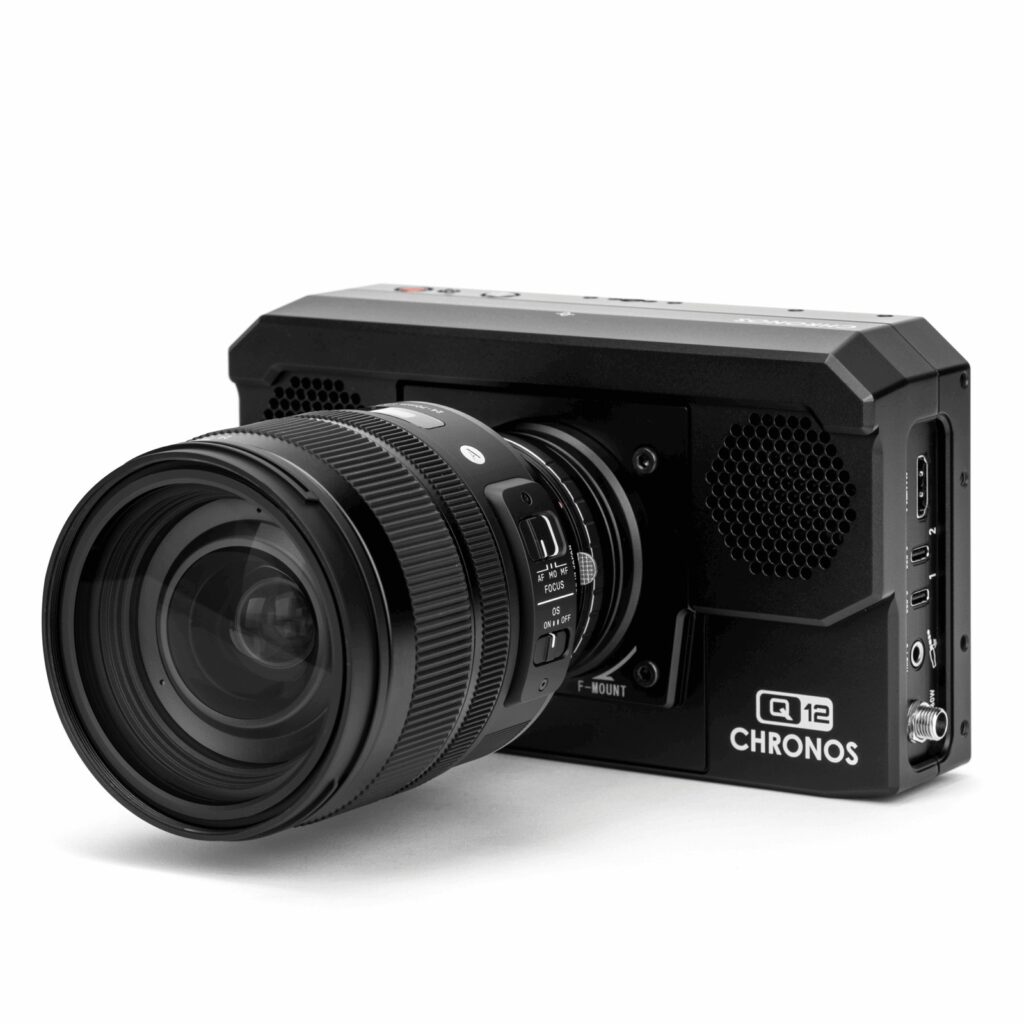
On September 21st Kron Technologies introduced the Chronos Q12, a high-speed camera that hits 5,148 frames per second at Full HD and 2,313 fps at its native 2560×2016 resolution. It costs $19,995 with a 64GB buffer, $21,995 with 128GB, and it is shipping now. Put like that it sounds like news for a ballistics lab. It isn’t: it matters to anyone shooting a food commercial, an industrial or a music video where something splashes, shatters or blows up.
What’s inside
- 23.04 x 18.14 mm APS-C CMOS sensor with a global shutter and 9-micron pixels
- 2,313 fps at 2560×2016, 5,148 fps at 1920×1080, 7,471 fps at 1536×864, up to 29,515 fps once you cut resolution hard
- Claimed dynamic range of 11.26 stops in 12-bit, ISO 80-640
- CinemaDNG RAW, TIFF, H.264 and H.265, with a 1TB internal NVMe SSD
- C, E, F, EF, MFT and PL mounts, all of them passive
- 1.32 kg without a lens, 188 x 111 x 53 mm, 5-inch 1,000-nit touchscreen
- External 12-24V, 60W power: there is no internal battery
The two numbers that matter on set
The first one is duration. The Q12 records into RAM and then dumps to the SSD: 64GB gives you roughly 5.7 seconds at full resolution, 128GB takes you to 11.5. This is not a camera you roll on and review afterwards – it is a camera where you wait for the moment and fire the trigger. Anyone who hasn’t worked this way finds out on day one, when they realise the bottle has to be smashed four times because the first three the buffer fired too early.
The second number only shows up in the official table: those 2,313 fps at native resolution are 8-bit. In 10-bit you drop to 1,900 fps, in 12-bit to 975. If somebody sells you “2,300 frames per second in 12-bit RAW”, this is exactly where they are cheating. And for commercial slow motion, where the file goes straight into grading anyway, the gap between 8 and 12 bit on a backlit liquid is not a detail.
Light is the real cost
With ISO 80-640 and a shutter that at 5,000 fps lets through 1/5000th of a second at most, every frame sees very little light. The budget for a high-speed day isn’t set by the camera, it’s set by the lighting package. On the floor, for a food table at 2,000-3,000 fps, you start from a couple of 600W heads like the Aputure LS 600x Pro and you usually end up adding a Nanlite Forza 720 punching in on the subject. Leave the heavy modifiers at home: diffusion that eats two stops is something you pay for in full at those speeds.
Buy it or book it by the day
Twenty grand is genuinely cheap for this category – serious high-speed bodies sit an order of magnitude higher. But for an Italian production the question isn’t the price list, it’s the calendar. In our view there is only one thing to ask: how many super slow motion days do you actually shoot in a year? If it’s three or four, a camera that can’t even work as a B-cam the rest of the time – 5.7 seconds of buffer and no on-board battery rule that out – is capital sitting still.
One more thing that hits the budget and isn’t in the spec sheet: every mount is passive. No iris control from the camera. That means PL glass, or stills lenses with a manual ring, and an assistant who sets the aperture by hand and leaves it there. If you come from a mirrorless set with stabilised RF or E lenses and electronic apertures, redo your numbers on the lens package, not just the body.
Where we stand
The Q12 isn’t in our inventory right now: we’re watching it, and if a production asks for it on a specific job we’ll source it. What we can say already is that if you’re prepping a high-speed day in Abruzzo, the hard part won’t be the camera body – that can be found – but having enough continuous light, a dry run for the triggers, and somebody who knows what to do when the buffer fires a second too early.
Full specs are on the official Kron Technologies page, and the announcement was covered by Newsshooter.
A wide range of equipment in our catalogue, on-set delivery included across Abruzzo.