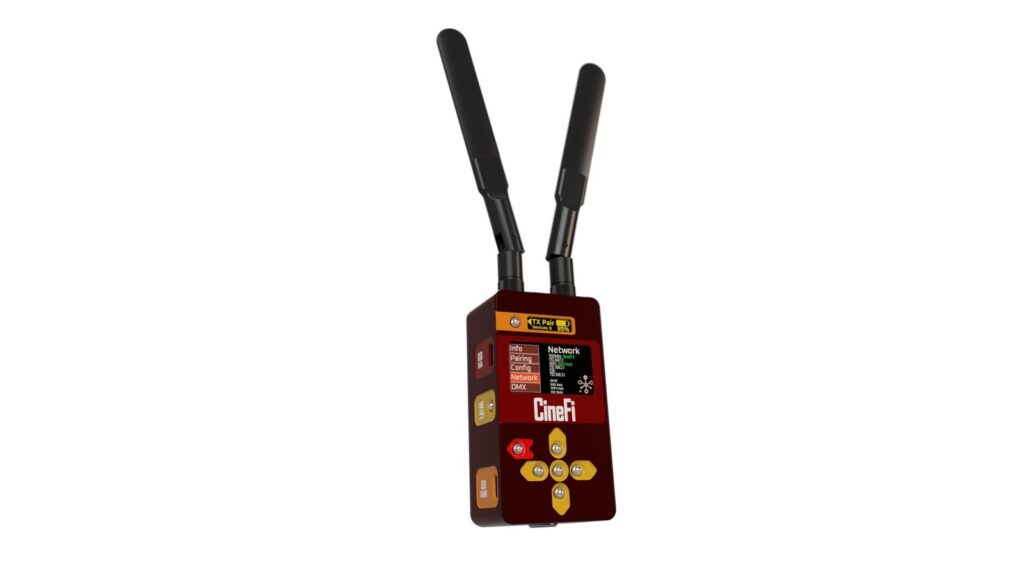
On 3 October CineFi Wireless introduced the Fox Box, a lighting control transmitter that packs DMX, Ethernet, Wi-Fi and USB into one unit and sends it all over 900 MHz radio instead of 2.4 GHz. The brand isn’t well known over here, but the person behind it is: Adam Knapp, former Director of R&D at Ratpac Controls, the engineer behind AKS and Cintenna, two systems that have been on American sets for years.
What it actually does
This isn’t just another wireless DMX box. According to CineFi, the Fox Box runs a proper bidirectional IP layer over the radio, rather than the usual point-to-point link that pushes DMX universes one way. The same network carries DMX512, Art-Net and sACN, and the fixtures can talk back.
- 900 MHz radio: less crowded than 2.4 GHz, where a set already juggles Wi-Fi, wireless video, follow focus and the whole crew’s phones.
- Four operating modes: base (transmitter), client (receiver on the fixture), relay to extend coverage, and a mesh mode still in development.
- Built-in Wi-Fi for control from an iPad or laptop with apps such as Blackout or Luminair.
- USB expansion ports for GPS, spectrum analysis and control surfaces.
- Internal battery rated for up to 12 hours.
- Real-time diagnostics: link quality, per-interface traffic and a graphical network map in the browser.
The Fox Box will be joined by the Foxtail endpoints (USB, Ethernet and DMX), plus FoxChip, an OEM platform for manufacturers who want CineFi’s radio built straight into their fixtures.
Price and release
This is where the numbers run out. CineFi talks about a release towards the end of 2026, with no price. The official page says nothing about certifications or regional versions either.
The 900 MHz question in Italy
For anyone shooting here, this is the part that matters most. In the US the 902-928 MHz band is open to this kind of device; in Europe it isn’t, at least not in the same way: the bands around 900 MHz are regulated differently and come with their own limits. Until CineFi announces a CE-marked version on European frequencies, the Fox Box is something to watch for an Italian set, not something to buy. That’s not red tape for its own sake: a device operating outside the permitted band can’t be used legally on set in Europe.
Why we’re still paying attention
We know the wireless DMX headache first-hand: in locations with thick stone walls, like the hill towns and churches where a lot of Abruzzo shoots happen, 2.4 GHz drops out from one room to the next. A lower frequency gets through obstacles better, and that’s exactly what CineFi is promising. The networking idea is the other appeal: a gaffer who can see on an iPad which fixtures are responding and how solid the link is saves real time when something quits halfway through a take.
That said, a small or mid-sized production doesn’t need to wait for the Fox Box. Our lights, from the Aputure LS 600x Pro to the Nanlite Forza 720 and the more compact Aputure LS 300X, can already be run from an app or a desk with the systems on the market today. When a shoot needs lots of fixtures controlled from one place, talk to us early: control gets planned alongside the lighting plot, not on the shoot day.
If CineFi does bring out a European version, we’ll test it as soon as we can. In the meantime, the full lighting package is under equipment.
Sources
A wide range of equipment in our catalogue, on-set delivery included across Abruzzo.