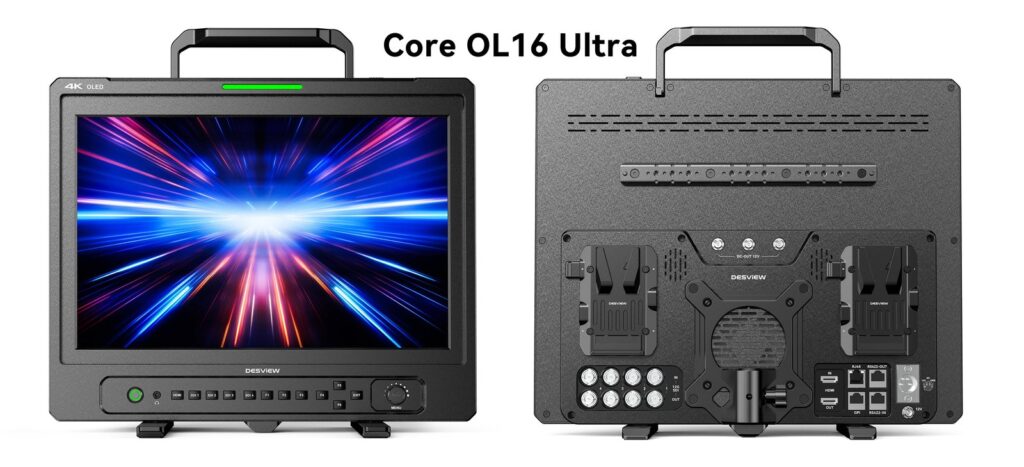
Desview has put its Core series on sale: three production monitors with AMOLED panels, four-way split screen and prices starting at $1,299. The announcement came from the IBC 2026 floor in Amsterdam, but all three models can already be ordered from the manufacturer’s site — which is far from a given, considering how much of what we saw at the show this week will only ship in 2027.
The three models
- Core OL14 Pro — 14-inch AMOLED, 1920×1080, three 3G-SDI inputs and two HDMI, single V-mount. $1,299.
- Core OL16 Max — 16-inch AMOLED, 3840×2400, four 3G-SDI with loop out plus HDMI 2.0 in and out at 4K60, dual V-mount. $1,999.
- Core OL16 Ultra 12G — same body and same panel as the Max, but with four 12G-SDI ports (they also take 8K over quad-link in Square Division) and an SFP+ cage for fibre, carrying uncompressed 4K 60p up to around ten kilometres. $2,999.
All three claim 1.07 billion colours, 100% DCI-P3 coverage, a 100,000:1 contrast ratio and 400 nits sustained with 1,200-nit peaks. Power is DC 12-26V over three-pin XLR or a locking barrel jack, and there are three 12V DC outputs on the back: your wireless receiver and accessories plug in there, so you don’t need to carry another battery.
OLED at video village: what actually changes
The point isn’t resolution, it’s black. On a backlit LCD the shadows of a night scene smear into a bluish grey, and when the director or the client looks at the monitor they see something different from what will come out of the grade. An AMOLED with a claimed 100,000:1 contrast ratio simply switches the pixel off: the low end stays readable without anyone cranking the monitor’s brightness and throwing off the whole exposure. On set, that kills half the arguments under the tent.
Watch the 400 nits sustained, though: that’s the honest figure for an OLED panel, and the 1,200 is a peak figure over part of the image. In an open field at midday you’ll need the tent or the magnetic sun hood that comes in the box. If you want a monitor to use in direct sun with no shade, look elsewhere: this is a director’s monitor, not a camera-top display.
Four sources, four LUTs
The feature we think will get used most is the four-way split with an independent LUT per source. On a multicam that means A-cam on a Sony BURANO, B-cam on a Sony FX6 and two secondary feeds on the same screen, each with its own look applied. Until now you needed two monitors, or a switcher in between.
The toolset is all there: waveform, vectorscope, histogram, false colour, focus peaking, zebra, picture-in-picture scopes, anamorphic de-squeeze at 1.33x, 1.6x, 2x and custom, plus 3D LUTs you can calibrate with Calman and ColourSpace. Round the back, alongside the XLR power input, there are RJ45, GPI and RS422 — broadcast plumbing you didn’t get on a three-thousand-dollar monitor.
Our take
Two years ago a director’s OLED with four SDI inputs sat above eight thousand euro and you only saw it on big sets. Desview doesn’t carry the name Flanders or SmallHD, and European support is worth checking, but at $2,999 for the 12G model the maths changes: this becomes a monitor a mid-size production can afford to have at video village.
That said, a video village monitor works a handful of days a year. If you shoot two commercials and a short film a season, buying it means tying up capital and eating the depreciation on a product that will have a replacement in eighteen months: it’s exactly the kind of piece you’re better off renting for the days you actually need it. We quote it alongside the Teradek Bolt 6 750, the cleanest way to get a signal to it without cables across the set, and leave the Atomos Ninja V on the camera for the operator. The rest of the list is on the equipment page.
Official source: Desview — Core OL16 Ultra 12G. Verification: CineD.
A wide range of equipment in our catalogue, on-set delivery included across Abruzzo.