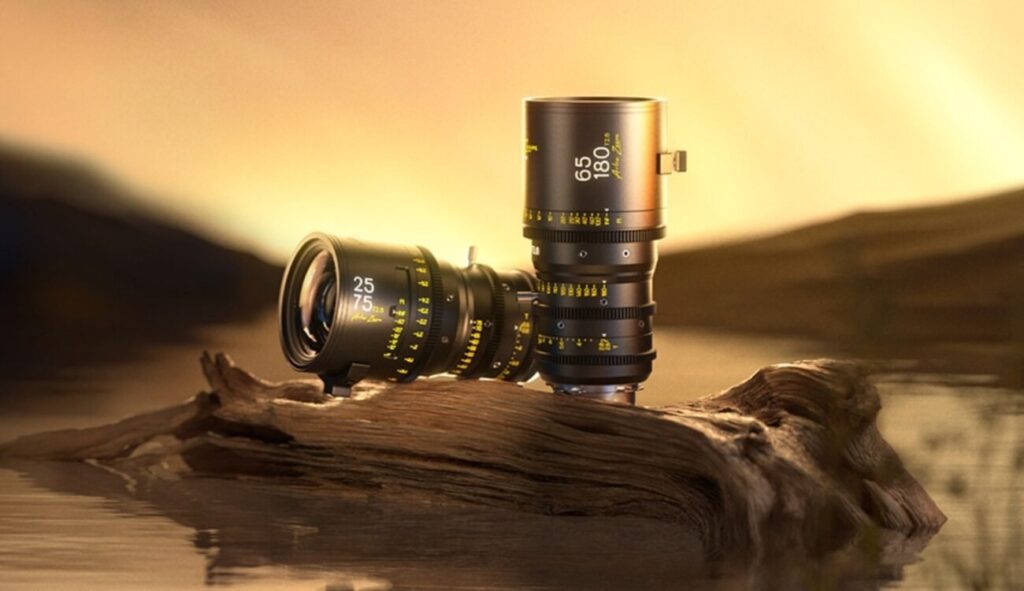
On 8 September, DZOFILM announced the first two zooms in its Arles family: a 25-75mm and a 65-180mm, both at a constant T2.6 and both covering full frame. List price is $2,899 each, or $5,199 for the two-lens kit with hard case. This is not a teaser — they are already on order and shipping starts this month.
The numbers, plainly
- 25-75mm T2.6 — 3x zoom, 22 elements in 8 groups (7 ED, 5 HRI), 0.51 m close focus from the sensor plane, 178.1 mm long in PL, around 1,767 g.
- 65-180mm T2.6 — 2.8x zoom, 20 elements in 8 groups (7 ED, 2 HRI), 0.89 m close focus, 190.85 mm in PL, around 1,782 g.
- 43.5 mm image circle, 16-blade iris, stopping down to T22, 95 mm front diameter on both, 270-degree focus rotation, 0.8 mod gearing.
- PL mount as standard, with an EF conversion kit at $99.
Why two, not one
The clever part is the overlap: the first ends at 75mm, the second starts at 65mm. With both in the case there is no focal length gap, ever. Anyone shooting two cameras gets it immediately — put the 25-75 on the A cam and the 65-180 on the B cam and you have covered moderate wide to long tele without a single lens change all day.
DZOFILM also kept the front diameter and gear positions identical to the eleven Arles primes. On set that is worth more than half a spec sheet: matte box and motors stay where they are, and a lens swap becomes a thirty-second job instead of three minutes with the focus puller rebuilding everything. Under 1.8 kg each, they also work on a proper gimbal, which full-frame cine zooms usually do not.
The comparison that matters
A constant T2.6 parfocal full-frame zoom at $2,899 is a price point that did not exist two years ago. A Fujinon Premista or an Angénieux Optimo with comparable coverage sits in a bracket ten times higher. Of course it is not the same glass and nobody claims it is: what you buy here is the convenience of a zoom, accepting a stop and a half less than a set of T1.4 primes, and a rendering that needs judging on set rather than in a brochure. In our view the right home for these two is the B camera, documentary work, behind-the-scenes, any shoot where you cannot stop everything to change a focal length.
What it means for producing in Italy
The real question is not “what do they cost” but “how many shooting days to pay them off”. A $5,199 set, with VAT and duty, lands close to 6,000 euro in Italy. At a realistic rental rate for a cine zoom set, that is twenty to twenty-five actual working days before you break even. If you shoot two commercials a year, buying is an accounting mistake: they sit in a cupboard losing value while the next version ships.
Our advice is the same as always and it applies here too: rent until you are forced to buy. If you need a lens set for a three-day short shot between L’Aquila and the coast, renting costs a fraction and leaves you free to change your mind about the look two weeks before the shoot.
Which bodies make sense
Full frame and PL mean serious bodies. In our inventory they pair with the Sony BURANO with a PL adapter, the Blackmagic URSA Cine 12K and the Sony FX9 for documentary, where a parfocal T2.6 zoom saves your day when the subject moves and you do not. Everything else we keep in house is on our equipment page.
They are on our list for a test. If you need them for a production in Abruzzo before they land, get in touch — until then, for the same kind of work, primes remain the safer choice.
Source: DZOFILM Store. Verification and specs: CineD.
A wide range of equipment in our catalogue, on-set delivery included across Abruzzo.