Anamorphics are the piece everyone wants to try and almost nobody buys. In our inventory the DZOFilm Pavo 2x set goes out mostly for music videos, commercials and short films: productions with a clear visual idea and three shooting days to pull it off. After sending them out on plenty of sets around Abruzzo, here is when we think they make sense and when they don’t.
What they are, briefly
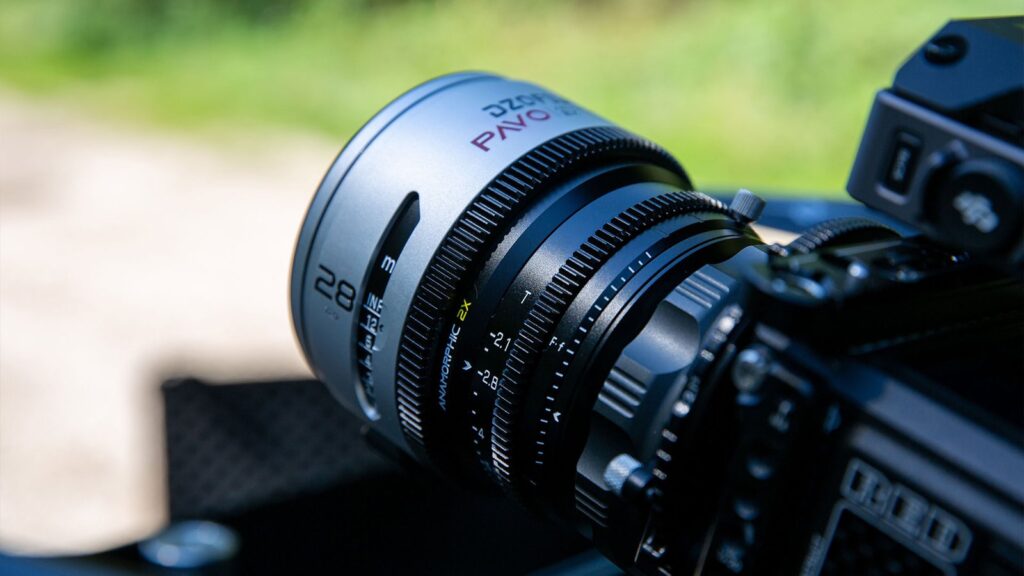
These are primes with a true 2x squeeze — no adapter, no 1.33x — covering Super35 and delivering a native 2.39:1 frame. Our set runs from 28 to 100 mm: 28, 32, 40, 55 and 75 mm at T2.1, with the 100 mm at T2.4. Sixteen-blade iris (fourteen on the 28 mm), PL mount with an EF bayonet included, and DZOFilm builds them in two coatings, blue or neutral flare: if you need one specific flavour, tell us when you book.
The real reason they travel so much isn’t on the spec sheet: they weigh between 1.2 and 1.6 kg with a 95 mm front. A genuine anamorphic that sits on a gimbal without starting an argument with the grip department is rare, and it changes how you can plan the day.
Who they actually suit
Music videos, commercials, short films — anything that lives on a visual signature. There the horizontal flare and oval bokeh do half the work, and audiences read them as “cinema” before they understand why. They also work for cine-style weddings, provided someone is pulling focus rather than one operator chasing everything.
Where we advise against them: documentary, corporate and anything run-and-gun. At T2.1 with a 2x squeeze the focus margin is thin, the set slows down, and in the edit you’ll find shots you have to throw away. If you’re shooting eight hours of interviews, take a spherical set and keep your nerves.
Three things we’ve learned on set
- Focus needs to be driven. With these lenses a wireless follow focus isn’t a luxury: we almost always send them out with a Tilta Nucleus-M, or a cMotion cPRO when there’s a dedicated focus puller.
- Super35 coverage. On a full-frame body you have to drop into S35 mode: check first what resolution and frame rate you’re left with, because it isn’t the same on every camera.
- Monitor with 2x de-squeeze on. Sounds obvious, but we’ve watched more than one crew frame by eye for half a day. Set it in camera or on the monitor before the first take.
What we pair them with
The natural match is a Super35 body: the ARRI ALEXA Mini for colour and latitude, the RED KOMODO 6K when you need something small for a gimbal or a car mount. If the day’s budget is tight, there’s also a three-lens version of the set that covers most of a dialogue scene without hauling the whole case around.
Why renting is the right call
At launch DZOFilm priced these around $5,499 per lens, over $30,000 for the six-lens set. With us the full set is 300 euro a day, 700 euro for three days, 1,000 euro a week. The maths takes thirty seconds: amortising a purchase means dozens of days a year with that specific look, and shooters working in Abruzzo rarely have them. On a single project, renting leaves you the budget for a second operator or an extra shooting day — both of which show up on screen far more than a lens set sitting in storage.
Full listings are in our kit catalogue and in the equipment section. Official specs are on the DZOFILM product page; for an independent technical overview of the series, see CineD.
A wide range of equipment in our catalogue, on-set delivery included across Abruzzo.