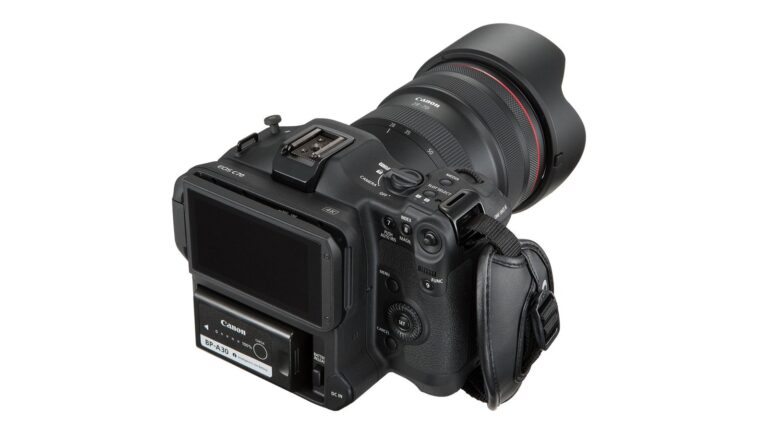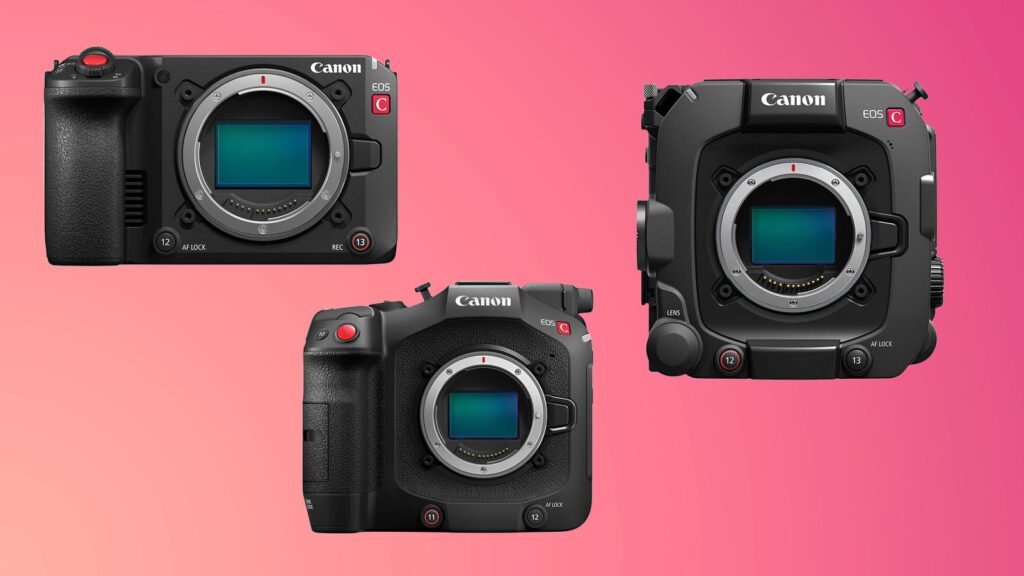
On June 25, 2026 Canon rolled out — via a Canon USA advisory picked up by the trade press, with Canon Asia’s page dating the C50 firmware to June 11 — updates for three cinema cameras: EOS C50 v1.0.4.1, EOS C80 v1.0.6.1 and EOS C400 v1.0.6.1. Let’s be clear up front: there is no new body here. It’s “just” firmware, but the substantial kind, touching remote control, streaming and reliability. And for anyone working with rented gear, as we’ll see, that’s the best possible news.
What’s new across the C50, C80 and C400
Three features land on all three bodies:
- Camera control over USB-C from an external device, laptop or controller: record start/stop, One-Shot AF, manual focus, iris, shutter and ISO.
- Automatic SRT streaming reconnection: if the link drops, the camera keeps trying to reconnect for the duration set under “SRT: Reconnection Timeout”.
- A level indicator that changes colour once the camera is level — a tiny thing on paper, genuinely handy when you’re rigging in a hurry.
The C50 gets the richest package
Canon saved the exclusive additions for the smallest of the three:
- Ease In/Ease Out option for smooth digital zoom transitions.
- View Assist can now be applied and adjusted in playback as well.
- Broadcast and multicast transmission in the CV Protocol, plus a new OpenLensIO-Equiv. Model setting.
- Recall of Look File descriptions within Custom Picture.
- Two concrete fixes: CFexpress card formatting and Digital IS metadata in Slow & Fast Motion.
Firmware 1.0.4.1 updates C50 bodies running versions 1.0.0.1 through 1.0.3.1, and the download is free from Canon’s support pages.
C80 and C400: stability first
The changelog for the two bigger sisters is shorter but no less useful: a connection issue with FTP servers has been fixed, along with general stability improvements. Less glamorous, sure — but anyone who delivers footage over FTP at wrap knows how much that matters. The full rundown is in Newsshooter’s report.
What this means for crews shooting in Italy (and Abruzzo)
USB-C camera control is the feature that wins us over most in the field. With the camera on a gimbal, on a jib or tucked into a car for a driving scene, handling start/stop, focus, iris, shutter and ISO from a laptop without touching the body means cleaner rigs and fewer dedicated accessories to haul around. For the video village a wireless link like the Teradek Bolt 6 750 is still irreplaceable, but for pure control the USB-C port now does a lot on its own.
SRT reconnection, meanwhile, feels very local to us. Anyone who has tried to run a live stream from a hilltop village in inland Abruzzo knows connectivity is never a given: with the reconnection timeout set sensibly, a network dropout no longer kills the broadcast. Paired with a Starlink kit, it makes streaming credible even from mountain locations where 4G struggles.
Finally, the usual rent-versus-buy question. Free updates like these are why Cinema EOS bodies age well: a camera bought months ago keeps gaining features. But they are also why renting pays off — the body shows up on set already running the latest version, with no firmware housekeeping on your plate. In our catalogue, the gateway into the Cinema EOS world is the Canon EOS C70, still one of the most sensible picks for documentary and branded content in our opinion.
If you have a production coming up and want to work out which body fits your budget, browse our rental equipment or drop us a line — we’re always happy to talk workflow.
A wide range of equipment in our catalogue, on-set delivery included across Abruzzo.