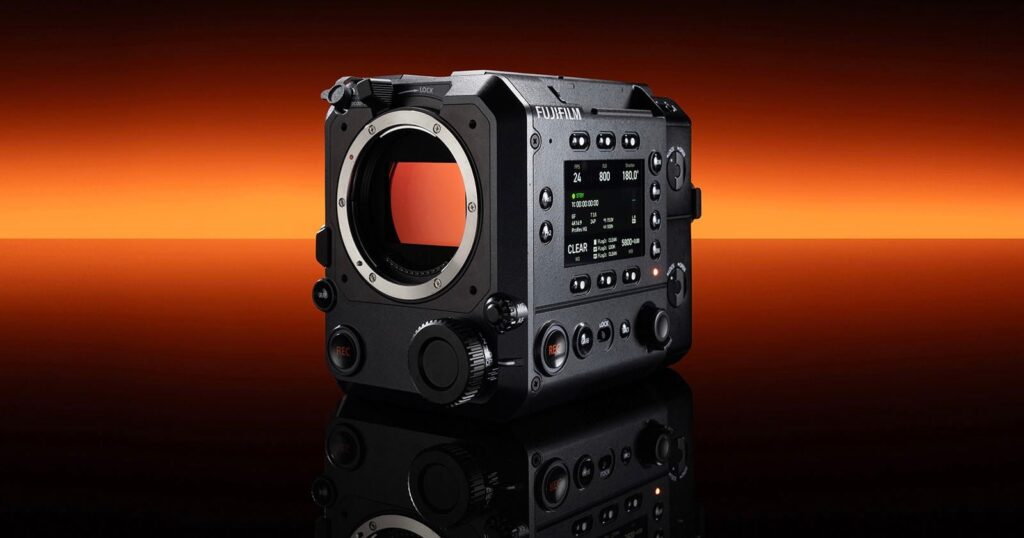
Fujifilm has released firmware 1.10 for the GFX ETERNA 55, its 102-megapixel medium-format cine camera, and alongside the update it published a roadmap that spells out exactly where this body is headed. For a rental house like us, the roadmap matters more than the changelog: it means Fujifilm is committing to this platform for the long haul, and that changes the maths when you decide whether to build a production around it.
What firmware 1.10 actually does
Let’s be honest and not oversell it: 1.10 is a stability update, not a revolution. It fixes the white-balance shift when you use the bundled PL mount adapter with Fujifilm PL lenses not yet updated for the camera, or with third-party PL glass. On set, with a rented lens set, that’s the difference between a clean day and half an hour lost re-doing the balance. It also improves menu and recording operability in certain conditions, display accuracy, timecode handling and monitor behaviour during shooting and playback. Housekeeping stuff, but it makes the camera more dependable as a rental.
The roadmap: this is the real story
Fujifilm has put in writing what’s coming. Version 1.20, expected before the end of 2026, will bring:
- in-camera MXF playback, to review clips on set without going through a recorder;
- settings backup and restore via a dedicated app;
- new anamorphic desqueeze options, including Open Gate 4K 4:3;
- latency improvements on the SDI and HDMI outputs.
Version 1.30, due from January 2027 onward, is the one that whets the appetite: automatic electronic ND that keeps iris, shutter angle and ISO constant, so you can pull the iris without changing exposure. There are also new presets for coarse VND adjustment, LANC support and remote control of Fujinon Duvo lenses from the multi-function dial. Automatic ND is the same logic found on some high-end Sony cine bodies: on paper, a serious-set feature.
Does it make sense as a rental in Abruzzo?
The GFX ETERNA 55 costs around 16,500 dollars body-only: it’s medium format, a tall sensor, a look no full frame gives you. But it’s exactly the kind of camera that, in our view, makes sense to rent rather than buy for a production in Abruzzo. You use it on a commercial, an auteur documentary, a music video where you want that breadth and depth, and for the rest of the year it would sit in a cupboard depreciating. A single shoot doesn’t justify the purchase; a targeted rental does.
On the field, bear in mind it’s a demanding body: it’s heavy, needs proper balancing, and if you work in RAW to an external recorder you’ll want to pair it with a monitor-recorder like the Atomos Ninja V. If instead you want the same large-format, high-resolution tier but with a more immediate workflow, our fleet has proven alternatives like the Sony BURANO full-frame 8K, the Blackmagic URSA Cine 12K or the ever-reliable ARRI ALEXA Mini. You’ll find everything else in our kit catalogue.
Our advice: if you have a project in mind where Fujifilm’s medium format makes the difference, call us for a test. The roadmap says the camera will keep improving firmware after firmware, and with a rental you get the best of it without the risk of buying.
Official source: Fujifilm firmware page. Further reading: PetaPixel.
A wide range of equipment in our catalogue, on-set delivery included across Abruzzo.