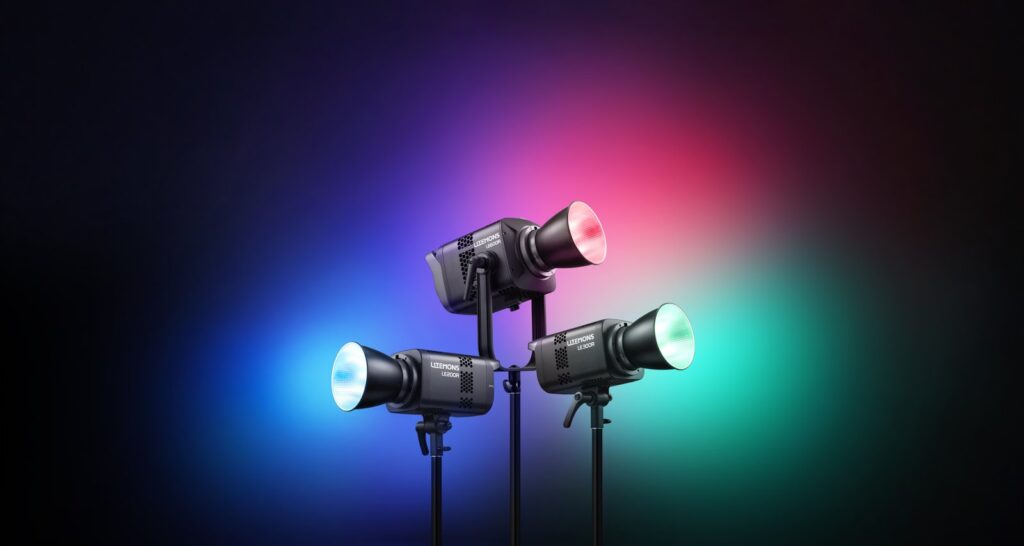
On 4 August Godox released three full-colour COB fixtures in its Litemons line: the LE200R, LE300R and LE600R, at $299, $379 and $599 in the US. This isn’t an announcement that turns a set upside down, but it’s the kind we pay attention to: when a serious RGB head drops under 400 euro, the way you fill out a lighting plan changes.
What’s inside
All three heads share the same layout: the power supply is built into the body, so there’s no ballast dangling off the stand, a Bowens mount, a 1800K to 10000K CCT range with green/magenta correction up to ±100, HSI, RGBW and GEL modes, 14 effects, a claimed CRI of 96 and TLCI of 95. Control runs through the on-board panel, the Godox app over Bluetooth up to 30 metres, or wired DMX512/RDM; app pairing is done over NFC by tapping your phone against the body.
- LE200R — 230W, 71,700 lux at 1 metre with the reflector at 5600K (7,330 lux without), 2.8 kg, $299
- LE300R — 330W, 94,400 lux at 1 metre with the reflector (10,400 lux without), $379
- LE600R — 635W, 130,000 lux at 1 metre with the reflector (18,600 lux without), 5.2 kg, $599
Cooling has four modes, including a quiet one. On paper that’s the most important line of the lot: a 600W COB roaring away during a live sound take is a problem you pay for in post, not on set.
Spec-sheet numbers vs. set numbers
A word of warning about those lux figures, because we all fall for them. 130,000 lux at one metre with the standard reflector is an honest number but not a useful one: nobody puts a source a metre from the subject in a real scene. What matters is how much light survives at three metres inside a softbox or through a diffusion frame, and there the gap to a high-end head is still there. Not so much in raw output as in colour consistency at low power, dimming precision below 10%, and fan noise when you push them.
In our view the real step forward here isn’t the RGB, it’s the built-in power supply. On a small crew that means one less cable per source, a faster build, and less hardware hanging off the stand. Anyone who’s struck a set at two in the morning knows what that’s worth.
Buy or rent
At these prices the question is fair. If you shoot two or three times a week in a studio, buying an LE300R makes sense and we won’t tell you otherwise. The maths changes when the lighting plan is for a commercial or a short film: you need three or four sources, a flagship for the key, big modifiers, stands that actually hold, and you need them for eight days a year. That’s where renting stays unbeatable, because you’re not tying up capital in gear that spends the rest of the year in a cupboard losing value.
And there’s something you only learn on the job: if a head dies at seven in the evening on the last shooting day, renting gets you a replacement, buying gets you a service centre in two weeks.
How we’d use them alongside our gear
In our inventory the key light is still a job for the Aputure LS 600x Pro or the Nanlite Forza 720, which punch through large diffusion and hold their own against daylight outdoors. The Aputure LS 300x is our workhorse for fill and backlight, the one that goes up in thirty seconds. A Litemons RGB, if you buy one, earns its place as a fourth or fifth source: a coloured practical in frame, a wash on a backdrop, the amber window just out of shot. Not as the main light on a scene that matters.
If you’re putting together a lighting plan for a production in Abruzzo, the quickest way in is to look at our kits and tell us what scene you have to shoot: we’ll write the shopping list together.
Availability
The prices announced are the US ones. European pricing and Italian distribution timing haven’t been confirmed yet, so expect a few weeks before they show up at local dealers.
Full specifications are on the official Godox product page; the announcement was also covered by CineD.
A wide range of equipment in our catalogue, on-set delivery included across Abruzzo.