Plenty of people can build a DCP these days. It is the drive that still catches small productions out: the cinema server wants media formatted as EXT3 or EXT2, and that file system simply does not exist on a Mac. For years the workaround was always the same — a borrowed Linux box, a hand-built virtual machine, or a paid third-party driver. Now there is a twenty-dollar alternative.
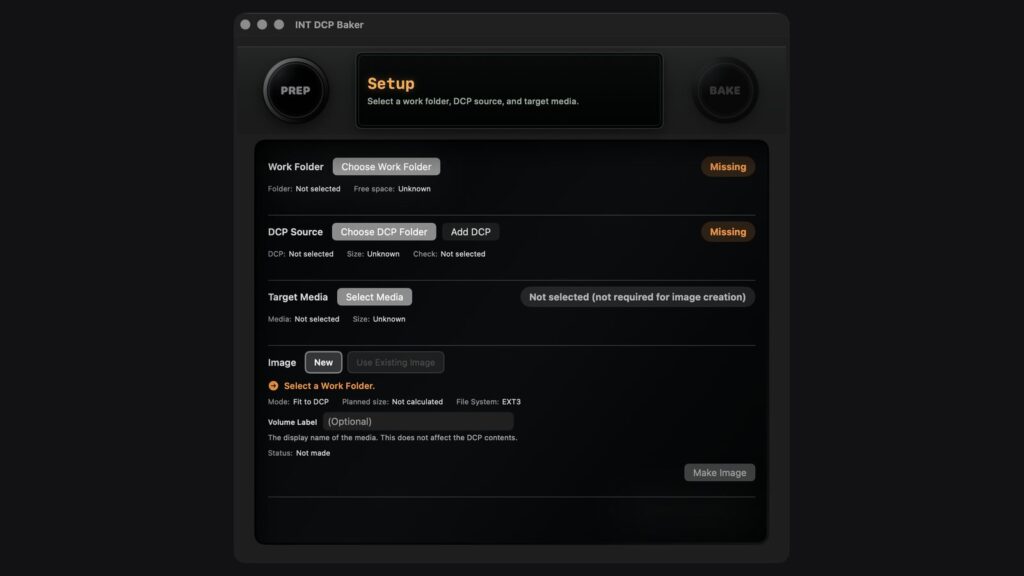
It is called INT DCP Baker, it comes from Interceptor Inc., a Japanese studio based in Meguro, and it has reached version 1.0.1. What it does is deliberately narrow, which is exactly why we like it: it does not generate the DCP — keep using DCP-o-matic or whatever your post house runs — it prepares and writes the delivery media straight from macOS.
How it works
The workflow is split into two clearly named stages. In PREP you pick the working folder, the DCP source and the target media, and the app builds a disk image with the correct partition scheme. In BAKE it writes to the physical drive and runs a readback verification, saving a Bake Report at the end.
That report, in our view, is worth more than the formatting itself: attaching it to a delivery gives you a document stating what was written and confirming that the data read back matches. Anyone who has spent an evening on the phone with a projection booth knows what we mean.
- Price: 20 dollars, one-time, with a 7-day full-feature trial
- Requirements: Apple silicon Mac and macOS 26 or later — Intel Macs are out
- Writes to USB flash drives, SSDs and external hard drives
- EXT3 and EXT2 file systems, the ones cinema servers actually ask for
- One-time online activation, then it runs offline
Under the hood it relies on the Container tool Apple open-sourced at WWDC 2025: no Docker, no kernel extensions, no virtual machine to maintain. The developer reports successful testing with Doremi DCP-2000 servers and the DCP-o-matic validator; those are internal tests rather than a certification, and that is worth saying out loud before you send a master to a screening.
Why a rental house cares
Because for the independent productions we work with here in Abruzzo, the bottleneck is almost never the shoot. A short filmed properly on an ARRI ALEXA Mini or a Blackmagic URSA Cine 12K reaches post without drama; then the festival delivery stalls on a formatting detail two days before the deadline, and someone ends up hunting for a Linux machine at eleven at night. Twenty dollars to remove that step from the list of things that can go wrong is money well spent.
The right fit, we think, is the small or mid-size production delivering a handful of DCPs a year: anyone shipping ten a month already has a proven pipeline and will not switch for this. Two practical notes from the field: buy the delivery drive new and keep it dedicated rather than recycling the stick that has been floating around set, and schedule the write with time to spare, because readback verification takes time proportional to the size of the DCP and is not instant.
If you are planning a short and need the shooting package — camera, glass, lighting, support — our ready-made rental kits cover the usual combinations. On the camera side, for a production aiming at the festival circuit, the Sony FX6 is still a core choice: the weight and the ergonomics hold up over long days on location.
The official software page is on the Interceptor Inc. site, while the technical rundown and first impressions are over on CineD.
A wide range of equipment in our catalogue, on-set delivery included across Abruzzo.