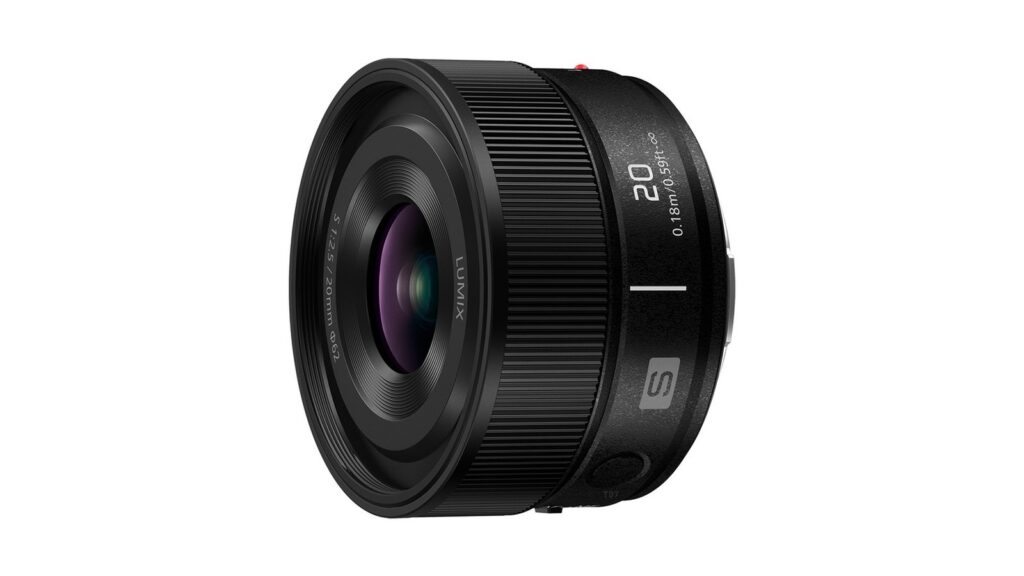
Panasonic announced the LUMIX S 20mm F2.5 (model S-S20) on 16 September: a full-frame L-mount wide angle that weighs 142 grams and is barely four centimetres long. It costs 499 euro, ships in October, black or silver. Put like that it reads as stills news, and partly it is. But the same press release carries the LUMIX firmware wave landing on 13 October, and that part is aimed squarely at people who shoot video.
The numbers
- 20mm F2.5 full frame, L-mount, three aspherical elements
- 142 grams, roughly 40.9 mm long, 62 mm filter thread
- Minimum focus distance 0.18 m
- Dust- and splash-resistant build, fluorine coating on the front element
- Silent AF and suppressed focus breathing, called out explicitly for video
- Customisable Lens Fn button and control ring
- 499.99 dollars, 499 euro, 429 pounds; shipping expected from October 2026
Why 142 grams matter
Lens weight is not a spec-sheet curiosity: it decides how much of your day goes into balancing instead of shooting. An L-mount body with this pancake in front sits comfortably inside a compact gimbal’s payload, and it balances once. Anyone who has spent twenty minutes re-trimming a DJI RS 3 Pro after a lens swap knows the feeling; on a DJI RS 3 Mini, a rig this light is precisely the use case that gimbal was built for. And for moving shots in tight interiors — houses, cellars, workshops, the places we actually end up filming in Abruzzo — 20mm at F2.5 is the focal length you reach for.
Where we stay realistic: this is not a cine lens and does not pretend to be. No long focus throw, no standard front diameter for a follow focus, no mechanical consistency with a prime set. It is an autofocus lens and should be judged as one: B-cam, behind the scenes, documentary work where you walk. When a focus puller is doing the job, cine glass still wins.
The 13 October firmware wave
Announced alongside the lens, free of charge, available from 13 October. In our view this is the more valuable half of the news, because it improves cameras already out in the field:
- LUMIX S9 v2.1: MP4 (Lite) recording at 4K 60p/50p and FHD 120p/100p/60p/50p, compatibility with LUMIX Flow 1.7.0, and a much longer list of functions assignable to the Lens Fn button (aspect ratio, E-Stabilization, Boost I.S., video image area, focus ring control, Hybrid Zoom, Crop Zoom, focus peaking, record start)
- S1RII, S1II, S1IIN and S1IIE: improved shutter responsiveness and burst shooting with an external flash, plus general operational stability
- LUMIX Lab 3.1.1: MP4 (Lite) support for the S9, LUT category filtering and downloadable LUT packs
- LUMIX Flow 1.7.0: S9 compatibility and a faster workflow
FHD 120p in MP4 Lite on the S9 is the most concrete line item: usable slow motion without dragging home files you have to transcode before you can even watch them. And a Lens Fn button that now covers nine functions means a very small camera can be driven one-handed, which is exactly how it gets used.
Our take
This is not a lens that belongs on a rental list: it costs less than two days of a full package, and anyone shooting L-mount will simply buy one. Our advice runs the other way. If the production is on LUMIX, spend the rental budget on what you should not be buying — lighting, wireless video, monitoring, support. An Atomos Ninja V in front of a small body changes more than any pancake, because it gives you an image you can actually expose to.
One reminder we repeat often: update firmware before the shoot, never on the morning of it. 13 October is a Monday. If you have an S9 working that week, update it on a day with slack in it and run a full record test before you leave. The rest of our inventory is here, and delivery to set anywhere in Abruzzo is included.
Official source: Panasonic press release. Verified and covered by Newsshooter.
A wide range of equipment in our catalogue, on-set delivery included across Abruzzo.