When a production books our Nanlite Forza 720, the question we hear most isn’t about light. It’s about power: “can I plug it into the house socket?”, “does it run on batteries?”, “do I need a generator?”. Fair enough, because in Abruzzo you often shoot where there is electricity, but the wiring belongs to a farmhouse, a mountain church or a hiking lodge. Here is what we have learned taking it on location.
The number to start from: 800 watts
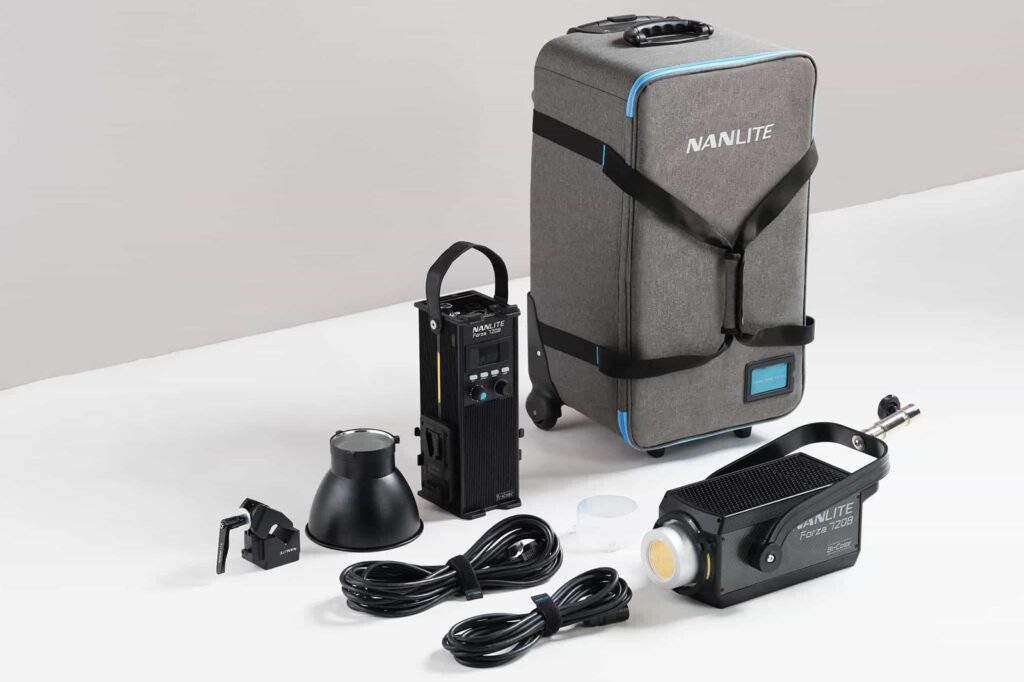
The Forza 720 is a 720W COB monolight, available as 5600K daylight or bi-color (720B). According to Nanlite, at full output it draws about 800W from the mains. It accepts 100-240V, so any Italian socket will do. It’s a two-piece system: a 4.8 kg head and a 4.2 kg ballast, joined by a cable.
In practice, one 720 on a household socket is fine. Two 720s at full power pull 1.6 kW, and on a typical 3 kW Italian home supply, with the fridge running and someone making coffee in the kitchen, you should already expect the breaker to trip. Before switching on, always ask which circuit feeds which sockets: in many old houses half the building sits on a single breaker.
On batteries: yes, but at 70%
The ballast takes two V-mount batteries, either 14.8V or 26V. Running this way, the light tops out at 70% of full output: that is a limit Nanlite states, not a fault in the unit. For a dawn exterior, a backlight in the woods or an interview far from anything, 70% of a 720 is still a lot of light.
How long does it last? It depends on battery capacity and dimmer level, so we won’t give you a precise figure: it changes on every set. Roughly, with two 190Wh batteries at full output you’re thinking in tens of minutes, not hours. The practical advice is to plan short setups on batteries and keep mains or a generator for the long blocks.
Power station or generator
When there is no socket, we rent two options.
- Power station: silent, it can sit two metres from the set without the sound recordist hating you. Our 2kWh power station handles a 720 for a real working session; the 1kW/1kWh unit will power it, but it runs close to its output limit.
- Generator: the Honda EU20i 2 kW is an inverter unit, so it delivers clean power that suits LEDs. Keep it well away from the set on a long extension though: even the quietest one shows up in location sound.
In our view, for a short film or a one-day commercial the power station almost always wins: no fuel to carry, no noise, no fumes to manage in an enclosed courtyard. The generator earns its place on multi-day exterior shoots, where recharging stations becomes the problem.
Three things that always matter
- The head-to-ballast cable decides where the ballast goes: if the light is high on a stand, hang the ballast on the stand instead of leaving it on the ground pulling.
- The fan: the 720 has a quiet mode, but at full power in a small room you’ll still hear it. If you need total silence, a 720 at 70% beats a smaller light pushed to the max.
- Bowens mount: the softboxes, lanterns and lenses you already own will fit. It can be controlled by app over Bluetooth or via DMX, handy when the light sits outside a first-floor window.
Why rent it here
Buying a 720 makes sense if you light every week. If you shoot a few projects a year in Abruzzo, renting it together with batteries, a power station or a generator means arriving on set with a package that has already been tested together, instead of finding out at six in the morning that the battery has the wrong connector. All our gear is on this page, and ready-made packages are among our kits.
Full specifications are on the official Nanlite product page; the 2022 launch is well covered by Newsshooter.
A wide range of equipment in our catalogue, on-set delivery included across Abruzzo.