When a production asks us for “the sun coming through the window”, this is what usually ends up in the van. The Nanlux Evoke 1200 is the fixture that stopped us pulling HMIs out for half our jobs: same power bracket, one cable, no ballast to warm up twenty minutes early. It isn’t perfect, and its two genuine flaws are below. But it’s one of the busiest lights in our inventory.
What it actually is, no marketing
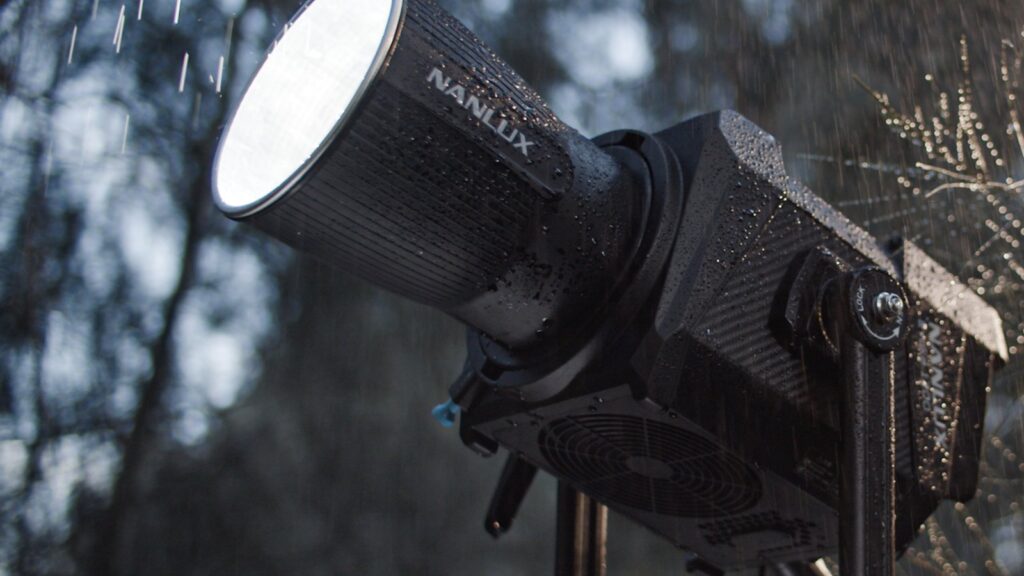
It’s a fixed daylight COB, 1200 W at 5600 K, with CRI 96 and TLCI around 97-98: clean colour, no green cast to chase in the grade. Open face, with the 120-degree beam, it puts out roughly 40,400 lux at one metre; with the supplied 45-degree reflector it climbs to around 144,000 lux at one metre. Nanlux compares it to a 1.8 kW PAR or a 2.5 kW HMI Fresnel, and on set that bracket is about right, all from a normal 230 V wall socket.
The head weighs 6.9 kg, the external power supply another 10.5 kg. It’s IP54 rated: light rain and dust won’t stop it, and on open Abruzzo locations that’s no small thing. Control is via the onboard display, DMX/RDM, Bluetooth, 2.4 GHz and LumenRadio.
Who it’s really for
In our view the 1200 shines in three situations. First, interiors with windows: park it outside, punch through a diffusion frame, and you have a stable fake sun all day instead of chasing the real one as it moves. Second, night exteriors, where you need a hard source that reaches ten or fifteen metres rather than a soft panel. Third, interviews and documentary work with a bounced hard key, where the high CRI saves your skin tones.
Why the fixed daylight version rather than the bi-colour? Because it rents for less and on the vast majority of sets 5600 K is exactly what you need. Bi-colour only makes sense when you have to blend with practical tungsten in frame.
Three field notes that save you half a day
- The fan is loud. Around 72 dB at one metre, and it isn’t adjustable: on or off, and in “off” output drops to 10%. For sync dialogue keep it away from the mic and, if you can, turn the fan side away from the actor.
- The real weight is the power supply. The 6.9 kg head goes on a normal stand, but the 10.5 kg supply needs somewhere sensible: put it on the ground, not halfway up the column, and always sandbag. The full package runs to about 22 kg.
- Without the reflector it sprays. At 120 degrees the light goes everywhere and dirties your set: if you need throw, the 45-degree reflector isn’t an accessory, it’s mandatory. If you want soft, diffuse it across a big frame rather than strapping diffusion to the head, which runs hot.
What we pair it with
The combination we suggest most often is the Evoke 1200 plus a 3×3 m butterfly with the right fabrics: it’s the quickest way to turn a hard source into a big, controllable window. If you work with bounce and negative fill, the Lightbridge CRLS C-Move gets you looks ordinary diffusion won’t. For locations with no power we send it out with the Honda EU20i generator: at full output the 1200 pulls roughly 1.3 kW from the wall, so it fits, but treat it as the only serious load on that generator. When you need more, you step up to the Nanlux Evoke 2400B.
Why rent it instead of buying
A new Evoke 1200 with case, reflector and cable runs into several thousand euros, and that only pencils out if you’re lighting every month. For the kind of productions we serve here, a commercial, two days of a short, a music video, a seasonal documentary, the maths says something else: take the right light for that project, already tested, and don’t keep a fixture in storage that loses value and still needs servicing.
Rates and availability are on the Nanlux Evoke 1200 page; delivery and pickup on set are included across Abruzzo, and if you’d rather start from a package that already makes sense, have a look at our kits. One practical tip: it’s one of the most requested lights we own, so book it a few days ahead.
Full specifications are on the official Nanlux Evoke 1200 series page; for measured field numbers the Newsshooter review is still the useful one.
A wide range of equipment in our catalogue, on-set delivery included across Abruzzo.