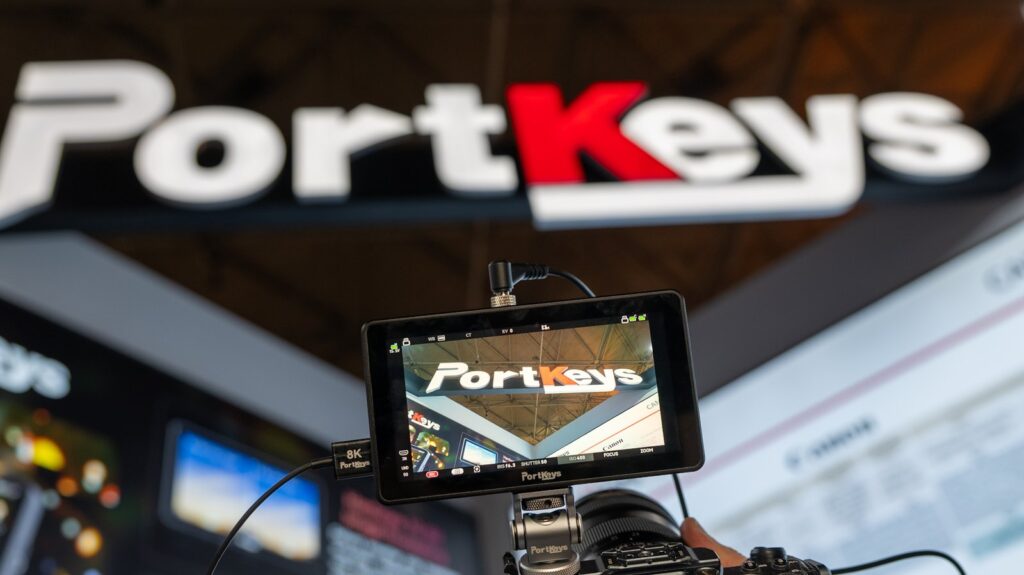
PortKeys announced the LH5P III at IBC 2026 today: the third generation of its 5.7-inch on-camera monitor with camera control built in. Price is $399, available now. The headline number isn’t the brightness — it’s that at this price you get a monitor that drives the camera body, and that from this generation on can also drive the other PortKeys monitors on the crew.
What’s inside
- 5.7″ panel, 2160 x 1080, 2,200 nits peak
- 10-bit hardware processing (8+2 FRC), 104% DCI-P3 gamut, 1400:1 contrast
- Per-unit Calman calibration, with a claimed Delta E below 1.1 in Rec.709 and a QR verification code on the unit
- 235 grams, 28.4 mm thick, aluminium alloy body: 18% lighter than the model it replaces
- HDMI in and HDMI loop-through out, input up to 4K DCI 60p, 3.5 mm audio out
- 13W draw, built-in Sony NP-F plate, alternative power over USB-C 3.0 PD
The operating system is PortKeys’ own MOVNORM, rebuilt for this version. On board you get 3D LUTs on a 17x17x17 grid with up to twenty custom LUTs, RGB and luma waveforms, histogram, zebra, peaking, ARRI-style false colour, anamorphic de-squeeze from 0.25x to 4.0x and their Log Stops exposure tool. Four assignable buttons sit on the top edge, and the touchscreen can be physically locked — a small thing that saves you half a day of swearing on set when you brush it with your shoulder.
Camera control, and the real news
The monitor drives the camera over USB-C or Wi-Fi: iris, ISO, shutter, focus, zoom, record. The official supported-body list covers Sony (FX3, FX30, FX6, FX5, A1, A7S III, A7 IV and others), Canon (C50, C80, C400, EOS R5 II, R6 and derivatives), Panasonic (S1, S1 II, S5 II, BGH1, BS1H), Nikon (ZR, Z8, Z9) and the Blackmagic Pocket 4K and 6K. Always check your exact body on the manufacturer’s page: compatibility lists on these monitors move with every firmware.
The new thing in this third generation is what PortKeys calls one-to-many collaboration: one LH5P III acts as the active controller for four more passive PortKeys monitors (LS7P, BM7II DS, LH7P, BM5IV WR and other LH5P IIIs), out to 50 metres. Each monitor stays paired to its own camera and controls it; the lead unit keeps them in line. On a multicamera shoot that’s genuinely useful: you match exposure across all the bodies from one position instead of sending an assistant round to turn dials one at a time.
Our take
The panel isn’t the interesting part: 2,200 nits is good but not the top of the class, and a bigger field monitor is still easier to read from two metres away. The point is where you put it. On a DJI RS 3 Pro with a Sony FX3 on top, the camera body is physically out of reach once it’s balanced: being able to change ISO and aperture from the monitor without pulling anything apart is exactly the problem this solves. Same story on a shoulder-mounted FX6 with an operator who won’t let go of the frame.
One honest note on price: $399 is the US list. In Italy, between exchange rate, VAT and distribution, the shelf price will be higher — check with the dealer before you do the maths. And if you need it for a single shoot, we’ve already done that maths for you: a field monitor is the classic piece you use three times a year and leave in the cupboard the rest of the time. That’s exactly why we keep ours in house alongside the wireless systems, and our cameras go out with monitors, plates and cables already matched. The rest of the rental fleet is here.
Sources: the official PortKeys LH5P III page and CineD.
A wide range of equipment in our catalogue, on-set delivery included across Abruzzo.