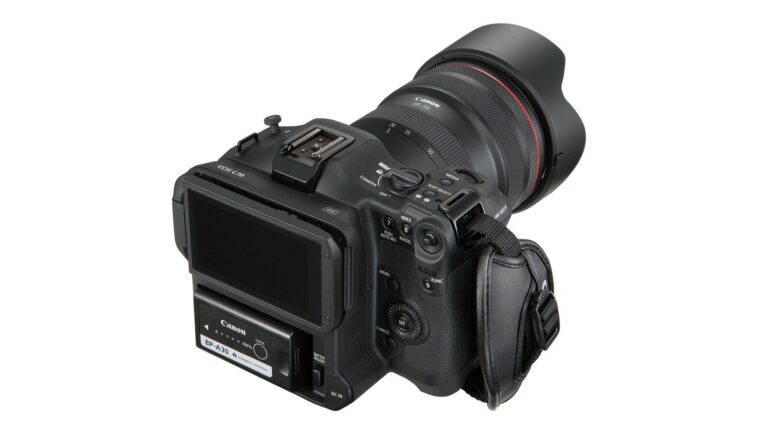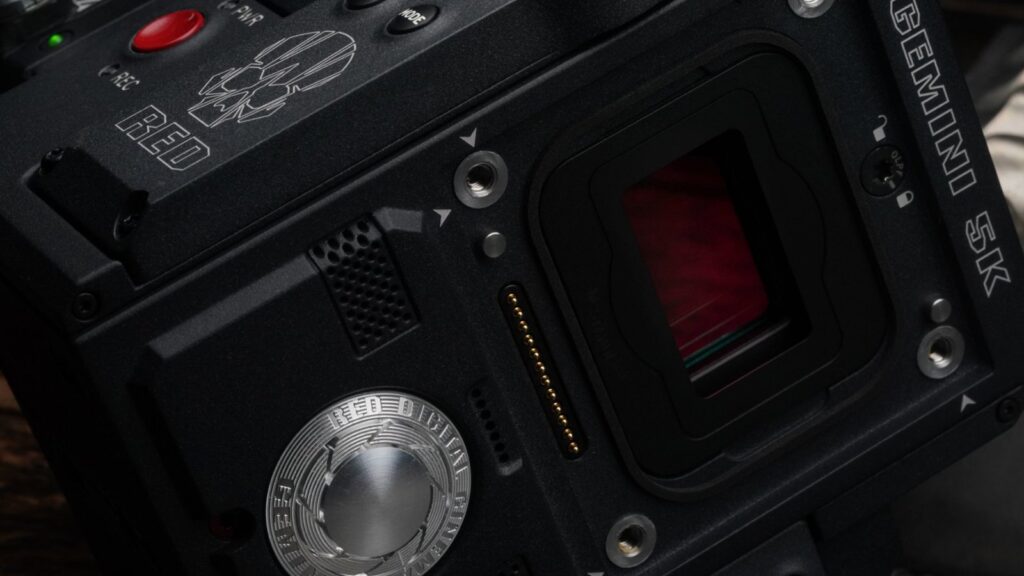
When a production asks us for “a RED”, our next question is always the same: to shoot what? We keep two of them in stock, the RED GEMINI 5K S35 and the RED KOMODO 6K. Same brand, same REDCODE RAW, same colour family. On set, though, they solve opposite problems, and picking one at random means paying for the wrong camera.
The numbers, side by side
Everything below comes from RED’s official spec sheets: DSMC2 GEMINI and KOMODO 6K.
- Sensor: GEMINI Super 35, 30.72 × 18 mm, 15.4 megapixels. KOMODO Super 35, 27.03 × 14.26 mm, 19.9 megapixels.
- Shutter: the GEMINI is a conventional CMOS; the KOMODO has a global shutter.
- Sensitivity: the GEMINI has two native modes, Standard at ISO 800 and Low Light at ISO 3200. The KOMODO has just one.
- Dynamic range: 16.5+ stops claimed for the GEMINI, 16+ for the KOMODO.
- Slow motion: GEMINI does 96 fps at full 5K, 120 in 4K, 240 in 2K. KOMODO does 40 fps at 6K 17:9, 60 in 4K, 120 in 2K.
- Media: GEMINI records to RED MINI-MAG at up to 300 MB/s; KOMODO to CFast 2.0 at up to 280 MB/s.
- Weight: KOMODO is 950 grams without card and body cap; the GEMINI’s DSMC2 brain is around one and a half kilos before you add anything.
When we pick the GEMINI
When we don’t get to decide the light. Real night exteriors, interiors lit only by practicals, concerts, churches and hill towns where hauling a generator is a project in itself: Low Light mode at ISO 3200 is a different readout of the sensor, not gain pushed in post, and the shadows stay clean where other bodies turn to mush. The GEMINI is also the answer when slow motion matters: 96 fps at full resolution and 120 in 4K cover almost anything a music video or a commercial asks for.
In our view it’s the A-camera for a short or a music video shot with a small lighting package. It takes longer to prep, because the DSMC2 needs proper rigging, but the image holds up against far more expensive bodies.
When we pick the KOMODO
When the camera moves hard or gets hung somewhere. The global shutter wipes out jello on whip pans, car shots and strobing lights: on a music video with flashes or an automotive spot, that’s an advantage no fix in post really makes up for. At under a kilo it sits comfortably on a DJI RS 3 Pro even with a serious lens, which with a fully rigged GEMINI turns into a balancing act.
The limit to know: at 6K it tops out at 40 fps. If slow motion is the heart of the project, the KOMODO is not the camera, and in poor light its single sensitivity shows.
Both together
In the field the most sensible pairing is exactly that: GEMINI as A-cam, KOMODO as B-cam or crash cam. Same REDCODE, same colour workflow: the colourist doesn’t have to chase two cameras from different brands, and the B-cam can go on a gimbal, on a car or anywhere you’d never put the main body.
The rental maths
With us the GEMINI is €230 a day (€550 for three days, €735 a week) and the KOMODO €120 a day (€295 for three days, €415 a week), VAT excluded, with on-set delivery included anywhere in Abruzzo. Buying a RED body with media, batteries and rigging only makes sense if it works all year. If you produce project by project, renting the right camera for that job, and only for those days, is still the cleanest choice.
Three things to watch
- Different mounts. The KOMODO is RF; we prep the GEMINI with PL glass. If you run them together, settle the lens set first and ask us for the right adapters.
- Different media. MINI-MAG for one, CFast 2.0 for the other: two readers at the DIT cart, two offload flows to organise.
- Low Light is not a free pass. ISO 3200 protects a correct exposure in the dark; it doesn’t license you to underexpose by another two stops.
If you’re not sure which one you need, send us the script or the moodboard and we’ll tell you before the quote. The rest of the gear is on our kit page.
A wide range of equipment in our catalogue, on-set delivery included across Abruzzo.