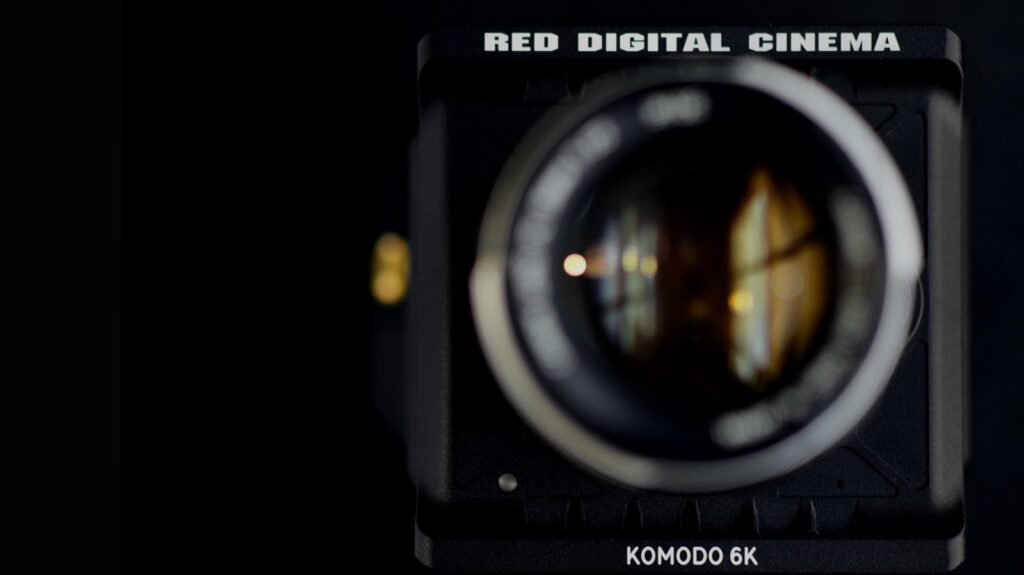
We’re fond of the RED KOMODO 6K for a simple reason: it’s one of the few cine cameras that solve more problems than they create. It’s small, it shoots 6K RAW and it has a global shutter – no jello, no skew when you whip-pan or put it on a gimbal. On set, for certain jobs, that changes everything. But it isn’t the right camera for everyone and everything. Here’s how we see it, as the people who rent it out and get it back after the shoot.
What it is, honestly
The KOMODO 6K uses a 19.9-megapixel Super35 CMOS sensor (6144×3240) with a global shutter and a claimed 16+ stops of dynamic range. It records REDCODE RAW and Apple ProRes to CFast 2.0 cards, with an RF mount (the same as Canon, so you can adapt PL, EF and use native RF glass). It shoots 6K up to 40 fps, 4K up to 60 fps and 2K up to 120 fps for slow motion. The body is a cube roughly 10 cm per side, under one kilo. Sensitivity runs EI 250 to 12800.
You’ll find the full specs on the official RED site; for a real-world take, Adorama’s hands-on review is worth a read.
Who it’s really for
In our view the KOMODO shines in three scenarios. First, gimbal work and tight spaces: light and global-shutter, on a DJI RS 3 Pro it’s a joy, with no distortion on fast moves. Second, as a B-cam next to bigger RED bodies or an ARRI: same RAW workflow, colour that grades in cleanly. Third, music videos, branded content and low-budget shorts, where you want RED RAW without hauling a truck.
On the flip side, if you do a lot of documentary run-and-gun with continuous autofocus and complex in-camera audio, a body like the Sony FX6 will let you sleep better: the KOMODO has autofocus, but that’s not its trade.
Three practical tips from the field
- Media and power: fast CFast 2.0 cards are mandatory for 6K, and the bare body always needs rigging with a battery, monitor and handle. We hand it over as a kit so you don’t lose half a day.
- No internal ND: plan for a filter set or a mattebox, otherwise on Abruzzo exteriors in summer you’ll stop down too far and lose the look.
- Monitoring: there’s no built-in screen, so you need an external monitor. An Atomos Ninja V covers viewing and, if you want, a ProRes backup.
Why rent it in Abruzzo instead of buying
A new KOMODO body, rigged and with glass, costs several thousand euros that only pay off if you shoot every month. For most of the productions we work with here – a commercial, a music video, a couple of days on a short, a seasonal doc – renting is the financially sensible choice: you get the right camera for that project, use it fully for as long as you need, and you’re not left holding a body that’s worth less in a year. On top of that you collect it already configured, tested and with cards formatted. If you like, we’ll pair it with the right light (an Aputure LS 600x Pro for interiors) and all the grip support. You’ll find the KOMODO and the rest in our kit catalogue.
If you’ve got a project in mind and aren’t sure the KOMODO is the right call, drop us a line: we’ve watched it work on enough sets to tell you in two minutes whether it fits or something else suits you better. Full specs and availability on the RED KOMODO 6K page.
A wide range of equipment in our catalogue, on-set delivery included across Abruzzo.