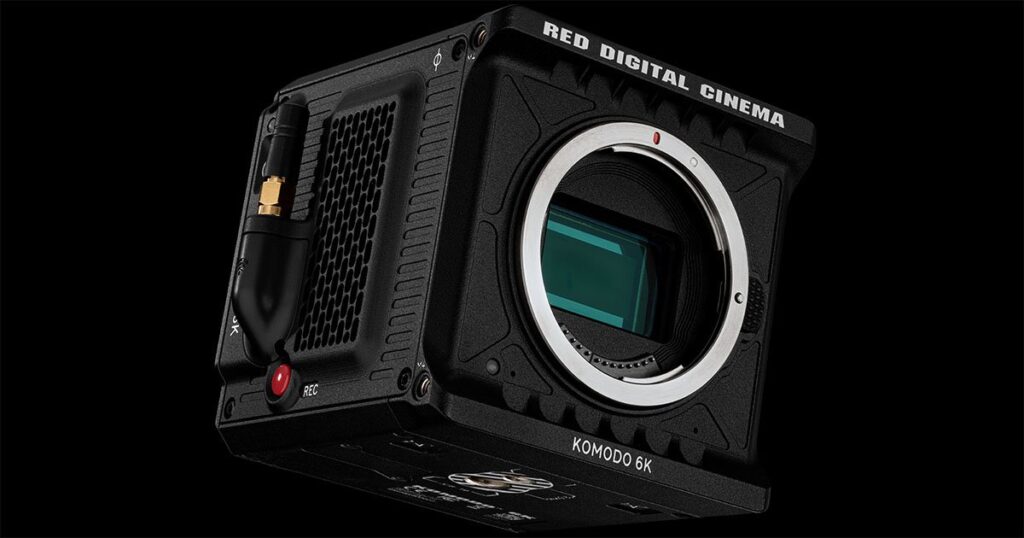
We have already written about the KOMODO 6K in general terms. This time we want to be more specific, because in our inventory this camera goes out for one reason above all others: it works as a second camera better than almost anything else. It is not the A-cam of a feature. It is the body you mount where a big one will not fit, and it brings home an image that holds up next to serious cameras.
The real reason is the global shutter, not the 6K
Everyone has resolution now. What the KOMODO 6K has, and most cameras under 10,000 euros do not, is a 19.9-megapixel Super35 sensor with a global shutter. On set that means no jello, no leaning poles on a fast pan, no banding when there is an LED wall, a strobe, a flashing light or a nightclub in frame. RED claims more than 16 stops of dynamic range, and the camera records REDCODE RAW and Apple ProRes to CFast 2.0 at up to 280 MB/s.
In our opinion the global shutter is worth more than the resolution on a rental: it is the thing that saves your day when a client hands you an event lit by somebody else and you cannot shoot the take again.
Where we actually mount it
- On a gimbal. Roughly a 10 cm cube and around 950 grams: on the DJI RS 3 Pro it leaves plenty of headroom even with a proper lens on the front, which is not the case with a shoulder camera.
- Car mounts and moving shots. This is where the global shutter earns its keep, on poles, wheel spokes and road markings.
- Tight spots. Car rigs, corners of a room, camera positions that should not exist. You mount it, leave it there and control it wirelessly.
- Crash cam and safety camera. When a stunt gets one take, having a second angle shooting RAW changes the edit.
How it marries the A-cam
The combinations we are asked for most are KOMODO plus ARRI ALEXA Mini and KOMODO plus Sony BURANO. They work, but let us be upfront: the colour does not natively match either one. It has to be handled in the grade, and it has to be decided before the shoot, not on the day of the colour session. If the project has a colourist, no problem. If it is a fast turnaround with a house LUT, budget half a day of testing before you roll: it costs far less than finding out afterwards.
No surprises on format: 6K 17:9 up to 40 fps, 4K 17:9 up to 60 fps, 2K up to 120 fps. For heavy slow motion you need another body, and we say so before you book.
Three things we always mention at pickup
- There is no internal ND. That is the first thing that stops people outdoors in summer. Bring screw-in filters or a mattebox: our equipment page lists the ND sets we rent alongside the body.
- The mount is RF, with a mechanical RF-to-EF adapter included. There is a lot of EF glass in circulation, so the lens choice stays wide, but check flange depth before committing to a PL set.
- The onboard monitor is small and onboard power does not last. We hand it over with a V-mount plate and an external monitor: the 12G-SDI output is there, and the built-in stereo mics and 3.5 mm input are for reference audio only, not for production sound.
Why rent it, and why here
A new KOMODO body, with CFast cards, batteries, filters and supports, only makes sense as a purchase if you shoot every month. For a commercial, a music video, a documentary or a short film — which is 90% of what gets produced between L’Aquila, Pescara, Chieti and Teramo — renting means having the piece for the days you need it and nothing more. And above all it means not owning a camera that is worth half as much in three years.
On the productions that come through us the KOMODO almost always goes out as a second body inside a package: you will find it in our kits together with the gimbal and the light. Tell us what kind of job you have and we will also tell you when it is not the right camera.
Full specifications on the official RED Digital Cinema page; the launch spec sheet is on Film and Digital Times.
A wide range of equipment in our catalogue, on-set delivery included across Abruzzo.