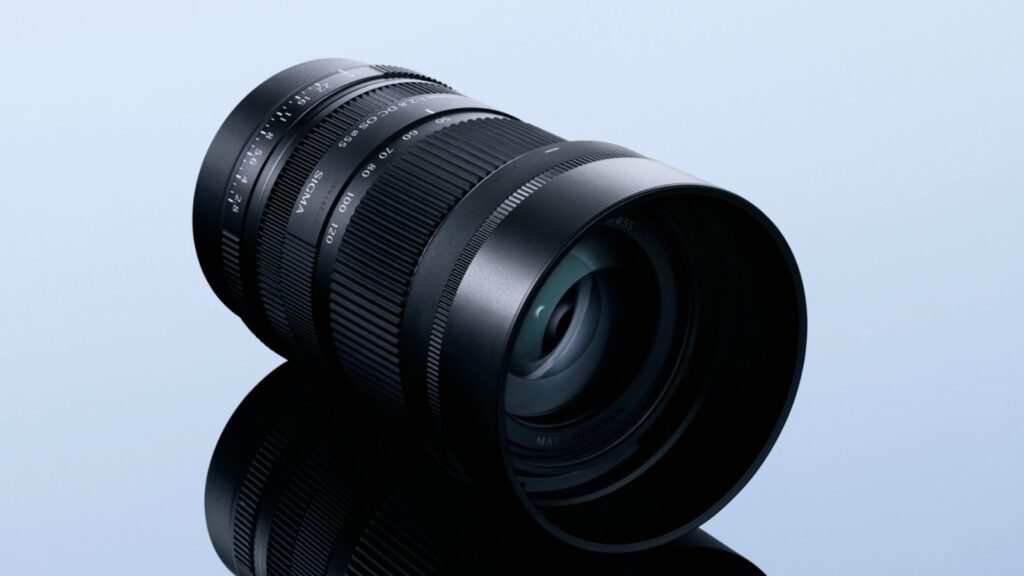
On October 8 Sigma announced the 50-120mm F2.8 DC OS | Contemporary, the telephoto zoom its constant-f/2.8 APS-C series was missing. After the 10-18mm and the 18-50mm, the range now runs from 10 to 120mm with three lenses that together weigh under a kilo. The 50-120 costs $799 and ships on October 22, 2026 in Sony E, Fujifilm X and Canon RF mounts, all at the same time. European pricing has not been announced yet.
The numbers that matter
- Focal range: 50-120mm, roughly 75-180mm equivalent on Sony and Fujifilm, 80-192mm on Canon’s 1.6x crop
- Aperture: constant f/2.8, 11 rounded blades, stops down to f/22
- Weight and size: 390 g and 99 mm long in E and X mount; the RF version is 410 g and 97 mm
- Stabilisation: OS2 algorithm, rated 6.5 stops at 50mm and 4.5 stops at 120mm (CIPA)
- Autofocus: HLA linear motor, the same as in recent Sigma lenses
- Optical design: 18 elements in 13 groups, with 1 FLD, 3 SLD and 4 aspherical elements
- Minimum focus: 23 cm at 50mm, 55 cm at 120mm, 1:3 magnification at the wide end
- Filter thread: 55 mm, shared with the 18-50mm f/2.8
- Aperture ring: present, a first for an APS-C zoom in the Contemporary line. No de-click switch is mentioned
- Build: dust- and splash-resistant, water- and oil-repellent coating on the front element, made in Aizu, Japan. The LH585-01 hood is included
One detail worth noting: Sigma has removed both the AF/MF switch and the stabiliser switch from the barrel. Everything is set from the camera menu. On a Sony you shrug; on a Fujifilm body, where people are used to physical controls, some will not love it.
Why it matters for video
Sigma claims an optical design built to keep focus breathing in check, and on a 75-180 equivalent telephoto that is the decisive point: on an interview or a moving close-up, breathing shows immediately. Add the aperture ring, a constant f/2.8 and 390 grams, and it is clear who this lens is for: people shooting APS-C or Super 35 on light bodies, often on a gimbal.
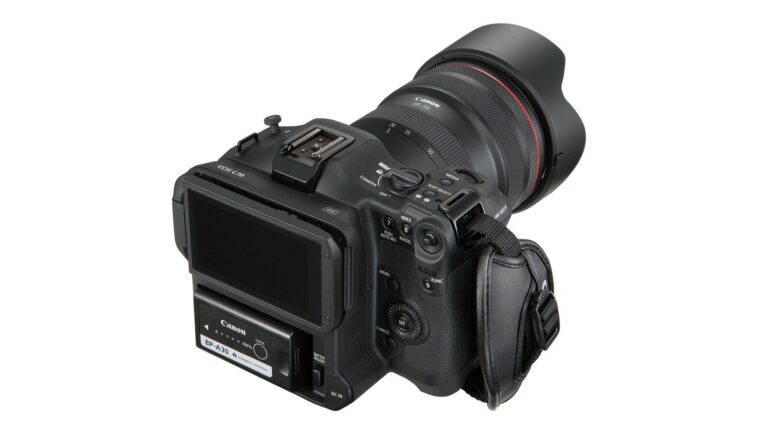
The most interesting case, in our view, is the Canon EOS C70: RF mount and a Super 35 sensor, so this 50-120 goes straight on with no adapter and with autofocus. One thing needs saying before you trust it, though: the C70 sensor is slightly wider than a stills APS-C frame, so the corners need checking with a test at 50mm wide open, not taken for granted. On the Sony side, an FX6 or an FX3 in Super 35 mode make good use of it, keeping full 4K and a weight that gives a DJI RS 3 Mini no balancing trouble.
The maths, from a rental house
Under $800, if you shoot APS-C regularly, this is a lens to buy, not to rent: the f/2.8 telephoto that fits in a side pocket of the bag and covers a wedding, a documentary and a small commercial. The picture changes when you need a telephoto three days a year and want full frame or a proper cine aperture ring: there, renting a body with its matched glass is still the sensible route, and in our inventory bodies and lenses come already paired.
In the field, with a light telephoto like this, three practical notes: keep the stabiliser on only when you need it, because at 120mm the claimed 4.5 stops will not rescue a walking shot; do not count on the 55 cm minimum focus at the long end for tight details; and check how autofocus behaves in video on your own camera, because the HLA motor is fast but tracking is the body’s job, not the lens’s.
Sources: official Sigma page for the 50-120mm F2.8 DC OS and CineD’s announcement coverage.
A wide range of equipment in our catalogue, on-set delivery included across Abruzzo.