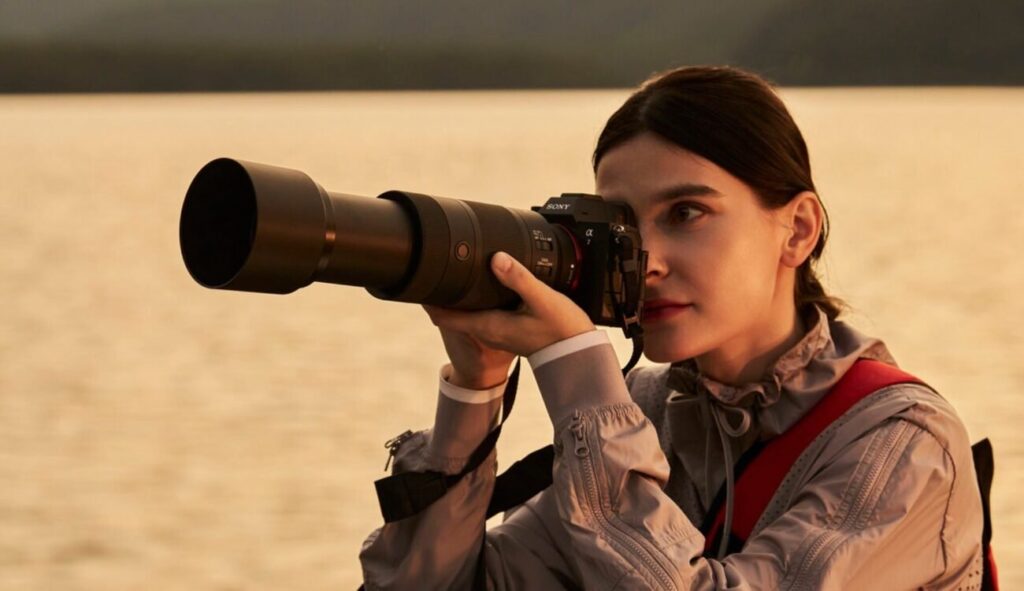
On August 4th Sony introduced the FE 100-400mm F5.6-8 OSS (model SEL100400), a super-telephoto zoom for full-frame E-mount that weighs 654 grams and sells for 899 euros. Sony itself pitches it as the hobbyist’s lens, and on paper it has nothing to do with a professional crew: f/8 at 400mm is not a number that raises a DoP’s eyebrow.
And yet we care, and here is why. Half of our summer bookings are documentary, wildlife, small-scale sport and hill-town coverage shot from a distance: people who put a Sony FX3 or a Sony FX6 on their shoulder and need reach without hauling six kilos of glass and a 15 kg tripod. Until now that gap was awkward to fill.
What is actually inside
The optical design is 15 elements in 10 groups, with two ED elements and one aspherical, plus a 9-blade rounded aperture. Minimum focus is 1.13 m at the wide end and 0.86 m at 400mm, with 0.41x maximum magnification, which is worth reading twice: at 400mm you get close to half-macro territory while keeping a safe distance. 67mm filters, built-in optical stabilisation, dust and moisture resistance, a zoom lock and a customisable focus hold button. It works with the 1.4x and 2.0x teleconverters.
Three video-relevant facts: dual linear motors, so autofocus stays quiet and on-camera audio remains usable; support for breathing compensation on recent Sony bodies; and compatibility with Active Mode stabilisation. AF tracking holds up to 120 fps on the a9 III. Shipping from September, with the first European deliveries expected in late August.
Our take from the field
The awkward part first: f/8 at 400mm means this lens lives on light. At dawn on the Gran Sasso, or in half-shade woodland, with a sensor whose base is ISO 800, you are already scraping the bottom. Anyone who works daily with the Sony 200-600 knows that the half stop between f/6.3 and f/8 bites exactly when you need it. This is not an interior lens, and it is not a backlight lens.
That said, the maths changes once you factor in weight. 654 grams means twenty minutes handheld without your operator cursing you, backpack-sized bulk alongside the body and two batteries, and the option of hiking up to a viewpoint instead of giving up the shot. With current sensors, clean ISO 4000 is no longer science fiction, and that is precisely what makes an f/8 lens sensible today when it would have been unusable five years ago.
Two practical notes, if you rent it from us. First, the zoom is external, so the barrel extends. On a gimbal that means rebalancing at every focal length change, so with the DJI RS 3 Pro you are better off picking one focal length and staying there. Second, it is not parfocal and has no cine focus scale, so forget repeatable manual pulls. This is an autofocus lens, and it helps that the motor is quiet.
Buy it or rent it
899 euros is cheap for a 400mm, and the urge to buy is fair enough. The real question is different: how many times a year do you genuinely need a super-telephoto? If the answer is «two documentaries and one transhumance feature», the sums are easy and renting wins outright, because that money spent on glass you use every week returns far more. If instead you shoot wildlife or sport weekly, buy it and stop thinking about it: at this price it pays for itself quickly.
On our side we are watching it for the autumn, when requests for national park documentaries start coming in. In the meantime, for anyone who needs reach now, the answer is still the right body: a Sony FX9 in Super35 gives you the crop without throwing away usable resolution. The rest is in our equipment catalogue.
Sources: Sony official press release and Newsshooter.
A wide range of equipment in our catalogue, on-set delivery included across Abruzzo.