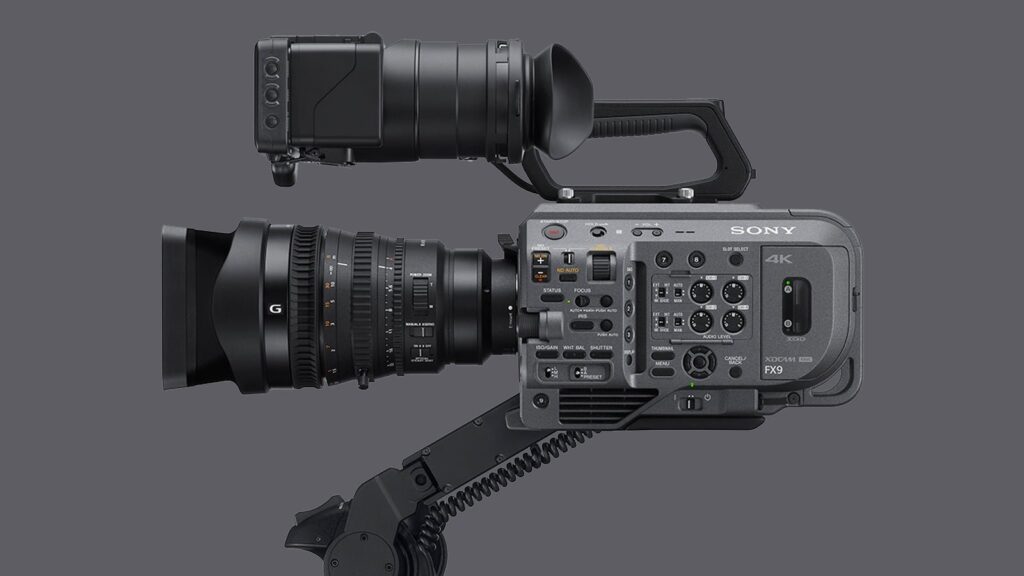
Nobody rents a Sony FX9 to impress anyone. The people who ask for it are documentary crews, production companies with four days of interviews to shoot, and branded-content directors working with one operator and no focus puller. It is a practical choice, not a status one, and that is exactly why it keeps leaving our shelves.
What it genuinely does well
At its core is a 6K full-frame Exmor R sensor: the camera records 4K by oversampling from 6K, and you notice it on fine detail — hair, fabric, stone walls. Sony quotes over 15 stops of latitude and a dual base ISO of 800/4000, inherited from the VENICE along with S-Cinetone colour science. That profile is why many clients pick it over a mirrorless: skin tones already look believable before you touch a grade.
- 6K full-frame sensor, 4K 10-bit 4:2:2 internal recording
- Dual base ISO 800 / 4000
- Electronic variable ND with Auto ND mode
- Fast Hybrid AF with 561 phase-detection points (roughly 94% x 96% of the frame)
- Full HD up to 120 fps for slow motion
- E-mount, genlock and timecode in/out on the body
The electronic variable ND is the feature that saves the most time on set. You move from a cellar interior to a courtyard in full sun by turning a dial: no mattebox, no filter swaps, no aperture sacrificed. On a documentary that relocates every twenty minutes, that adds up to hours across a week.
Who we recommend it to
In our view the FX9 is at its best in four scenarios: documentary and reportage, multicamera corporate interviews, branded content with a small crew, and second unit on a bigger production. The common thread is always the same — few people, many locations, tight schedules. Face-detection autofocus holds focus at f/2.8 on full frame while the operator walks backwards handheld, and that safety margin is something a pure cinema A-cam will not give you.
Where we do not push it: high-budget fiction with a focus puller on the team and a DoP who wants 4K raw. There an ARRI ALEXA Mini or a Sony BURANO makes more sense, and that is what we suggest.
Three things we always mention before handover
First, rolling shutter. CineD’s lab measurements put the FX9 at 22.2 ms — a fair figure for the class, but not negligible: if fast pans or car mounts are planned, better to know beforehand than in the edit. Second, media. The FX9 records to XQD cards, so budget them alongside the body, not after. Third, weight in full rig. On the shoulder with zoom, battery and loupe you feel it after the third hour: if the day is entirely handheld, budget for a support system.
Why rent rather than buy
A new FX9 body with a lens, cards, batteries and a case is a commitment of several thousand euros. The calculation we run with clients is always the same: how many real shooting days will you put on that camera in a year? Below forty or fifty actual days the amortisation does not work — and meanwhile the body ages, firmware moves on, the used market drops. With us the FX9 is 150 € per day, 405 € for three days and 565 € per week (VAT excluded), with delivery and pickup on set included across Abruzzo. For a production shooting one commercial or one documentary a year, the maths settles itself.
There is a less obvious advantage too: if the next project calls for something else, you switch cameras without reselling anything. Our kit catalogue exists precisely for that.
What we pair it with
The most common configuration out the door is an FX9 plus a Sony FX6 as B-cam: same colour science, same E-mount, so lenses move between bodies and the edit does not fight you. For interviews in tight rooms we add an Aputure LS 300x, whose adjustable bi-colour output handles mixed daylight and tungsten without gels. And if the client wants to watch the frame from a monitor ten metres away, the Teradek Bolt 6 750 closes the loop with no cable runs.
We always hand it over with the loupe fitted and tested. If you have a project coming up and you are not sure the FX9 is the right camera, write to us: telling you that you need something else costs us less than a wrong rental.
Further reading: Sony’s official PXW-FX9 announcement and CineD’s lab test on rolling shutter and dynamic range.
A wide range of equipment in our catalogue, on-set delivery included across Abruzzo.