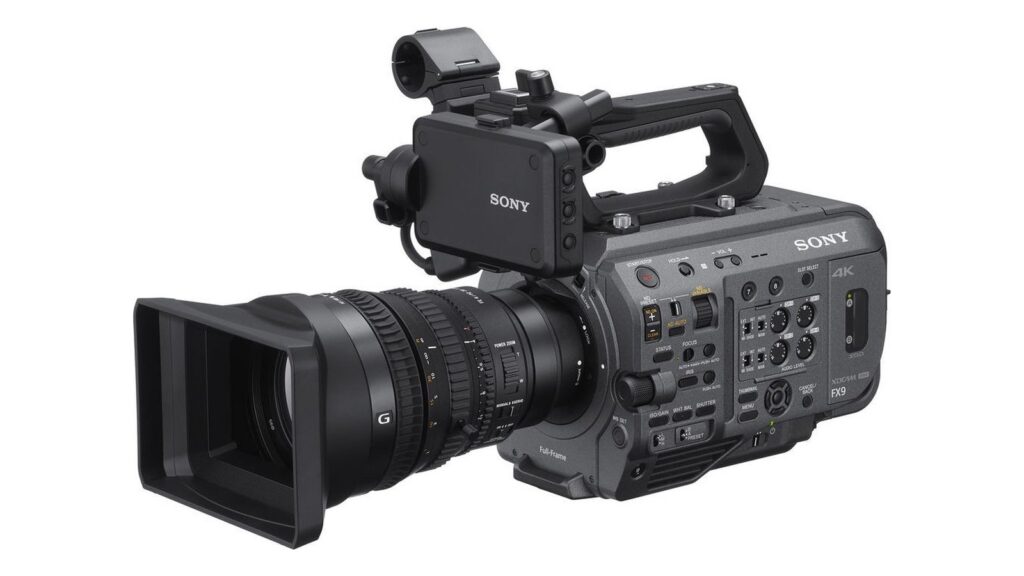
The Sony FX9 goes out less often than the FX6 here, and that’s a shame. First-time renters usually pick it for the full-frame sensor; they come back for a different reason: on a long shoot with a small crew, it wastes less of your time than almost any other camera on our shelves.
What’s inside, plainly
- Full-frame 6K Exmor R sensor, oversampled down to a clean 4K.
- Dual base ISO 800 and 4000, with more than 15 stops of dynamic range according to Sony.
- Built-in electronic variable ND, adjustable continuously or by preset.
- 10-bit 4:2:2 XAVC-I up to 600 Mb/s on two XQD slots, with simultaneous or relay recording.
- Fast Hybrid AF with 561 phase-detection points, E-mount.
- 12G-SDI and HDMI outputs, timecode and genlock on BNC, powered by BP-U batteries. The body weighs about 2 kg.
4K goes up to 60p, HD up to 120 fps, and 180 fps with the firmware released after launch. 16-bit RAW needs the XDCA-FX9 extension unit plus an external recorder. We rarely see that on set, and in our view internal XAVC-I is more than enough for most jobs.
Who it’s for, in our opinion
Documentaries and long interviews. This is where the FX9 shines. The variable ND lets you follow someone walking from sun into shade without touching iris or shutter, and the autofocus keeps a fidgeting interviewee sharp while you think about framing. It balances well on the shoulder, and after four hours you notice.
Mid-budget commercials and branded content. Full frame, Sony color science with S-Log3 and S-Cinetone, files that behave in post. For a corporate client who wants a “cinema” look without the logistics of a big studio camera, it’s a safe call.
Cinematic weddings and events. Native ISO 4000 in a church or at an outdoor dinner makes the difference: noise stays low and you don’t have to flood the place with light.
Where we wouldn’t use it: on a light gimbal, or anywhere you need a small camera you can hide. The FX6 or the FX3 fit better there, and they share the same color, so they cut together easily.
Why rent it instead of buying
The FX9 is a workhorse: buying one makes sense if it shoots every week. For a ten-day doc, a run of interviews or a commercial, renting gets you the body, BP-U batteries, XQD cards and reader ready to go, without tying up thousands of euros in a camera that then sits in a cupboard. In Abruzzo, where many productions work project by project, we think the numbers almost always favor renting.
Three things to watch on set
- Pick your base ISO before you start. 800 for exteriors and controlled light, 4000 when the light drops. Switching mid-scene changes the grain texture, and it shows in the edit.
- Keep an eye on the XQD cards. At 600 Mb/s they fill up quickly. We always send more cards than you think you need, but plan your offloads anyway.
- Only put the ND on auto if the scene allows it. For a static interview, set it by hand: on auto it can “breathe” when a cloud passes.
What we pair it with
For two-camera interviews we run it as A-cam with an FX6 as B: same curves, same color, no surprises in the grade. If a director or client is watching, a Teradek Bolt 6 750 sends the picture to video village with no cables. For a daylight key outdoors, an Aputure LS 600x Pro.
Full specs are on Sony’s official PXW-FX9 page. To see what goes with it, check our ready-made kits or the full equipment list.
A wide range of equipment in our catalogue, on-set delivery included across Abruzzo.