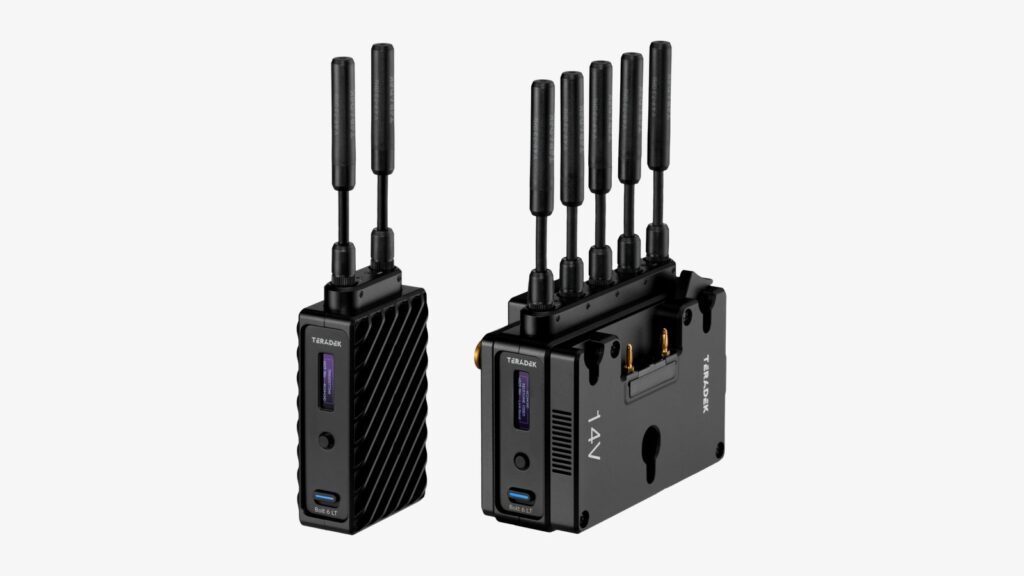
Some gear looks like a luxury on the quote and, half an hour into the shoot, turns out to be the line item that saved the day. Wireless video is exactly that. The Teradek Bolt 6 750 is the kit clients ask for most often the moment someone says “the director needs to see it”, and the comment at wrap is almost always the same: next time we budget for it from the start.
What it does, in two lines
It is a point-to-point video link: one transmitter on the camera, one or more receivers wherever the pictures are needed. Our kit ships as 1 TX and 2 RX, so you can feed video village and the client at the same time without picking a winner. Latency is under a millisecond, which means the image lands on the director’s monitor as the actor moves, not a beat later. Inputs and outputs are 3G-SDI and HDMI, up to 1080p60 10-bit 4:2:2 HDR on the SDI chain, with a rated range of 750 feet, roughly 230 metres line of sight.
The 6 GHz band is the real reason
Bolt 6 runs on 6 GHz alongside the usual 5 GHz, with twelve dedicated channels. On a spec sheet it reads like a footnote; on location it is the difference between a clean signal and an afternoon spent hunting for a free channel. Any wireless system works in an empty stage. At a trade fair, in a historic town centre where every bar runs its own access point, or at a wedding with two hundred phones in the room, 5 GHz is gridlock. That is where 6 GHz gives you room nobody else is using. In our view it is the main argument for asking for a Bolt 6 rather than a previous-generation system.
Who actually needs it
- Commercials: client and agency sitting at video village, the director free to step away from the camera.
- Music videos and drama: wide moves, gimbals, Steadicam. A cable simply is not an option.
- Documentary and live: when direction and production need to follow the shot without crowding the operator.
- High-end cinematic weddings: a receiver in the second operator’s hands changes how you cover the ceremony.
Why rent it instead of buying
A new Bolt 6 LT kit, transmitter plus receiver, starts in the low thousands at list price; add the second receiver and the battery plates and the total climbs fast. With us the complete kit is 100 euro per day plus VAT. If you shoot two or three projects a year that call for it, renting is not even a debate. Then there is the part that never shows up on an invoice: current firmware, antennas that are not bent, the right plates for the batteries you already own, and someone to call when the link refuses to pair at seven in the morning. On a piece of RF electronics that matters more than depreciation.
Three things we relearn on every set
- Keep the antennas off metal. A transmitter squeezed between the cage and a battery means half the range. Give it air and mount it high on the rig.
- Line of sight beats raw distance. Those 230 metres are in open ground: a load-bearing wall or an iron staircase cuts it far sooner. If video village is in another room, put the receiver near the door, not at the end of the corridor.
- Give it its own power. The transmitter runs warm and drinks: plan a dedicated battery, not the half-empty one already on the camera.
What we pair it with
The natural match is a camera with SDI out: the Sony FX6 for documentary and corporate work, the ARRI ALEXA Mini when the job steps up. At the other end of the link, an Atomos Ninja V turns the receiver into a proper director’s monitor without hauling a cart around. If you are assembling a full crew, look at our ready-made kits: wireless almost always fits without blowing the budget.
Full specifications are on the official Teradek page; the series introduction and the technical background on 6 GHz are covered by CineD.
A wide range of equipment in our catalogue, on-set delivery included across Abruzzo.