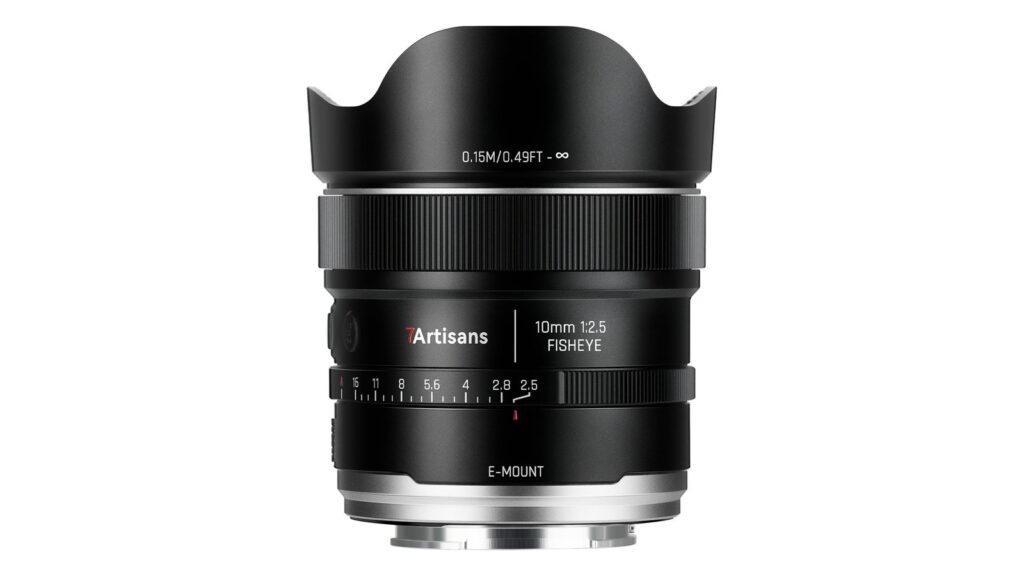
7Artisans put the AF 10mm F2.5 MAX on sale on August 26: a full-frame autofocus fisheye at 449 dollars, available in Sony E, Nikon Z and L mount at the same price across all three. That is not a typo — it is an autofocus lens that costs less than a decent set of filters.
What the spec sheet says
- 185-degree angle of view, F2.5-F16, 9 aperture blades
- 11 elements in 8 groups, including 2 ED elements and one aspherical
- Minimum focus distance 0.15 m
- STM motor, USB-C port for firmware updates, two function buttons on the barrel
- Around 504 g in the E-mount version, 76 x 94 mm, aluminium barrel with a dust gasket
- No front filter thread, no stabilisation
185 degrees means the lens sees behind itself
This matters more than any other number, and anyone who has never worked with a true fisheye finds out on the first take. At 185 degrees the field of view goes past the plane of the front element: in come the tripod legs, the operator’s hand, the C-stand you parked “out of frame”, the lamp you thought was hidden. On set that means rethinking your blocking and, more often than not, keeping the crew literally behind a wall. Focus down to 15 cm is almost touching distance, too: put an actor in front of it and the nose is sharp — and so is the rest of the room.
For video, the real problem is exposure
With no front thread you cannot screw on an ND, and you cannot fit a standard mattebox without dedicated adapters either. Outdoors at midday you are left with two levers: stop down, or lean on the camera’s internal NDs. That is why, in our view, this lens makes most sense on bodies that have ND built in: on the Sony FX6 the electronic variable ND saves your day, and the Sony FX9 is the same story. On the Sony FX3, which has no internal ND, you either stop down to F11 and give up the lens at its best, or you accept very long shutter angles.
Second thing to watch: the aperture ring is clicked. Fine for stills, much less so for an exposure ramp mid-take. Our habit on the job with lenses like this is to leave the ring in the A position and drive everything from the body — which also keeps the audible click out of your production sound.
Where we would actually use it
This is not a lens you shoot a whole film on: it is an effect, and like every effect it gets old fast. But there are jobs where it solves problems. Tight interiors, which in Abruzzo come up constantly: cellars, village houses, churches, car interiors. Music videos and action work, where 504 grams sit very comfortably on a light gimbal such as the DJI RS 3 Mini. And POV shots, where autofocus — until now the preserve of manual fisheyes alone — removes a lot of risk when the camera moves and nobody can pull focus.
One warning about post: if you plan to straighten the distortion in the edit, plan for it while shooting. De-fishing crops the edges and eats resolution, so shoot 6K or above if the final master is 4K.
Buy it or rent it? Let us be honest
We are a rental house, but at 449 dollars there is no point telling you renting is the smarter move: if you need a fisheye more than two or three times a year, buy it and be done. The rental question shifts to everything around it — the body that can take the high-resolution crop, the gimbal, the support — and to a more practical concern: the same lens exists in three mounts, and if you work project to project you can easily spend a whole season shooting on a system you do not own. In that case you take the body from us and bring your own glass. Compatible bodies and ready-to-go configurations are in our shooting kits.
Official source: 7Artisans. Verification and first technical details on CineD.
A wide range of equipment in our catalogue, on-set delivery included across Abruzzo.