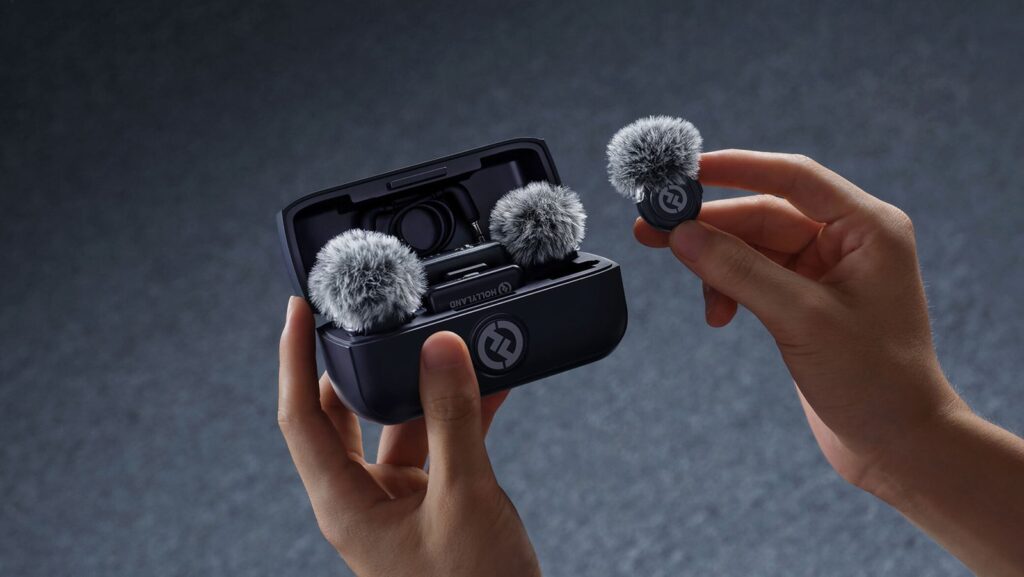
Hollyland announced the LARK M3 on 22 September, and the news isn’t the microphone itself: it’s how the pieces talk to each other. Up to four transmitters into one receiver, or one transmitter feeding four receivers at once. For anyone shooting multi-person interviews or talks with two or three cameras, that’s an architecture you used to find only much higher up the price list.
What’s inside
The figures published by Hollyland, also confirmed by Newsshooter:
- System: up to 4 transmitters and 4 receivers, which can be added or removed even while recording
- Transmitters: 9 grams each, 70 dB signal-to-noise ratio, 125 dB max SPL, magnetic mounting
- Audio: 48 kHz 32-bit float on iOS, 24-bit on Android; up to four isolated tracks through the USB-C receiver
- Range: up to 300 metres in open space, on the 2.4 GHz band
- AI noise reduction with three levels, plus eight customisable voice presets
- Battery: about 8 hours per transmitter with noise reduction off, 4-4.5 hours with it on; the charging case brings the total up to 48 hours
- Receivers: a camera version (shoe-mounted) and a USB-C version for phones and computers, with Primary/Secondary logic and automatic failover if the main one drops
US pricing: $99 for 2 transmitters + 1 receiver, $119 with 2 receivers, $179 for either 2+4 or 4+2. Seven configurations in total, already shipping.
Where we think it makes sense
The real use case is light documentary and corporate work: three people around a table, one wide camera and two tighter ones, each person on a clean track of their own. With one transmitter feeding several receivers you get the same reference audio on every camera, and waveform sync in the edit becomes a non-issue. With a Sony FX6 as A-cam and a Sony FX3 as B-cam, it’s a setup we see go out a lot for interviews and branded content.
That said, let’s be clear about what it isn’t. The announcement mentions no timecode and no internal backup recording in the transmitter. And 32-bit float applies to the phone over USB-C: into a camera the signal still goes through the camera’s own preamp, so you set levels the usual way.
Three things to watch on set
- 2.4 GHz is crowded. At a wedding or a trade show, between Wi-Fi, phones and video transmitters, the claimed 300 metres shrink fast. Keep the receiver in line of sight of the mics.
- Use noise reduction with care. Besides halving battery life, on close speech it tends to clip the tails of words. Outdoors in wind, use the fluffy first, then the lowest level.
- A dirty track can’t be saved. If the interview is the heart of the job, record a reference on a second receiver too: with this system it costs very little.
Buy it or rent it?
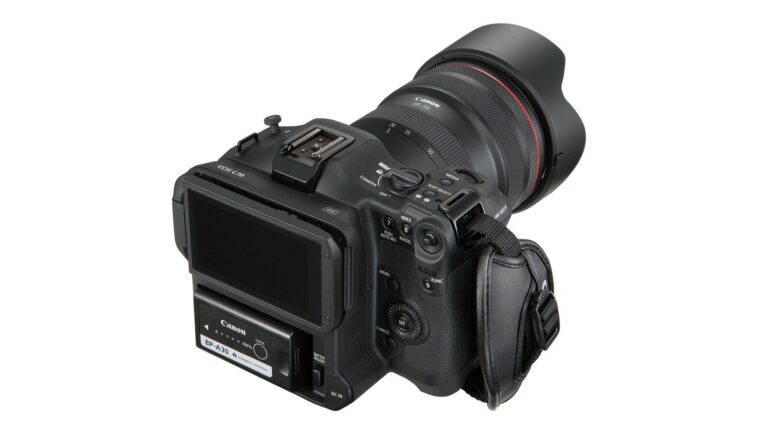
At this price, a videomaker working every week should just buy it: it pays for itself in a few jobs. What’s worth renting is the rest of the chain, meaning the cameras, lenses and lights these mics end up mounted on. For drama or a commercial with a sound recordist on set, we still stick with professional UHF systems: a creator kit doesn’t replace a sound department. If you’re putting together a multicam interview setup, take a look at the Canon EOS C70 and our ready-made kits.
A wide range of equipment in our catalogue, on-set delivery included across Abruzzo.