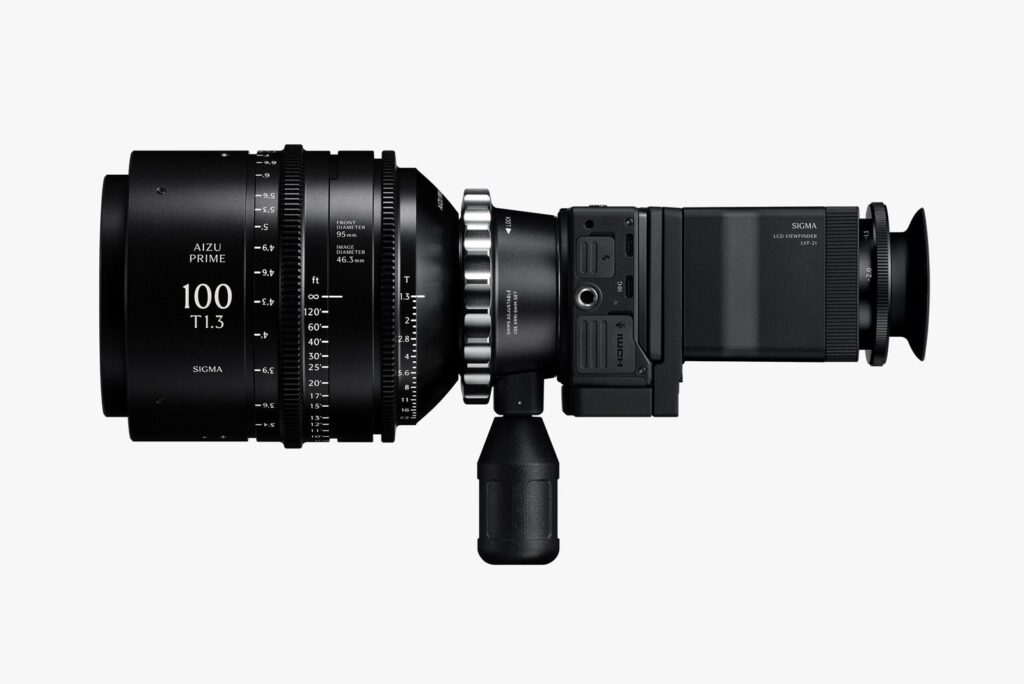
On October 22 Sigma announced the FP2, the second generation of the 2019 fp. The concept hasn’t changed: a pocketable full-frame brick. This time, though, it packs a 24.5 MP partially stacked sensor, 6K open gate and ProRes RAW. The body weighs 376 grams, 460 with battery and card. US pre-orders are open at $2,199 body only and $2,749 with the EVF-21 electronic viewfinder. European pricing has not been announced yet.
What’s inside
From Sigma’s official spec sheet, the items that matter to people who shoot:
- Sensor: full frame, 35.9 x 23.9 mm, L-Mount
- 6K open gate up to 59.94p in H.264/H.265; 4K up to 59.94p, 100 and 119.88p in crop; 2K up to 119.88p
- Apple ProRes RAW HQ and ProRes RAW at 12-bit, up to 6K 29.97p
- Leica L-Log, dual base ISO of 1,250 and 10,000 in Log and RAW
- 14.1 stops claimed in 4K full-frame L-Log, with 7 stops above middle grey from ISO 1,250 up
- 32-bit float audio on 4 channels, but only with the HU-21 hot shoe unit and Panasonic’s DMW-XLR2 or DMW-DMS1
- Media: 70 GB internal memory, UHS-II SD, external SSD over USB 3.2
- Outputs: full-size HDMI 2.1, timecode input on the 3.5 mm jack, no SDI
- About 130 minutes of recording on the BP-91 battery, 30% more than the original fp
One thing to keep in mind: ProRes RAW only records to an SSD connected over USB-C. SD and internal memory take H.264, H.265 and L-Log. Newsshooter, which covered the announcement with the full spec tables, points out some inconsistency in the maximum RAW frame rate: for now the official figure is 6K at 29.97p.
What a DoP will like
In our view the most interesting part isn’t the sensor, it’s the Director’s Viewfinder. It simulates the field of view of several cinema cameras, and the list now includes ARRI ALEXA 35, Sony VENICE 2 and Sony BURANO, with desqueeze for anamorphics. On a location scout that’s genuinely handy: 400 grams in your pocket, you try the focal lengths and you already know what the real camera will see on the shoot day.
Then there’s the gyro data: the FP2 writes a .CSV with motion data and a .JSON lens profile next to each clip, useful for stabilising in post. The in-camera stabilisation Sigma lists is electronic only, with a 1.25x crop, and it doesn’t work in 6K.
Where it fits on set
In the field, a camera this small does three jobs: crash cam, car rig or tight-space camera, and a light second camera on a gimbal. In all three cases weight is the point. On a DJI RS 3 Mini it sits comfortably even with a compact prime.
Where we don’t think it replaces anything: as an A-camera on a crewed production. No SDI, pro audio tied to another brand’s accessories and RAW only to an SSD hanging off a cable means the rig grows fast, and at that point a Sony FX3 or an FX6 does the same job with fewer compromises. If you need a proper monitor, full-size HDMI 2.1 is good news: an Atomos Ninja V connects without fragile adapters.
Buy it or wait?
For a solo shooter who wants a pocketable full-frame camera with RAW, the FP2 makes sense at $2,199. For a production in Abruzzo that would use it a few days a year as a crash cam, it doesn’t: renting works out better, and it comes with SSDs, batteries and cards ready to go. Before buying a camera to sit next to the ones you already have, check our equipment and give us a call: we’ll tell you whether the second camera you need is already on our shelves.
A wide range of equipment in our catalogue, on-set delivery included across Abruzzo.